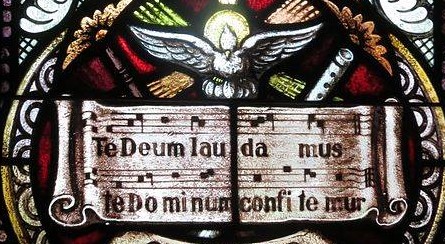
►The “Te Deum” was an ancient hymn of praise to God. It began: “O GOD, WE PRAISE THEE: WE ACKNOWLEDGE THEE TO BE THE LORD!” According to legend, it was improvised antiphonally by St. Ambrose and St. Augustine at the latter’s baptism. It has more plausibly been attributed to Bishop Nicetas (d. 414 AD), bishop of Remesiana in present-day Serbia in the early fifth century.
It was the battle hymn of the “26 Martyrs of Nagasaki” (日本二十六聖人) as they walked barefoot in the snow – their left ears cut off, with some noses cut off too! — from Kyoto to their martyrdom in Nagasaki in Feb. 5, 1597 – along a scenic route of some 1,000 km passing through Sakai, Osaka, Hyogo, Akashi, Himeji, Okayama, Mihara, Hiroshima, Shimonoseki, Kokura, Shigashima, Hakata, Tokitsu, and finally, Nishizaka (Nagasaki) — which the martyrs (including the Manila Franciscan missionary, St. Pedro Bautista (of San Francisco del Monte, in Quezon City) covered in 27 days.
Every Takayama-era Japanese Catholic prepared for martyrdom by memorizing the first parts by heart – understanding each difficult Latin phrase and its meaning. This was the arrival hymn of praise to God that ‘Lord Justus Takayama and his 350 Companions’ sang at the Santa Ana Church inside the Jesuit Compound (now PLM University Campus), when the Japanese exiles arrived on Sunday, Dec. 21, 1614.◘
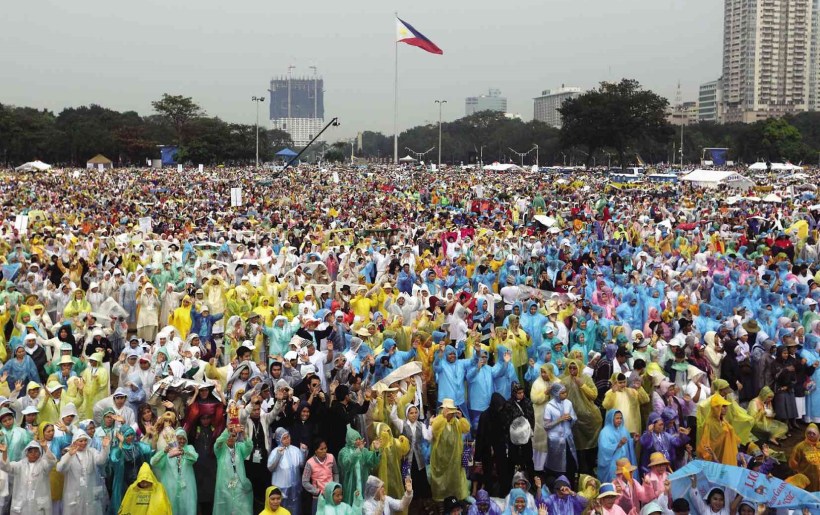
When a Pope visits the Philippines, he draws some six to seven million Filipinos for the final Mass at the Luneta — larger than anywhere else in the world. Pope Francis drew a crowd of up to seven million people, the largest ever for a papal event.
Vatican spokesman Fr. Federico Lombardi said the Office of the President told the Vatican that between six and seven million attended the Mass in Manila’s Rizal Park and surrounding areas. “We are not able to count all these people, obviously, or to verify this, but in any case, we have seen so many people that we believe that it is possible,” Lombardi shared with reporters.
“If this is true — and we think it is — this is the largest event in the history of the Popes,” he said, noting that an earlier pope, Pope John Paul, drew some five million to the same area in 1995.
With the terrible motor traffic in Manila, the threat of ill-willed elements, plus the rains — how do authorities, both Church and government, manage to pull off such an event?
Pope John Paul II’s helicopter flies 15 January 1995 over the huge crowd in Manila’s Luneta Park prior to celebrate an open-air mass to an estimated crowd of over two-million people gathered for the 10th World Youth Day congress. The pontiff was visiting from 11 to 21 January Philippines, Papua New Guinea, Australia and Sri Lanka. (it was his 63rd Internatinal Pastoral visit). AFP PHOTO JUN DAGMANG
Faced with tremendous logistical problems, they can never hope to field enough Portalets, nor enough plastic ponchos to ward off the rain – but they can count on an army of first-aid volunteers to be on the ready. It is a demonstration of group dynamics at its best.
Wearing a transparent yellow poncho over his white cassock, the Pope was driven through the ecstatic crowd in a “popemobile” modified from a jeepney, the most popular mode of transport in the Philippines which is based on a U.S. military vehicle used in World War II.
He stopped often along the route to kiss children and bless religious statues on the day the Philippines celebrates the feast of the infant Jesus. The faithful, also wearing ponchos, held up rosaries in a forest of uplifted arms as he passed by.
Some people had waited all night for gates to open at dawn.
Traditional Life-long Devotions
Without the drawing power of a Pope – how do Catholic crowds rate?
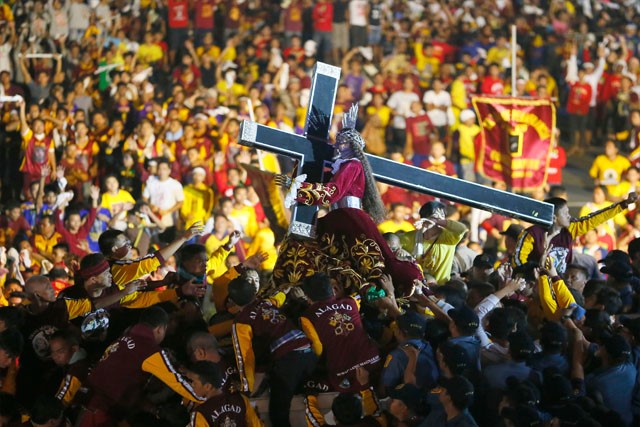
Catholic devotees wave white handkerchiefs as they prepare for an annual procession of the black image of Jesus Christ, known as the Black Nazarene, Saturday, Jan. 9, 2010 in Manila, Philippines. Hundreds of thousands of Filipino Catholic devotees seeking redemption from sins, miracle cures for illnesses and a better life poured into the streets of the Philippine capital in the procession to honor a centuries-old dark image of Jesus Christ. (AP Photo/Bullit Marquez)
The Procession of the Black Nazarene – on January 9 at Quiapo Church in Manila – draws some two million devotees. The Black Nazarene is a life-sized statue of Christ, carried through town by barefooted men yelling, “Viva Señor, while huge crowdd try to touch the statue. The statue was bought by a priest from Mexico and brought to Manila in 1606. Since 1787 the statue has been housed at Quiapo.
Huge crowds attend in the hope of being able to touch the statue, or its processional carriage, in the hopes of bringing good luck to themselves.
Local media reported that – at its height — the throngs reach an estimated five million people at its height. Because of the crowds, the procession, which is some 6.7 km long, takes around 20 hours to complete. The procession is expected to return to the statue’s home base, the Minor Basilica of the Black Nazarene, at around midnight local time.◘
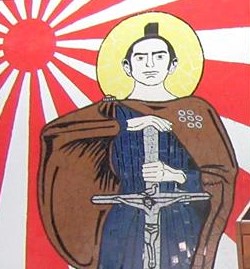
A painting of Blessed Takayama de Manila made in Japan by Filipino artist John Andrew Sustaita, of Real Catholic Art
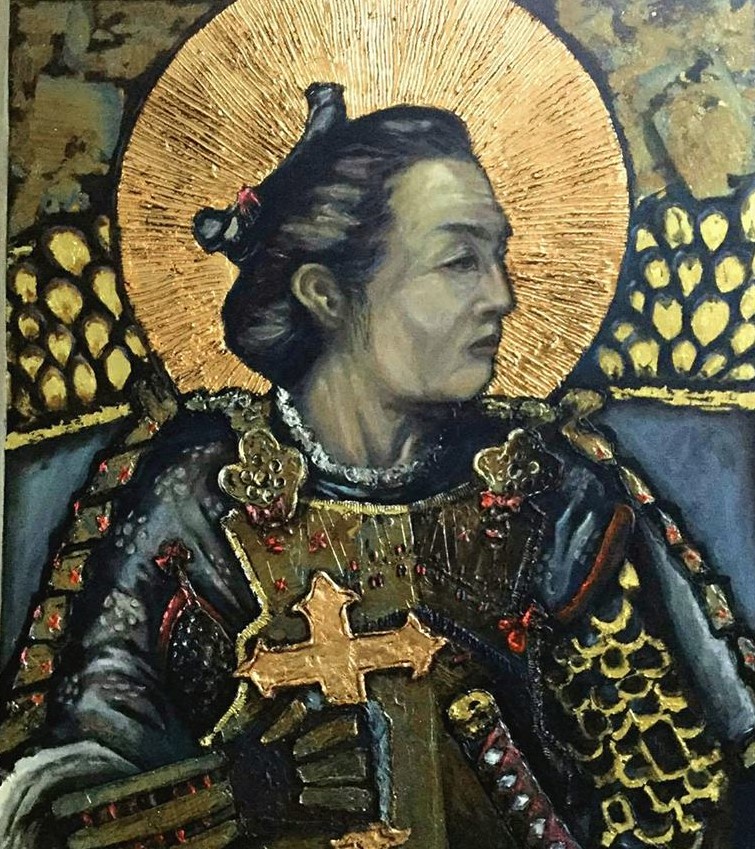
►This painting of Blessed Justo Takayama was made by Texas-based John Andrew Sustaita, owner of Real Catholic Art. Note that the venerated Martyr wears a halo, but not the ‘Palm of Martyrdom.’
This poster/painting of Blessed Takayama was created by a team of U.S.T. Seminarians led by Elson Santos, who exhibited it during the Fourth Philippine Conference on New Evangelization (PCNE-4) on July 24-28, 2017 at the U.S.T. Campus.
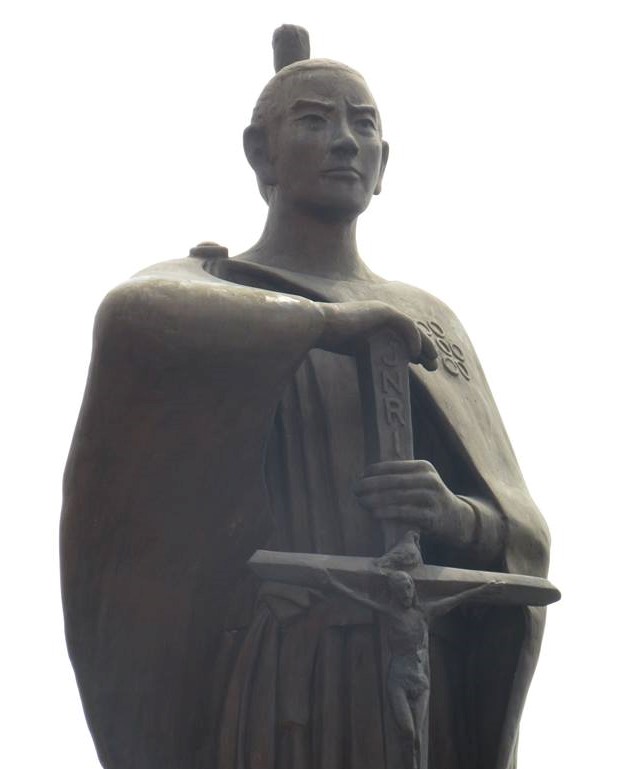
Manila Archbishop Luis Antonio Cardinal Tagle extols the importance of Blessed Takayama de Manila to the bilateral relations between Japan and the PhilippinesOn Feb. 7, 2017 — Beatification of Lord Takayama in Osaka — Photographer Robert Queddeng visited the Takayama Memorial at Plaza Dilao to take this memento picture. Since then, the statue has been wrapped in mufti and caged with a wire screen — as construction for Skyway-3 Overpass proceeds. By then, the statue had stood at Plaza Dilao for 40 years, collecting grime and dust from the street traffic.Different artists, different interpretations. Can your art group re-imagine this revered figure of Philippine-Japanese history? Email these to us.
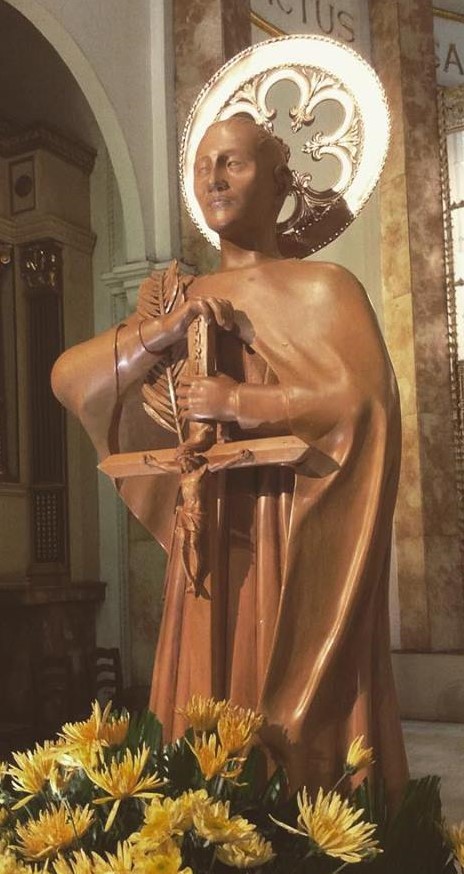
Altar Statue of Blessed Takayama, carved by the celebrated Paete artist, Paloy Cagayat, was installed on Dec. 21, 2017 at the Paco Catholic Church (est. 1580), Manila — showing Ukon with ‘Palm of Martyrdom’ and a metal halo. The Paco Catholic Church is in the pastoral care of Msgr. Rolando R. dela Cruz, parish priest, and Fr. Carlo del Rosario, parochial vicar.#
The Takayama Altar Statue was borrowed by the Manila Cathedral for the Feb. 3, 2018 Thanksgiving Mass marking Takayama’s first Feastday as ‘Beatus’ (Blessed).Blessed Takayama portrait made by +Noel Velez at his Tokyo hospital bed.
Imploring Blessed Takayama’s intercession for his healing — on just the basis of an ‘estampita’ (prayer card), Noel Velez (b. 1951) decided to make his own portraits of what he imagined the celebrated ‘Kirishitan Samurai’ looked like. A Tokyo-based Filipino, Noel Velez was familiar with the lore about this martyred Japanese Christian of great heroic virtue. He prayed fervently — even after his doctors told his family there was no hope from the hospital treatment. Noel died Jan. 14, 2018.
His widow, Puchie Gan, compiled his art works into a slim booklet — and presented this to Cardinal Tagle after the Mass celebrating ther first Feastday of Blessed Takayama.
Another work by +Noel Velez.Book cover of “Kirishitan Daimyo: Takayama Ukon” by Shinzuke Tani (Tokyo: Daughters of St. Paul, 1979).
Photos of new artwork (even old ones) about Blessed Takayama may be emailed to <blessedtakayama@gmail.com> or <ernestodepedro@gmail.com> so we can share them on this blog.◘
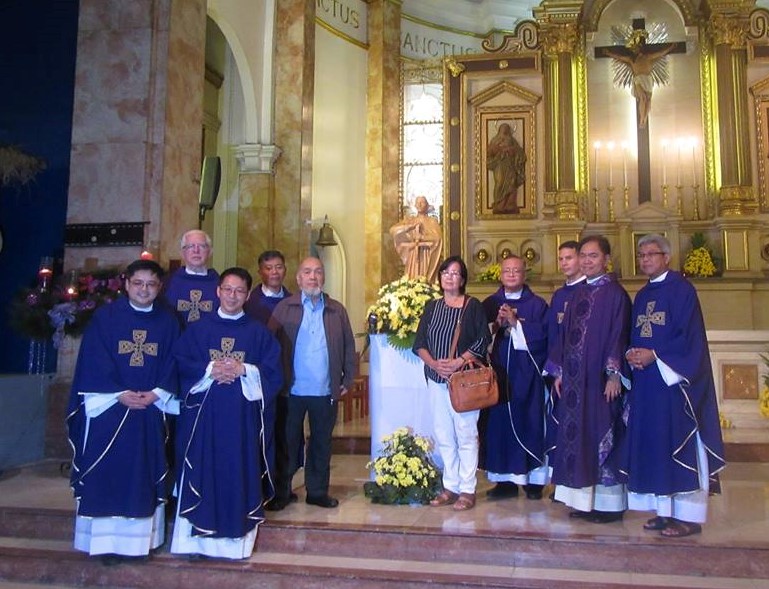
The Thanksgiving Mass was celebrated by Rev. Msgr. Rolando dela Cruz, Paco parish priest — with seven priests from four nations concelebrating.
(Photo credit: Robert Queddeng)
►For the first time in 403 years, Paco Parish Church (est. 1580) commemorated the Dec. 21, 1614 arrival of Justo Ucondono (Lord Justo Takayama Ukon) – and ‘350 Japanese Christian Exiles.’
A halo — symbolizing the holiness of Saints and Angels — was added by Msgr. R. dela Cruz.
The Thanksgiving Mass was concelebrated by Rev. Msgr. Rolando de la Cruz, parish priest – with seven other priests: ♦ Fr. Carlo del Rosario, parochial vicar; ♦ Fr. Iwao Ikegami, FMVD; ♦ Fr. Vincent Guinoo, FMVD; ♦ Fr. Antonius Harnoko, CICM (a Tagalog-speaking Indonesian missionary in Ofunato, Iwate Prefecture); ♦ Fr. Luke Moortgat, CICM; ♦ Fr. Celso Alcantara, and ♦ Fr. Wilfredo C. Talavera.
After the Mass, memento photos were taken of the eight concelebrants, with Dr. and Mrs. Ernesto A. de Pedro, Takayama Trustees. Members of mandated Catholic organizations similarly took souvenir photos. Then parishioners were allowed to take ‘selfies.’
The Japanese contingent of Manila-based nuns was made up of: Sr. Therese Fukatani, of the Congregation of Marie Auxiliatrice (MA); Sr. Kinue Maura, MA; and Sr. Ma. Therese Chiba, of the Handmaids of the Sacred Heart of Jesus (ACI), and lay Japanese: Masako Yamamoto; Mrs. Risa (Ishii) Peralejo, and Sakiko Ishida.
The Paco parishioners’ response was superb — and augurs well for the spread of devotion to Blessed Takayama de Manila.
The San Fernando de Dilao Parish in Paco counts with 27,000 parishioners (according to census data of 2010 — but Msgr. Dela Cruz estimates the number in 2017 at 95,000) — making Paco PARISH larger than any DIOCESE in Japan: ►Archbishop Joseph Mitsuaki Takami (Nagasaki – 67,729 Catholics), ►Bishop Paul Yoshinao Otsuka (Kyoto – 19,198), ►Bishop Bernard Taiji Katsuya (Sapporo – 17,993), ►Bishop Tarcisio Isao Kikuchi, SVD (Niigata – 7,711), ►Bishop Paul Kenjiro Koriyama (Kagoshima – 9,291), and ►Bishop Berard Toshio Oshikawa, OFM (Naha – 6,118). (It should be noted that the Paco Catholic School, adjacent to the church, has the largest student enrollment among Catholic schools in the Philippines.)
This altar-statue, presented to the Paco Catholic Church by the Prayer Warriors of Blessed Takayama, was carved by the celebrated Paete woodcarver Paloy Cagayat, and financed with contributions from the family and relatives of Dr. Ernesto A. de Pedro — who wanted the honor of producing the first Takayama statue in the Philippines.
It is the first Takayama altar statue with the “Palm of Martyrdom” – and a saintly halo. ◘
Dr. Ernesto A. de Pedro
Lord Takayama Jubilee Foundation
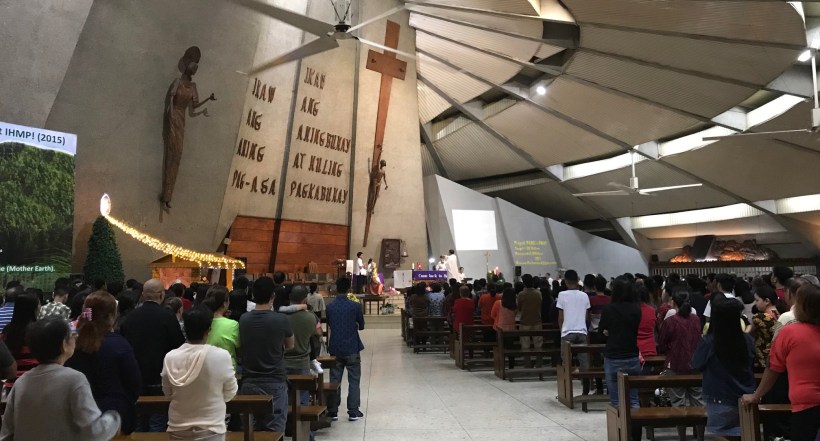
Holy Mass at Claret Church, Quezon City, Philippines
►With the Feastday of Blessed Justo Takayama de Manila included in the Catholic Church’s liturgical calendar on February 3 every year – may we request that photos of the celebration in your parish church (anywhere in the world) be shared with our Movement?
Send photos to our email address: blessedtakayama@gmail.com — If possible, please include the ♦ name of the priest who celebrated the Mass, and the ♦ name of the church and city.
We hope we can receive some photographs of the worldwide celebration of Blessed Takayama’s first feastday on February 3, 2018 — from churches in these top ten countries. ◘
Ó DEUS, que em sua maravilhosa Providência,
escolheu Justus Takayama Ukon
para ser promotor singular de seu Reino,
e testemunha intrépida da fé católica.
RECOMPENSA, nós vos suplicamos, seu zelo pela sua glória,
conceda-nos o que humildemente pedimos
por sua intercessão.
CONCEDE-NOS também que, seguindo seu exemplo,
possamos aceitar todas as dificuldades
por causa da nossa santa fé católica.
Por nosso Senhor Jesus Cristo. Amén.
►The rustic views of Takayama village are still there – four centuries later. The ancestral Takayama village is in the background.
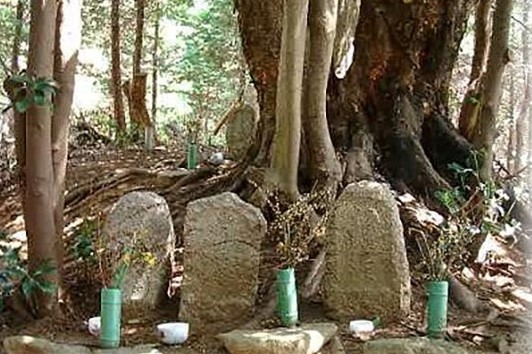
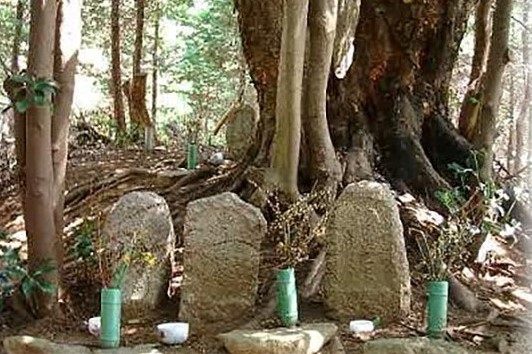
No wonder the mother of Blessed Justo Takayama Ukon — Maria Takayama — insisted on being buried in the old Takayama village — when she died in Kanazawa in 1596. The gravesite of Maria Takayama still draws domestic tourists today to the ancestral Takayama Village in Toyono-cho. (Photo from the office of Maria Leona D. Nepomuceno, of the Philippine Department of Tourism-Osaka)
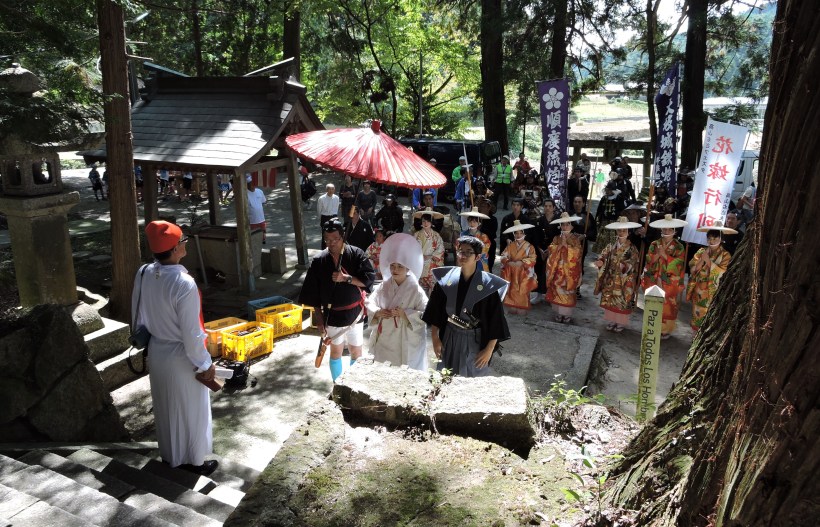
For this commemorative procession during the ‘Ukon Festival’ (Oct. 1, 2017), the villagers wear — NOT everyday street wear – but traditional apparel worn on special occasions.
Commemoration of Ukon’s wedding at the ‘Ukon Festival.’
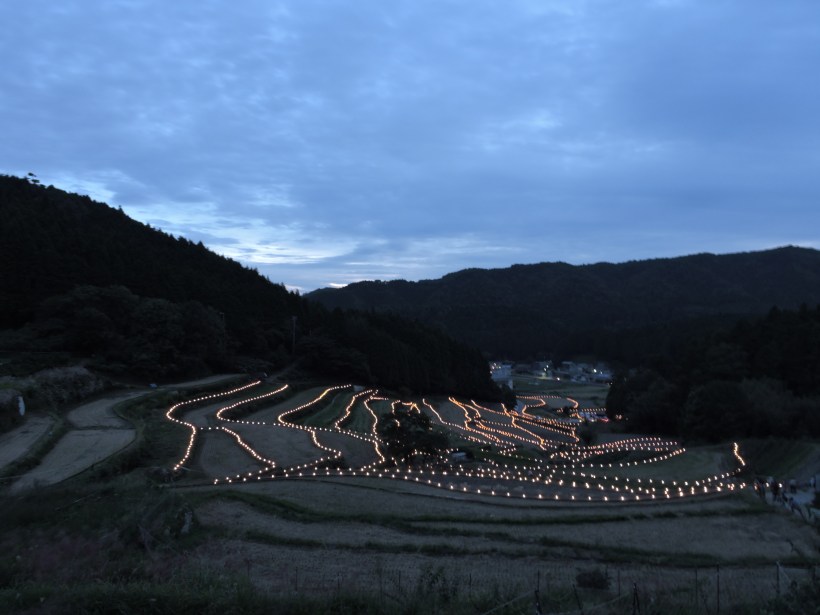
The terraced paddies of Takayama village at dusk
The photographs were shared by Mr. Takaki Ohnishi of the municipal government of Toyono-cho – which is also famous for a brew of ‘Sake’ wine labelled ‘Takayama’ — NOT after Ukon, but after the Takayama village. Mr. Ohnishi headed a delegation that brought a granite marker from Toyono-cho — to “add a stone” — to the Takayama Memorial at the Graduate School of the University of Santo Tomas (UST). ◘
The Santa Ana Church (1590) was built by Fr. Antonio Sedeño, SJ, as a look-alike of the Jesuit mother-church in Rome – “Il Gesù Church” (erected between 1568 and 1584). Conceived in 1551 by St. Ignatius de Loyola, the founder of the Society of Jesus, its facade is “the first truly baroque façade,” introducing the baroque style into architecture. “Il Gesù Church” served as model for innumerable Jesuit churches all over the world.
Lord Takayama was buried near the High Altar – in the expectation he would, one day, be elevated to Sainthood
►The story of Lord Justo Takayama Ukon – and ‘350 Japanese Christian exiles,’ including Lord Juan Tocuan Naito and the 15 cloistered nuns of the ‘Beatas de Miyako’ form part of the evangelical annals of the Philippine Church — (not of the Church of Japan) – as detailed in five chapters of “Labor Evangelica, ministerios apostolicos de los obreros de la Compañia de Iesvs, fvndacion, y progressos de su provincia en las islas Filipinas” by Colín, Francisco (1592-1660; first published 1663); Chirino, Pedro (1557-1635); and Pastells, Pablo (1846-1932), eds. Barcelona: 1900. The history of the Japanese Catholic exiles, written by Jesuits, appears on pp. 434-562.
With Full Military Honors
After State Honors by Spanish Governor-General Juan de Silva and necrological services by Manila Archbishop Diego Vazquez de Mercado (r. 1610-1616), and Superiors of the five religious orders — Augustinians, Franciscans, Jesuits, Dominicans and Recollects – Lord Takayama was laid to rest, with great pomp and ceremony, near the high altar of the Jesuits’ ‘Iglesia de Santa Ana.’
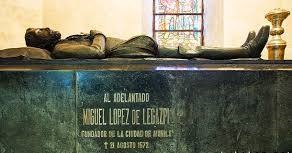
Takayama’s tomb near the main altar – was similar to that of El Adelantado, the Spanish Governor-General Miguel Lopez de Legazpi (1502-1572), who was buried 43 years earlier at the Capilla de Legazpi of San Agustin Church, its top slab covered by a bas relief of Legazpi.
After Santa Ana Church was destroyed by a series of earthquakes (1621-1625), Takayama’s remains were transferred to the new San Ignacio Church (I) that was built in 1632 alongside the ruins of the original church.
But when the Jesuits were deported from the Philippines in 1768, this church deteriorated from neglect and decay. Upon their return to the Philippines in 1859 — after 91 years in exile, the Jesuits built at a different site (partly with stones from the first San Ignacio Church) a new Church – which they also called San Ignacio Church (II). This was inaugurated in 1889.
It means that from 1615 to 1889 – for 274 years! — the bones of Blessed Takayama were at the Jesuit Compound (now PLM Compound), until their transfer from the compound to the newly constructed San Ignacio Church (II) at Arzobispo St., near the Arzobispado de Manila.
Already proposed for sainthood in 1630 – though not yet recognized as a ‘Servant of God’ by the Vatican — fragments of Takayama’s bones served nonetheless as the altar-stone of the Main Altar of the second San Ignacio Church.
The Odyssey of Takayama’s earthly remains is told in “The Search for the Bones of Takayama Ukon.” ◘
Dr. Ernie A. de Pedro
Managing Trustee
Lord Takayama Jubilee Foundation
The celebrated samurai, born in Toyono-cho, Osaka Prefecture, is recognized as a Christian of heroic virtue.
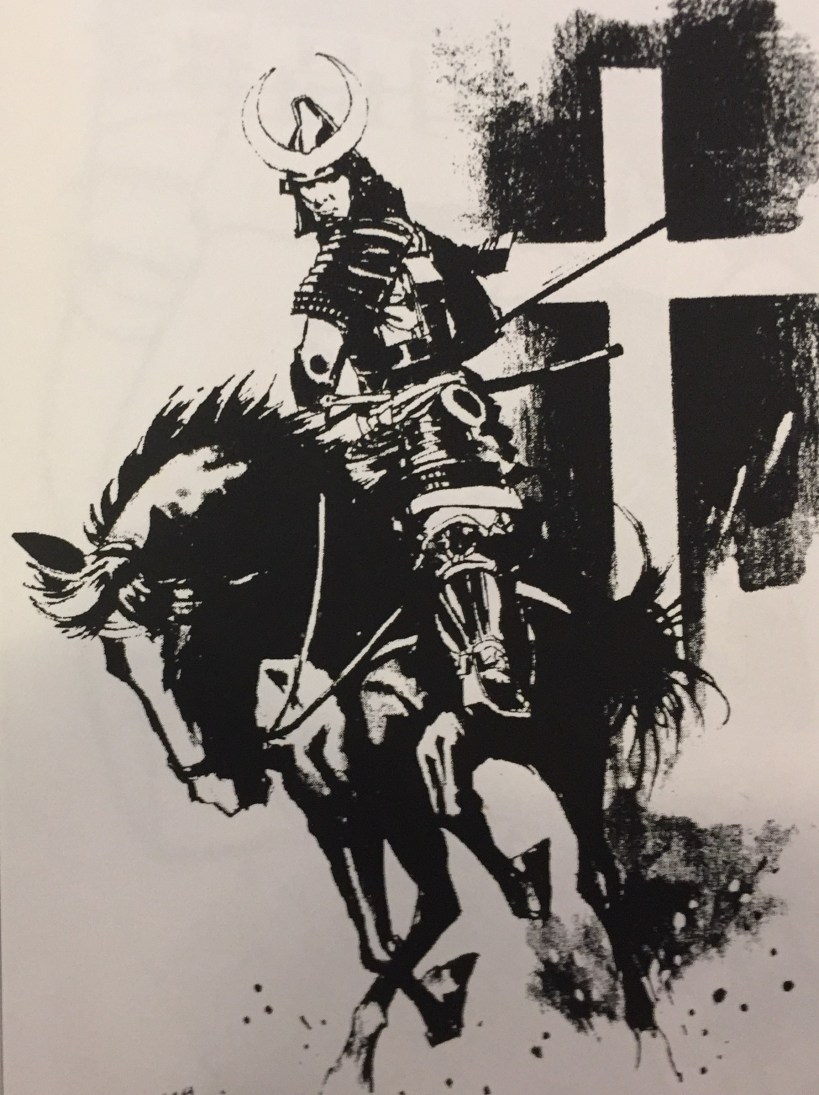
►As Japanese church historians record it, TAKAYAMA Hikogorō (彦五郎) – (better known as Justo Takayama Ukon (高山右近) – 1552-1615) was born in 1552 in Takayama village, in Toyono-cho, Toyono-gun, Osaka Prefecture.
This is the conclusion of a Historical Commission appointed in 1963 by the Catholic Bishops’ Conference of Japan (CBCJ), headed by Sophia University’s Fr. Hubert Cieslik, SJ (1914-1988) to study the life and times of Takayama. Fr. Cieslik specialized in early Japanese mission history.
Indeed, the grave of Ukon’s mother — Maria Takayama — wife of Takayama Tomoteru (高山友照), later known as Darius Zusho Takayama, is located here, where it is a tourist attraction to this day. Maria Takayama was the mother of three sons, the eldest being Justus (and thus heir), and three daughters. Maria had joined Ukon during his 27-year domestic exile in Kanazawa which began in 1587, but when she died in 1596, the Takayama family chose to bury her in the ancestral village of Takayama in Toyono-cho, Osaka Prefecture. (That’s an acknowledgement by the Takayama family themselves that Toyono-cho, Osaka Prefecture was their hometown.)
The gravesite of Maria Takayama (d. 1596), mother of Blessed Justo Takayama Ukon, still draws domestic tourists today to the ancestral Takayama Village in Toyono-cho, Osaka Prefecture. (Salamat kay YUI YAMADA, Philippine Department of Tourism-Osaka).
But two other places claim the honor:
►SECOND CLAIMANT: Sawa Castle in Haibara-cho, Nara Prefecture. In this claim, Ukon was born at Sawa fortress, stronghold held by Ukon’s father, Takayama Tomoteru (1531–1596), a samurai in the service of the Daimyo Matsunaga Hisahide (松永 久秀), 1508–1577, in Yamato Province (today in Haibara-cho, Nara Prefecture).
►THIRD CLAIMANT: Takayama Castle in Settsu Province (now in Ibaraki City), Osaka Prefecture. — (P. Luis Frois, SJ).
Father Frois (1532-1597), who was the second of eleven (11) contemporary Jesuits who reported on the life and times of Takayama Ukon while Ukon was still alive, is best remembered for writing “The First European Description of Japan,” 1585. (This was the earliest systematic comparison of Western and Japanese cultures.)
Toyono-cho is definitely the birthplace of Takayama Ukon. ◘
Dr. ERNIE A. DE PEDRO
Managing Trustee
Lord Takayama Jubilee Foundation
Medical miracles — if proven authentic — are the best supporting evidence of God’s grace.
Takayama Does NOT Perform the Miracle – Only God Does That. But We Ask Ukon to Intercede – with God!
►It may take five years. Ten years. Or 100 years. It all depends on ONE fervent Takayama devotee to remember to invoke Ukon’s name — to intercede with God for a difficult case — needing God’s miracle. If Blessed Takayama’s life or virtues are not known, nobody will invoke his name. There are other saints more alive and relevant to today’s everyday challenges. Thus, the ardor of Takayama devotees to share all available studies about the man, his life, his virtues. In time, he should be a familiar go-to friend — an exemplar of a courageous Catholic who dedicated his life being obedient to God’s will.
Not all “Beati” (Blessed) get to be canonized as Saints. There is a large number of Blessed – with incorruptible bodies – who have not been proclaimed Saints, though they are miracles by themselves. The requirement of the Pontifical Congregation for the Causes of Saints is for a miracle from God for some supplicant — realized though their intercession.
Among Japan’s 436 venerated Martyrs – 394 Blessed have NOT graduated to Saints yet, waiting for miracles to be performed through their intercession. If no devotee remembers to ask for their intercession, will a miracle ever happen?
DURING HIS LIFETIME, many people found Takayama Ukon’s life a great inspiration — his holiness was so evident. In Manila, he was regarded as a living saint.
At his deathbed, Ukon implored Our Lady of the Rosary for her prayers “now and at the hour of our death,” was given the Last Rites by Jesuit priests, while surrounded by his loving family. Here was a saint indeed! In the Catholic religion, anyone who dies in a state of grace is in the presence of God for all eternity. They became saints the moment they entered Heaven.
Which is why the Manila Archdiocese readily proposed Sainthood for Takayama Ukon de Manila in 1630. But the process of being recognized as Official Saints – of being enrolled in the Church’s “Canon of Saints” – requires a long official process involving both the proposing diocese and the Vatican.
Specific Petition
To be proclaimed as an Official Saint in the Holy Roman Catholic Church, the Congregation for the Making of Saints requires that a miracle be produced through the intercession of a candidate — as proof of God’s caring grace. According to the Church, miracles — or divine events that have no natural or scientific explanation — serve as proof that the person is in Heaven and can intercede with God to change the ordinary course of events. Since such miracles are considered proof that the person can intercede for us, the miracle must take place as a result of a specific petition to that particular candidate – NOT a scatter-shot “Prayer to All the Saints in Heaven – Particularly Blessed Takayama de Manila Who is in Need of a Miracle.” The prayer must be for the solointercession of the newly beatified Blessed Takayama with God – to make the miracle happen.
In brief, it must be the gravely-ill patient himself, anxious for a miracle from God, who invokes the intercession of Blessed Takayama, who himself died from an illness the doctors could not heal.
A growing community of Prayer Warriors for Blessed Takayama de Manila – from Sikatuna Village (Quezon City) to Waukesha, Wisconsin (USA) — have emailed their readiness to support the miracle-seeker’s prayers with our own concerted supplications — wherever in the world the patient may be.
Scientifically Unexplainable
If a miracle through the intercession of Blessed Takayama is reported in Manila or Osaka — a Diocesan Commission, composed of scientific experts and theologians, will examine the claimed miracle. To be recognized as such, the purported medical miracle must be “spontaneous, instantaneous and complete healing — while also being scientifically unexplainable. Doctors must conclude, ‘We don’t have any natural explanation of what happened.’” If the claim passes muster, this is forwarded to the Vatican — where a Miracle Commission sifts through all such claims.
Decree of Miracle
If the Pope agrees, he issues a Decree of a Miracle. Through the Rite of Canonization, the Pope, by an act which is protected from error by the Holy Spirit, elevates a person to the universal veneration of the Holy Roman Catholic Church.
By canonization, the Pope does not make the person a Saint. Rather the Holy Father declares that the Saint – who was actually a saint upon his death — is indeed with God and is an example of someone who lived a holy life in obedience to God’s will — worthy of emulation by the faithful throughout Christendom. ◘
By Dr. ERNIE A. DE PEDRO
Managing Trustee
Lord Takayama Jubilee Foundation













 Blessed Justo Takayama Ukon