The Nagasaki group poses for memento photographs in front of the statue of Blessed Justo Takayama Ukon
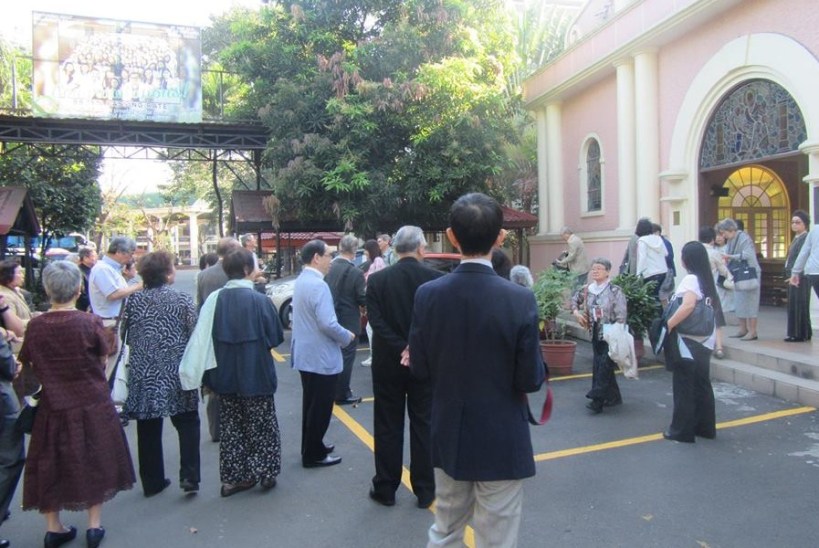
►In 29 years of welcoming Japanese pilgrims tracing the footsteps of Blessed Justo Takayama Ukon (1552-1615) who died in Manila, we have had a range of tourists – from one jeepneyful to three tourist busloads – with only a few Catholics among them. In a Philippines which counts with over 200 religious women’s congregations, nine nuns do not really make a splash. But this group of nine nuns from Nagasaki Diocese in a tour group of 19 Catholics, accompanied by Fr. Michael Shimosako, who visited UST on Oct. 9, 2017 is a RARITY. Remember: Only ONE in 300 Japanese is Catholic!
The UST visit of the Japanese nuns of the Nagasaki Diocese was coordinated by the UST Office of Public Affairs (headed by Prof. Giovanna Fontanilla, A.P.R.) and the UST Graduate School (where the Takayama Memorial stands) under Dean Marilu R. Madrunio, PhD. ◘
Dr. ERNIE A. DE PEDRO
Managing Trustee
Lord Takayama Jubilee Foundation
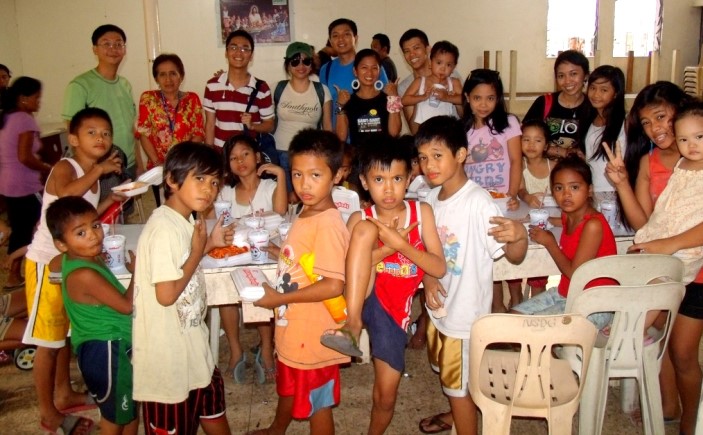
Catholic Charities Manila feeds schoolchildren in a feeding program funded by contributions from Catholic communities
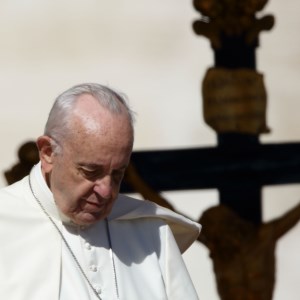
►ROME – Sept. 28, 2017 — On the Feast of St. Vincent de Paul, Pope Francis said that charity is central to the Church’s mission, and we are called to share it with the world, especially those in need. “All of us, in truth, are called to water ourselves upon the rock that is the Lord and to quench the world’s thirst with the charity that springs from Him,” the Pope said on Sept. 27. “Charity is at the heart of the Church, it is the reason for its action, the soul of its mission.”
As Benedict XVI wrote in the encyclical ‘Caritas in Veritate’: “Charity is the main path of the Church’s social doctrine. Every responsibility and commitment outlined by this doctrine is attuned to charity which, according to Jesus’ teaching, is the synthesis of all the Law,” he said.
Pope Francis sent the message Wednesday for the 400th anniversary of the start of the charism of the Vincentian Family, a group of organizations founded by or under the inspiration of St. Vincent de Paul, whose feast is Sept. 27. A 17th-century French priest, St. Vincent is known as the patron of Catholic charities for his apostolic work among the poor and marginalized.
“Inflamed by the desire to make Jesus known to the poor,” St. Vincent “intensely devoted” himself to the announcement of the Gospel, especially through missionary work, charity, and the care and formation of priests, Pope Francis said. In his message, he compared St. Vincent to a tiny mustard seed, which sprouted and spread through his charitable works, the priests he taught, and the religious orders he founded.
‘Reach the Peripheries of the Human Condition’
Like St. Vincent, “you are called to reach the peripheries of the human condition,” Pope Francis said, “to bring not your own capacities, but the Spirit of the Lord, ‘Father of the poor.’” “He spreads you into the world as seeds that sprout on dry land, as a consolation balm for those who are hurt, as a fire of charity to warm up many hearts choked by abandonment and hardened because they are discarded.”
St. Vincent still speaks to us and to the Church today, his testimony inviting us to be on the road, working to sow the love of God in the hearts of others, even the unpleasant, the Pope said. “I ask for the Church and for you the grace to find the Lord Jesus in the hungry brother, the thirsty, the stranger, the one stripped of clothing and dignity, the sick and imprisoned, but also the doubtful, the ignorant, the obstinate in sin, the afflicted, the offensive, the bad-tempered and the annoying.”
He also asked that from the “glorious wounds of Jesus,” the “dying seed that gives life,” and the “wounded rock from which water flows,” members of the Vincentian Family would find the strength and joy to go out of themselves and into the world, facing challenges with creativity. Because “as St. Vincent said, ‘love is creative even to infinity.’”
“This is the way to follow,” the Pope said, “because the Church is always more and more mother and teacher of charity, growing and overflowing in mutual love towards all.” “We ask for smallness of heart, full availability, and docile humility. It pushes us to fraternal communion between us and our courageous mission in the world.” ◘ — Catholic News Agency
‘If a person is respected and their creativity is developed, they do not become a threat,’ the Cardinal said in an appeal to governments
►Cardinal Luis Antonio Tagle, the President of Caritas Internationalis — the global network of national Catholic charities — today (September 27) made an impassioned plea for governments across the world to welcome migrants as he launched a campaign for the world to welcome those leaving their homelands for a better life.
Speaking during a press conference at the Vatican, the Archbishop of Manila became emotional when he talked about his grandfather, a poor migrant who arrived in the Philippines with a widowed mother.
“Whenever I think of migrants, I think of my grandfather who emigrated from China,” he explained. “Who would have thought he’d produce a cardinal grandson.”
He said that if a “politician cares for their country” then they will welcome new arrivals, and said more leaders need to have a personal encounter with migrants.
“If a person is respected and their creativity is developed, they do not become a threat,” the cardinal said in an appeal to governments. “Don’t close the doors. You might be closing the doors to people who will enrich your community.”
“Share the Journey”
Earlier today Pope Francis formally launched the “Share the Journey” campaign in St. Peter’s Square during the Wednesday General Audience.
The two-year initiative is aimed raising awareness about the plight of migrants, encourages people to meet with them and hear their stories, rather than treat them as numbers and statistics.
Opening his arms, the Pope said “Christ urges us to welcome our brothers and sisters with our arms truly open, ready for a sincere embrace, a loving and enveloping embrace.” ◘
Francis admitted he had made a mistake with softening the sentence of abusive ex-priest, Mauro Inzoli, and said he had learnt from this
►Pope Francis says he will never pardon priests convicted of sexual abuse while admitting the Church waited too long before taking the matter seriously.
Talking during his first ever meeting with the papal abuse commission today (21 September), the Pope said there can be no place in the priesthood for those who harm children and that he had learnt from his own mistakes in handling such cases.
Francis met the group for an hour and rather than speaking from a prepared speech gave 20 minutes of off-the-cuff remarks.
One of the 14 members of the Pontifical Commission for the Protection of Minors present at the meeting was Baroness Hollins, a professor of psychiatry and member of the House of Lords.
“He [Pope Francis] said if pedophilia is proven then he will never pardon an ordained priest and that the Church has come late to an understanding of how serious this matter is,” she told The Tablet afterwards. “He is completely committed to trying to get the Church to address this properly and he said he felt deeply ashamed about what has happened.”
The Pope faced criticism earlier this year when it emerged he had softened a sentence of laicisation against Mauro Inzoli, 67, an abusive priest in the Diocese of Crema. Inzoli has since been laicised.
During his meeting with the commission the Pope admitted this was a mistake, confessing that he thought at the time he was dealing with matter in “the most benevolent way.” Francis added, however, that he learnt from this and would never do it again.
“Whoever is sentenced for sexual abuse of children can turn to the Pope for pardon,” but he stressed he had “never signed one of these and will never sign.”
Pedophilia an “Illness”
Describing pedophilia as an “illness” Francis admitted that the Church had not faced up to the problem of abuse quickly enough: it was, he said, thanks to a number of “prophetic” men and women that the matter was now being taking seriously.
He stressed that the Congregation for the Doctrine of the Faith (CDF), the Vatican department which acts as a clearing house for abuse case, will be getting more resources. There have been complaints that the congregation has been understaffed and that cases are being processed too slowly.
Baroness Hollins described the Pope’s talk as “very honest” adding that she believes he understands the gravity of the problem.
In the official text prepared for the meeting, Francis re-iterated a “zero tolerance” approach on sexual abuse and pointed out he had implemented new laws to hold accountable any bishops and religious superiors who are negligent when handling cases.
“We are ashamed of the abuses committed by holy ministers, who should be the most trustworthy,” the Pope explained. “Let me say quite clearly that sexual abuse is a horrible sin, completely opposite and in contradiction to what Christ and the Church teach us.”
The papal safeguarding commission is meeting in Rome for its bi-annual general gathering whether they will assess recommendations for improved protection of children and vulnerable adults within the Church, and care for people who have been abused. These will then be submitted to the Pope for his approval. Francis has so far accepted all the group’s recommendations.
Earlier this year the commission suffered a blow when Marie Collins, a sexual abuse survivor from Ireland, resigned due to what she said was internal resistance to the group’s work by the CDF.
Ms Collins has continued to offer her advice to the Church and was in Rome earlier this month to address a group of recently ordained bishops at a Vatican organized conference.
The sexual abuse scandal has dogged the Church for years with last week the Holy See announcing it was recalling a diplomat from Washington for a “possible violation of laws relating to child pornography images.” ◘
Bishop Severo Caermare of Dipolog holds Mass after closing rites for the diocesan investigation into the cause of the martyrdom of 17th Italian Jesuit missionary, Father Francesco Plliola, who served indigenous people in the Philippines. (Photo by Angie de Silva)
Thousands of Filipinos Mark Close of Probe into Life of 17th-Century Jesuit Fr. Francesco Palliola
►UCANews – Sept. 18, 2017 — Thousands of Catholics packed the Cathedral of the Most Holy Rosary in the southern Philippine city of Dipolog last week as the diocese closed its probe into the life of 17th century Jesuit missionary, Father Francesco Palliola.
The diocese nominated Father Pallolia as a Catholic martyr, citing his defense of the faith and upholding of Christian virtues.
The priest is considered the patron of the Lumad or indigenous people of the western tip of Mindanao. He was born to a noble family in Naples, Italy.
The close of the diocesan investigation comes a year and a half after its launch in January 2016.
All Supporting Documents Submitted to the Congregation for the Causes of Saints
Bishop Severo Caermare of Dipolog signed the archetype, transcript and copies of the local historical and theological commissions’ proceedings, which opened in January 2016. They now head to the Vatican.
Father Rene B. Javellana, archivist of the Philippine Province of the Society of Jesus, said Father Palliola was martyred on Jan. 29, 1648 at Ponot, now the town of Jose S. Dalman, an hour away from Dipolog. He was 37 when he died.
A Subanon leader named Tampilo is believed to be his killer.
Tampilo had reportedly been baptized, but later rejected Catholicism.
The priest was trying to bring Tampilo back to the faith when the Subanon leader led an attack on his residence and small church, said Father Javellana, a member of the probe’s historical commission.
People who said prayers for intercession were answered also attended the event.
Among them were 33-year-old Jason Luwagi and his mother, Monica, who said her appeals for intercession led to an overnight cure from a birth deformity that prevented him from walking.
Church officials acknowledged many testimonies of answered prayers but cautioned against venerating Father Palliolia as a saint. ◘
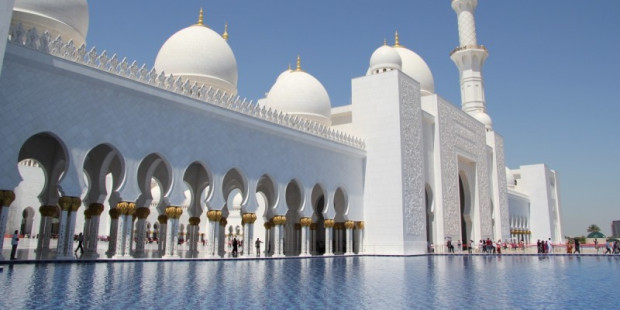
The first mosque named “Mariam, Umm Eisa (Mary, Jesus’ Mother) Mosque.”
►A mosque in Abu Dhabi, capital of the United Arab Emirates (UAE), has been renamed “Mariam, Umm Eisa (Mary, Jesus’ Mother) Mosque.”
Sheikh Mohammad bin Zayed Al-Nahyan, Abu Dhabi crown prince and deputy supreme commander of the UAE Armed Forces, ordered that the mosque be renamed to “consolidate bonds of humanity between followers of different religions.”
[Mary (Mariam) is revered in Islam as the mother of Jesus. She is mentioned in the Qur’an 34 times, while Jesus (Isa) is mentioned 25 times.]
Rev. Elias D. Mallon places this development in context:
“Our Lady plays an important role in Islam. She is the virgin mother of Jesus, although with no connotation of the Incarnation as understood by Christians. She is the one who hears God’s word and believes it. And in the Qur’an, she is the focus of Chapter 19.
“When members of the early Muslim community fled to Abyssinia (ancient Ethiopia) to escape persecution, they were required by the king to explain their new faith. When he heard of the devotion they had to Mary, he immediately accepted them as protected refugees.
“Two women play a major role in Islam. The first is Fatimah, the daughter of the Prophet Muhammad and wife of Ali bin Abi Talib. The second is Mary, Mother of Jesus. Known among Muslims as Fatimah al-Zahra, “the Illustrious,” the daughter of the Prophet is widely revered in Sunni and especially Shi’ite Islam.
“While it is common among Shi’ites to have mosques bearing the name of Fatimah, to my knowledge this mosque in Abu Dhabi is the first to be named after the Virgin Mary.” ◘
Pope Francis meeting Japanese Bishops on their Ad Limina visit to the Vatican – (17/09/2017). The Catholic Church of Japan has 42 Saints and 394 Beati (Blessed) — all Martyrs!
►(Vatican Radio) — Pope Francis has urged Christians in Japan to face current challenges bearing in mind the witness of their many martyrs.
In a letter addressed to the Bishops of Japan, on the occasion of Cardinal Fernando Filoni’s pastoral journey to the Land of the Rising Sun, the Pope held up the memory of Japan’s many martyrs and ‘hidden Christians’ whom, he said, from the 17th to the mid-19th centuries lived clandestinely so as not to have to repudiate their faith.
Cardinal Filoni, the Prefect of the Congregation for the Evangelization of Peoples, has undertaken a pastoral journey to Japan lasting from 17 to 26 September.
Japanese Christians facing current challenges
In the letter, the Pope pointed out that Japanese Christians are facing “the challenges that current times pose” and he invited them not to be “resigned,” nor to resort to “an ironic or paralyzing dialogue even although there are problematic situations that raise not a few concerns.”
Amongst the situations that arouse concern, the Pope mentioned the “high rate of divorce” in Japan, “the number of suicides, even among young people,” the phenomenon of the ‘hikikomori’ – people who choose to live completely disconnected from society, “religious and spiritual formalism, moral relativism, indifference towards religion, an obsession for work and earning”.
It is also true, the Pope continued, that a society that is a frontrunner in economic development leaves many behind: the poor, the marginalized, the excluded – not only those who are excluded in a material sense, but also those who are spiritually and morally in need.
Need for constant renewal in the Church
Within this particular context, Francis pointed out that it is necessary and urgent that the Church in Japan be constantly renewed, always bearing in mind “Jesus’ mission which is salt and light.”
The Pope concluded pointing out that the true evangelical force of the Japanese Church stems from the fact that it has been a Church of martyrs and confessors of the faith, and this “is a great asset to be safe-guarded and developed.” ◘
In Grim Protest Against Grievous Extra-Judicial Killings (EJT) of the Poor and Defenseless
Agence France Presse
►Church bells tolled across the country for five minutes beginning Thursday night (Sept. 14) – and for the next 40 nights — as Catholic bishops rallied opposition to the “reign of terror” that has left thousands dead in President Rodrigo Duterte’s drug war.
The Philippine National Police has reported killing more than 3,800 people to fulfill Mr. Duterte’s vow to rid the Philippines of narcotics, with the 15-month crackdown triggering wider violence that has seen thousands of other people found dead in unexplained circumstances.
Forty Nights
Church bells tolled at 8 p.m. to honor the dead and remind the living that the bloodshed must stop. The ritual will continue for 40 nights.
“We cannot allow the destruction of lives to become normal. We cannot govern the nation by killing,” the archbishop of Manila, Luis Antonio Cardinal Tagle (in photo), said in a pastoral letter last week launching the campaign.
The president of the Catholic Bishops’ Conference of the Philippines (CBCP), Lingayen-Dagupan Archbishop Socrates Soc Villegas, followed up this week with an even stronger pastoral letter. “For the sake of the children and the poor, stop their systematic murders and spreading reign of terror,” Villegas wrote.
Mr. Duterte won last year’s presidential election on a brutal law-and-order platform in which he promised an unprecedented campaign to eradicate illegal drugs in society by killing up to 100,000 traffickers and addicts.
Top Priority
He has made the drug war the top priority of his administration, and has regularly encouraged more bloodshed with comments such as describing himself as “happy to slaughter” three million addicts. Nevertheless, Mr. Duterte and his aides reject allegations they are overseeing a crime against humanity.
Self-Defense?
They say police are killing only in self-defense, and the thousands of other unexplained murders could be due to drug gangs fighting each other.
Many Filipinos looking for quick solutions to crime continue to support Duterte, according to polls, and he enjoys majority backing in both houses of Congress.
But the Church has emerged as the leader of a growing opposition in recent months.
The killings of three teenagers, two of them at the hands of Caloocan police, sparked rare street protests against the crackdown.
Church officials say the tolling of bells is a direct throwback to the Crusades in the Medieval Age, when Christian nations of Europe sent military expeditions to reclaim holy places in the Middle East.
The Catholic Church, to which eight in 10 Filipinos belong, has a history of influencing politics in the Philippines and helped lead the Edsa People Power Revolution that overthrew dictator Ferdinand Marcos in 1986. —AFP
►That question is often asked by Japanese pilgrims tracing the footsteps of Lord Justo Takayama Ukon in Manila. Many guests insist on a side trip to a fruit market to buy a sampler basket of tropical fruits. They never buy bananas or pineapples — they have those in Japanese grocery stores. But they like ripe mangoes, chicos and guayabano (jackfruit.)
The Philippine Jesuits were superb hosts, of course. But they left no notes about what they stocked the pantry of the Takayama family at their ‘Casa San Miguel’ guesthouse in Intramuros.
But there were choices a-plenty – if his wife, Dona Justa Takayama, or daughter, Lucia Yokoyama, could drop by the Chinese open-air fruit stalls at the nearby Parian de los Sangleyes just outside the Walls of Intramuros. ◘
Dr. ERNIE A. DE PEDRO
Managing Trustee
Lord Takayama Jubilee Foundation
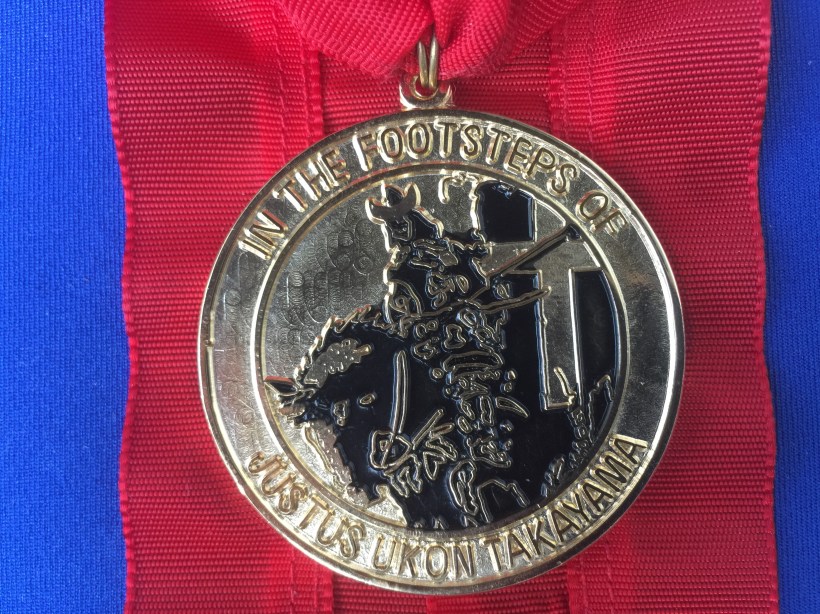
‘IN THE FOOTSTEPS OF JUSTUS UKON TAKAYAMA’ — The batch of Takayama medallions still in supply was blessed by the late Bishop Francis Xavier Osamu Mizobe, SDB (1935-2016) of Takamatsu Diocese, who was then chair of the CBCJ Commission for the Promotion of Saints.
►Centered on Intramuros, the Tour Is for One or Two Days
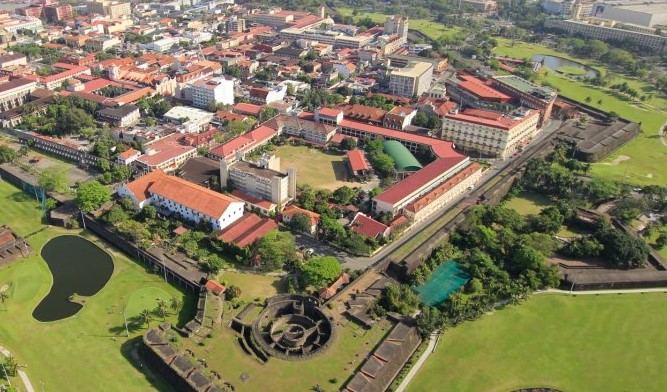
THE CENTRAL FACT that Japanese pilgrims should remember when they tour Takayama’s ‘Old Manila’ is that the Christian samurai, Justo Takayama Ukon (1552-1615) — proposed for sainthood by the Manila Archbishop in 1630; declared a “Servant of God” in 1994; recognized as a Martyr by Pope Francis in 2016; and beatified in 2017 – died in Manila in the Jesuit Compound in Intramuros.
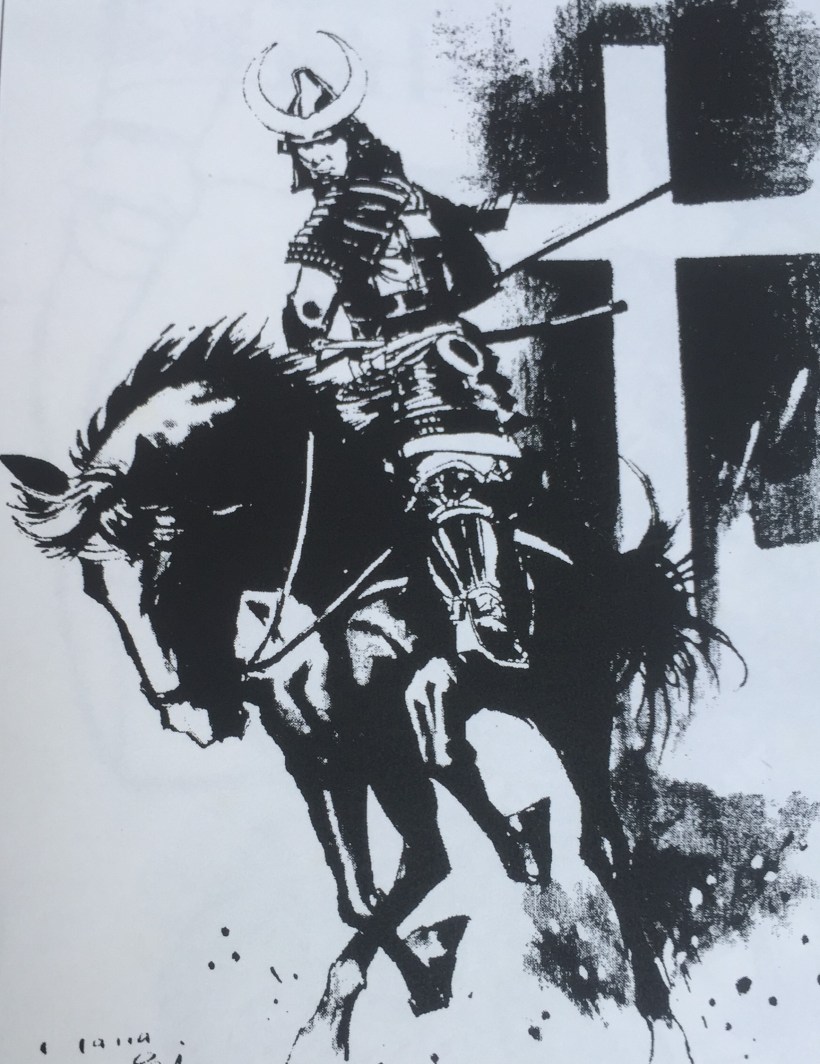
Lord Justo Ukon Takayama (1552-1615) is best remembered as the Sengoku Period’s ‘Samurai of Christ.’ This is the illustration after which the Takayama Medallion was based on.
The Jesuit Compound in Intramuros
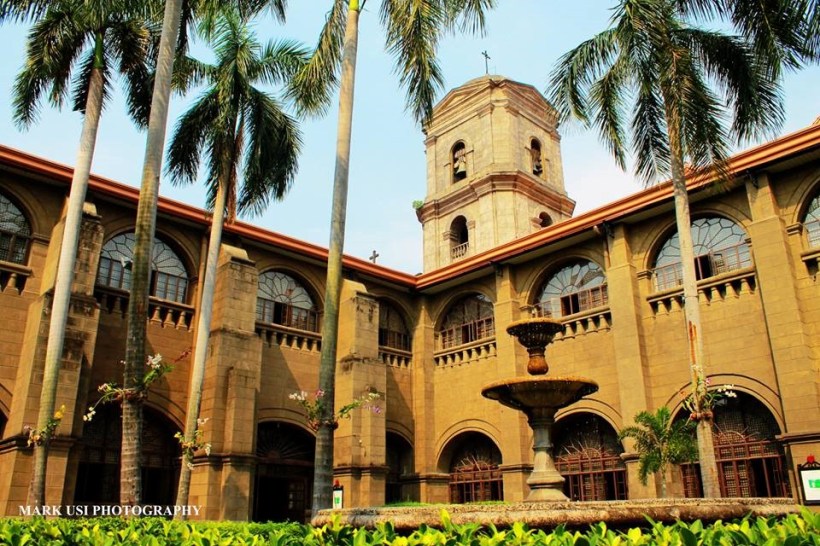
That Jesuit Compound is now occupied by the Pamantasan ng Lungsod ng Maynila (PLM, est. 1965) – which, though a government university, maintains a Catholic chapel in the area which used to house ♦ the Jesuit Iglesia Ana Church (1590-1625), later replaced by San Ignacio Church (No. 1) built in 1632 next to the earthquake-ruined church; ♦ Colegio de Manila (1590- ), renamed in 1626 as “Universidad de San Ignacio” (1626-1768), and ♦ Casa San Miguel, the Jesuit guesthouse. Eleven years later, the Jesuits established in the same city block the ♦ Colegio de San Jose (1601- ) as a residential college for students studying at the Colegio de Manila. (San Jose Seminary is now located at the Ateneo compound in Loyola Heights, Quezon City). ALL THESE IN ONE CITY BLOCK!
Japanese Christian exiles who arrived in 1614 continued their seminary studies in Manila – at Colegio de San Jose. Among these was Blessed Diego Yuki Ryosetsu, a seminarian ordained as a Jesuit priest in 1615, and martyred in “the pit” in Osaka in 1635.
In 1621, the Colegio de Manila was authorized by Pope Gregory XV to confer degrees in theology and arts. In 1626, the authorization was confirmed by Philip IV of Spain, who elevated the school into a university, thus making the Universidad de San Ignacio the first royal and pontifical university in the Philippines and in Asia.
Because he died at “Casa San Miguel,” Lord Takayama is considered by the Catholic Church as a “Son of Manila” — under the rubric that “where a man dies, is where he is born to Heaven.” Thus, the PLM is the actual site of the Martyrdom of Japan’s 436th venerated Martyr, who was proclaimed as ‘Blessed’ — by the Vatican’s Congregation for the Causes of Saints (CCS) on Feb. 7, 2017.
This distinguished historical record preceded the present-day stewardship (since 1965) of the former Jesuit compound by Pamantasan ng Lungsod ng Maynila (PLM).
Points of Interest for Japanese Tourists
For Japanese pilgrims tracing the footsteps of Lord Ukon Takayama in Manila, the Takayama Foundation developed “A Japanese Pilgrim’s Tour of Takayama’s Manila.” Depending on the time available, sites are selected by the tour coordinator from our checklist:
The Portuguese-captained Chinese junk was loaded with 350 Japanese Christian exiles, the most famous of whom was Lord Justo Takayama who brought with him his wife, Dona Justa, a daughter and five grandsons.
◘ ||| The Governor’s Galera (galley propelled by oarsmen) – which was dispatched to Bataan to pluck all the Japanese refugees on the de-masted Chinese sampan — landed on the open beach fronting the Palace of the Governor-General Juan de Silva, as the whole city turned out “to see the men of whom such great things had been told.” The “Takayama 350” made their Manila Bay landing at the Governor’s Gate (named Postigo Gate only in 1662). The landing faced the open sea, with no walled defences yet in 1614. Only ships on business with the Governor or Manila Archbishop were allowed to debark there, for security reasons. (All other commercial ships landed at the mouth of the Pasig River, and paid customs duties at the Aduana.) Colin/Pastells notes — “it was very late” — indicating that the Galera arrived at the Manila Bay landing in late afternoon.
The Governor sent his entire guard and many distinguished persons to escort the party from the landing to the palace. The galera signaled the arrival of Lord Takayama with a cannon and the artillery on the batteries of Fort Santiago answered in unison.
◘ ||| The Palacio del Gobernador – not the same building we have today — is where military honors were rendered to Lord Takayama by Spanish troops, passing-in-review. The troops were told: Make your marching very snappy; Ukon was Commanding General of Hideyoshi’s vanguard! The company of arquebusiers gave a salute with such precision that Lord Takayama who had been a samurai all his life, was greatly pleased and he praised the precision and dexterity with which the Spaniards handled their pieces.
The Plaza Mayor in front of the Manila Cathedral (renamed “Plaza Roma” when Manila Archbishop Rufino J. Santos became the first Filipino cardinal in 1960) was filled with welcomers — nobles, citizens and religious — dressed in their Sunday best, because in fact December 21, 1614 was a Sunday.
◘ ||| The exiles then ascended the palace’s stairs to meet the Governor, Manila Archbishop Diego Vázquez de Mercado (r. 1608–1616), the Auditors of the Royal Audiencia and the highest ranks of citizens who were waiting. The Governor advanced with open arms to meet them and that first greeting and reception was accompanied by many tears from each party. There was a pleasant exchange of words and compliments in which Don Justo showed great courtesy and ease. As it was very late, they bade each other good-bye very courteously and Don Justo thanked the Governor for his charitable hospitality.
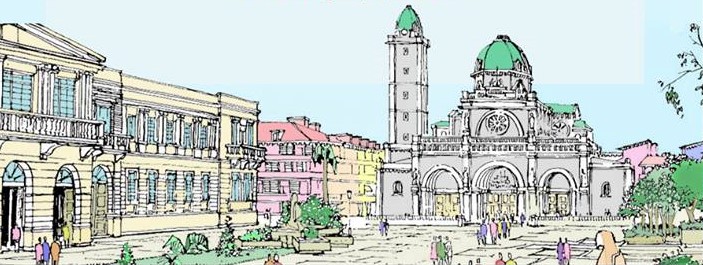
No actual sketch of Manila Cathedral (III) — during Lord Takayama’s time — has been found so far. There were eight (8) churches built on the same site, after destruction by earthquakes, fires or bombs. It appears they all looked alike. The present basilica is Manila Cathedral (VIII).
◘ ||| Though the Manila Cathedral (III) — a grand church with three naves and seven chapels — was blessed on Dec. 5, 1614, the Japanese refugees did not drop in ‘to say a little prayer.’ Perhaps some scaffolding still stood in the way. But in later days, all the Japanese Christian exiles attended Masses – not only at the Manila Cathedral – but in all six churches of Intramuros.
◘ ||| The Governor-General then placed his carriage at the disposal of Don Justo to bring him, his wife Doña Justa ‘Shino’ Takayama, his daughter Lucia Yokoyama and his five grandsons to the Colegio San Jose (in the Jesuit compound now occupied by Pamantasan ng Lungsod ng Maynila.). Don Juan Ronquillo, with a guard of soldiers and an escort of noble persons, accompanied the carriage. Such a large crowd turned out to see the entourage that it was difficult to pass through the throng desirous of showing honor to the exiles. On its way to the Jesuit College, the cortege passed by San Agustin Church, where the bells were rung, and the clergy came to the doors, and music of various kinds greeted the Japanese.
At the San Agustin Chuch, Intramuros, Manila
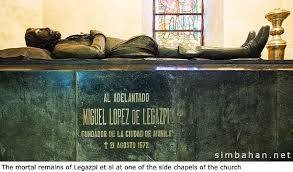
Japanese pilgrims may want to visit the Tomb of Legazpi – at the ‘Capilla de Legazpi’ to the left of the Main Altar of San Agustin Church. The tomb of El Adelantado, the Spanish Governor-General Miguel Lopez de Legazpi (1502-1572), who died 43 years earlier, was the inspiration for Lord Takayama’s tomb – at the Jesuit Santa Ana Church (which was totalled by earthquakes in 1616-1625).
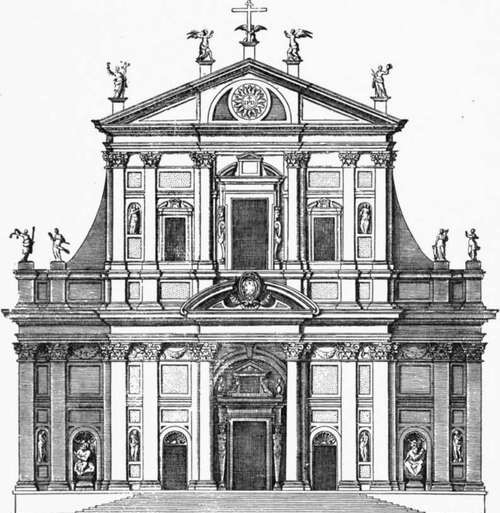
The Jesuit ‘Iglesia de Santa Ana’ (1590-1625), copied from the ‘Il Gesù Church’ (1568), the central church of the Jesuit order in Rome, was the centerpiece of the Jesuit compound in Intramuros, Manila
◘ ||| On reaching the Jesuit College, they visited the Santa Ana Church where they were met with the same festive sounds of bells and clarinets as in the other churches.
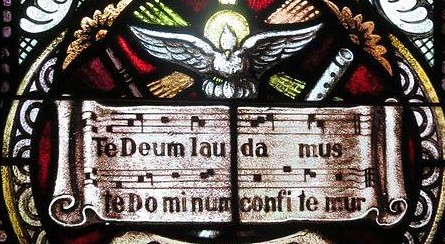
The ancient Latin hymn of praise “Te Deum Laudamus”
Here, the Japanese exiles chanted the ancient Latin hymn of praise “Te Deum Laudamus” to thank God for the exiles’ deliverance from a perilous voyage:“We praise thee, O God : we acknowledge thee to be the Lord. / All the earth doth worship thee : the Father everlasting. / To thee all Angels cry aloud : the Heavens, and all the Powers therein. / To thee Cherubim and Seraphim: continually do cry, Holy, Holy, Holy : Lord God of Hosts…”
As the “Te Deum” was the battle-hymn of “The 26 Martyrs of Nagasaki” (1597) as they, with their left ears lobbed off, were force-marched barefoot through the snow from Kyoto to Nagasaki — a distance of some 1,000 km — passing through Sakai, Osaka, Hyogo, Akashi, Himeji, Okayama, Mihara, Hiroshima, Shimonoseki, Kokura, Shigashima, Hakata, Tokitsu, and finally, Nishizaka (Nagasaki) — which the martyrs (including the Franciscan missionary, St. Pedro Bautista, of San Francisco del Monte, Manila) covered in 27 days – it may be presumed that “Takayama’s 350,” who were all living on the edge of martyrdom, knew the Latin hymn by heart.
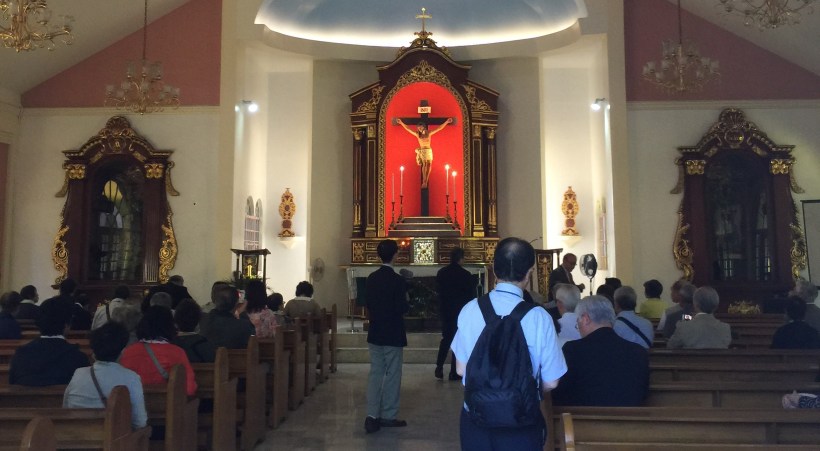
PLM University Chapel — consecrated by Manila Archbishop Jaime Cardinal Sin on Dec. 17, 1990 — was built in the Jesuit compound where Blessed Takayama died — and was buried.
◘ ||| From the Jesuits’ Santa Ana Church, the ‘350 Japanese Christian exiles’ were conducted to the Jesuit refectory where they had their first meal since landing, and afterwards shown to some good houses near the Jesuit College which had been prepared for them. Everyone co-operated to show honor to the exiles.
◘ ||| The earthquake-ravaged Jesuit-owned Santa Ana Church, now the site of Pamantasan ng Maynila [City University of Manila] – was where the original tomb of Takayama was located. PLM has erected the PLM University Chapel there, which Manila Archbishop Jaime Cardinal Sin inaugurated in 1995.
One Japanese acquaintance of Lord Takayama visited him in Intramuros. The meeting was held here in the garden adjacent to the San Agustin Church
◘ ||| San Agustin Church — The Inner Court Garden is where Lord Takayama met with Japanese visitors bringing news from Japan.
One of four cannons pointed at Dilao settlement — in the area now occupied by Manila City Hall
◘ |||(OPTIONAL) The Bastion de San Francisco de Dilao (at the Muralla), whose four cannons were pointed at the Japanese settlement – showing that the cannons were aimed directly at the Manila City Hall, which was the original location of the Dilao community in 1592, when it was designated for Manila Japanese residents.
San Marcelino Church — site of the original ‘nihon-machi’ of Japanese transients (not the Japanese Christian exiles).
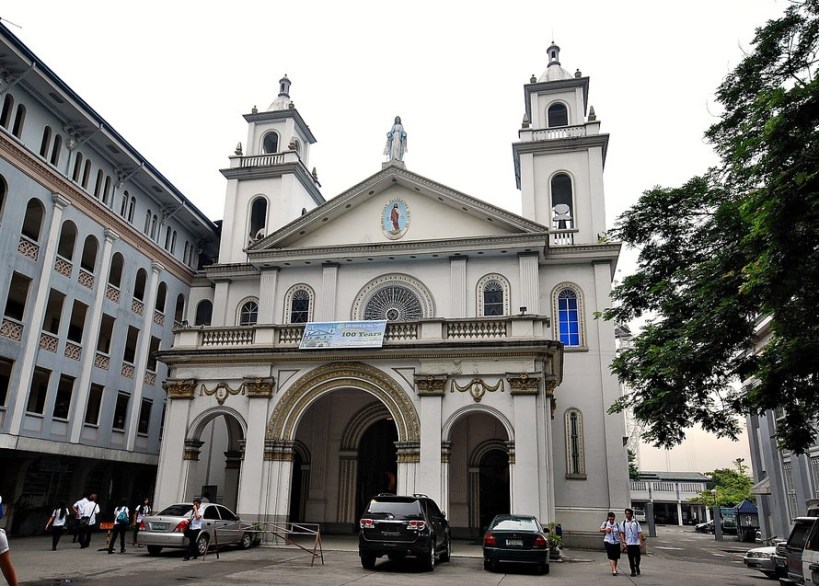
◘ |||(OPTIONAL) San Marcelino Church (St. Vincent de Paul Church) where a Memorial Mass for Takayama Ukon was celebrated on Sept. 20, 1942 by Osaka Bishop Paul Yoshigoro Taguchi, with Philippine government officials in attendance.
Fr. Toru Albert Nishimoto, CSsR, was instrumental in securing the permission of the Vincentian Fathers for the erection of this Japanese Christian marker.
At the side of the church is a marker (in the form of a Cross) commissioned by Ryohei Fujimoto, from Kyoto, to commemorate the first Japanese nihon-machi in Dilao. This marker was inaugurated on April 25, 2002 by Manila Mayor Jose “Lito” Atienza (r. 1998-2007).
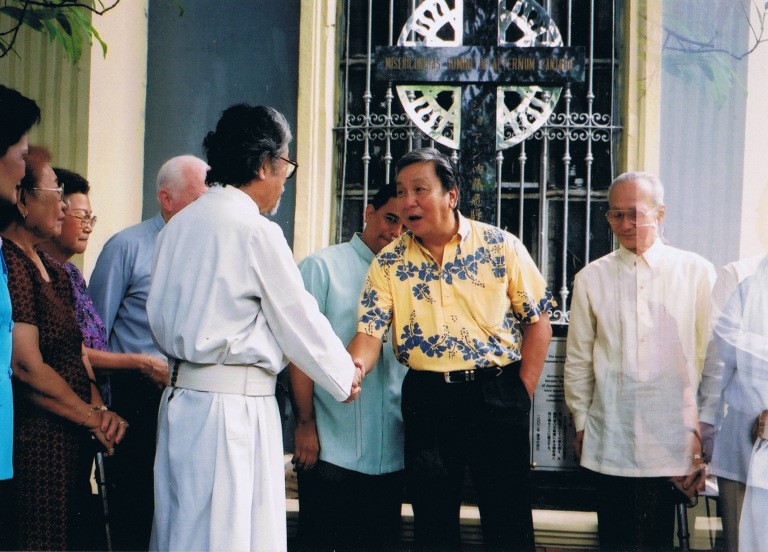
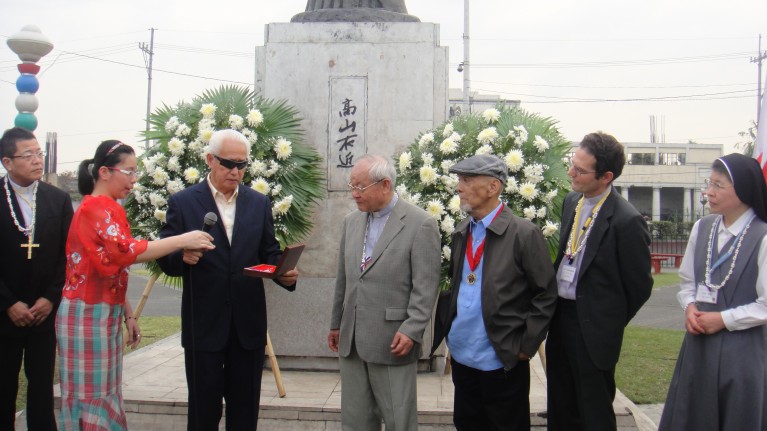
◘ ||| The center of all Takayama pilgrimages since 1977 was the Takayama Memorial that was the centerpiece of the Philippines-Japan Friendship Park at Plaza Dilao, certifiably the area where the fourth Japanese settlement (originally established in 1592) was relocated in 1764.
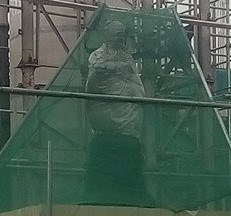
But in 2018, the Takayama Memorial is currently inaccessible as major infrastructure construction (Skyway-3 project) proceeds behind the statue. It will take two more years before the Skyway project is completed — and the status of the Takayama Memorial is clarified.
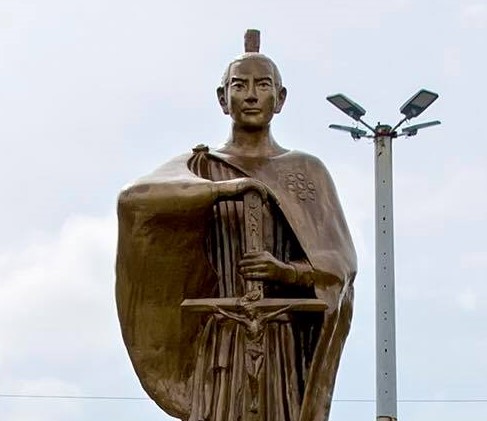
◘ ||| The Takayama Memorial, inaugurated Nov. 17, 1977 at the Philippines-Japan Friendship Park at Plaza Dilao, Paco, Manila. The bronze statue was made by the Japanese convert Johannes Masaaki Nishimori. Three other ‘twins’ of this statue, cast from the same mold, stand in Takatsuki, Takaoka and Shodoshima, Japan.
The Takayama Memorial was the centerpiece of the Philippines-Japan Friendship Park (est. 1977), but has now been ‘eclipsed’ by the ongoing construction of the MP-3 Skyway.
◘ ||| But work for ‘Skyway-3’ is currently going on in the Plaza Dilao area. The situation will not clear up for another two years.
In 2018, the Takayama statue at Plaza Dilao is ‘caged’ in steel and wiremesh.
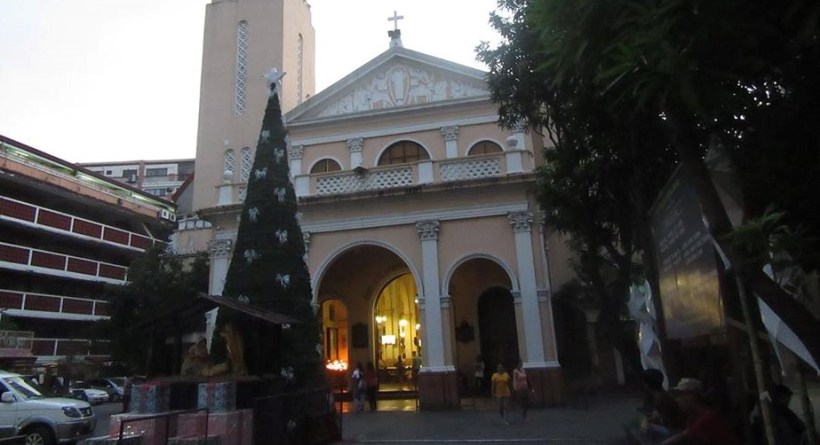
◘ ||| Instead of the ‘mothballed’ Takayama Memorial, visit the Paco Catholic Church, which has the only altar-statue (so far) of Blessed Justo Takayama in the Philippines. The Paco Catholic Church (San Fernando de Dilao Parish Church) ministered to a Japanese community of 3,000 in the 1610s. The first statue of Blessed Takayama (donated by the family of Dr. Ernesto A. de Pedro, Takayama Trustee) was enshrined here on Dec. 21, 2017 — exactly 403 years after Ukon’s arrival in Manila.
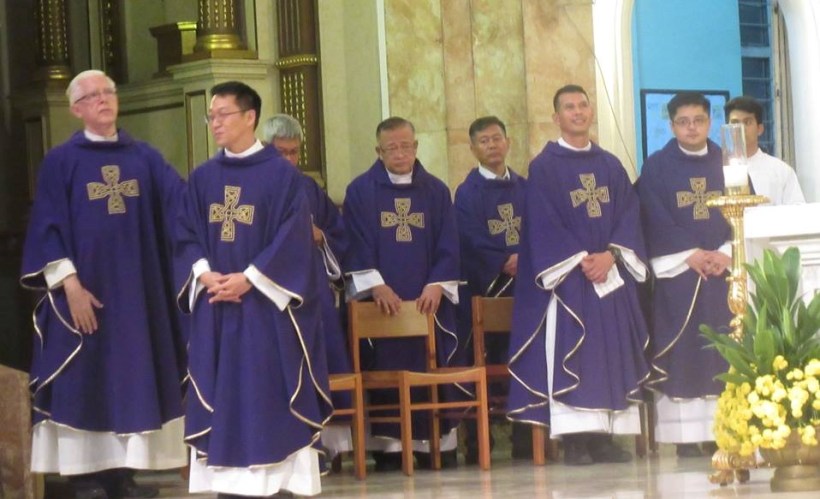
The San Fernando de Dilao Parish Church in Paco, Manila The Takayama Thanksgiving Mass was celebrated by Rev. Msgr. Rolando dela Cruz, Paco parish priest — with seven priests from the Philippines, Japan, Indonesia and Belgium concelebrating.
◘ ||| The UST Chapel (site of the annual Takayama Memorial Mass since 1987); site where one of the FOUR Japanese seminarians (from the Imperial Japanese Army’s Catholic Unit) who enrolled at the UST Central Seminary during World War II, was ordained a priest on January 5, 1945; where three Popes – Pope Paul VI (1970), St. Pope John Paul II (1981, 1995) and Pope Francis (2015) — have celebrated Masses.
Takayama Memorial at the entrance of the UST Graduate School. With the Takayama Memorial at Plaza Dilao “in mothballs,” this is the only public memorial of Takayama in Manila in 2018.
◘ ||| The Thomas Aquinas Research Center (also at UST), at whose entrance a Takayama statue stands. The statue, which had been the centerpiece of a now-defunct ‘Takayama Garden Restaurant’ (open August 1985-February 2002) in Greenhills, San Juan City was donated to UST by the De Mesa Sisters – Erlinda de Mesa-Yap, Diana de Mesa-Santamaria, and Ruby de Mesa-Borja — who were the co-proprietors of the three-branch chain.
(LUNCH BREAK: After memento photographs are taken at the Memorial — in pre-Skyway-3 days — the Tour breaks off for lunch at the Philippine Columbian Clubhouse, which serves a great menu of Filipino dishes.)
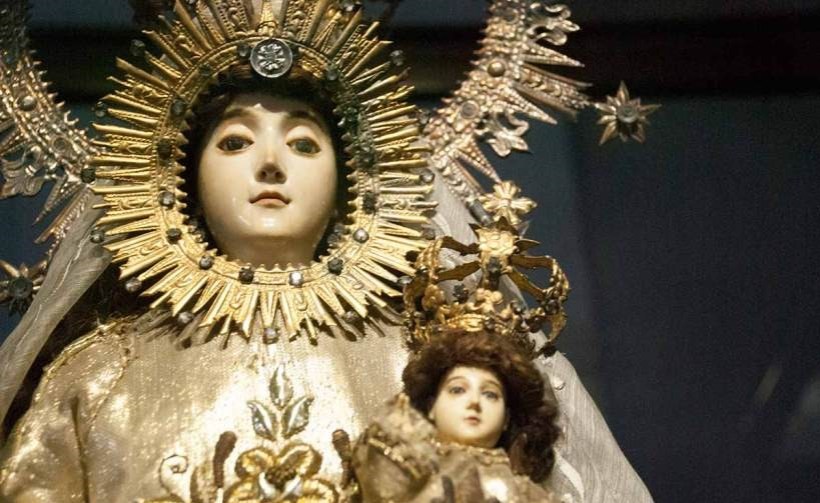
The famous Marian icon “La Japona” was brought to Satsuma, Japan on June 1, 1602 by the first Dominican missionaries. The statue was ‘extracted’ from the soon-to-be-demolished Santo Domingo Church in Nagasaki in 1614 — and entrusted to the care of Lord Justo Takayama during the voyage of exile to Manila.
◘ ||| Visit to the statue of the Our Lady of the Holy Rosary (“La Japona”) which was “rescued” and brought to Manila from Our Lady of the Holy Rosary Church in Nagasaki by Lord Takayama and is now enshrined as one of three iconic images of Our Lady of the Holy Rosary – (La Naval; La Mexicana, and La Japona) — at the Santo Domingo Church in Quezon City.
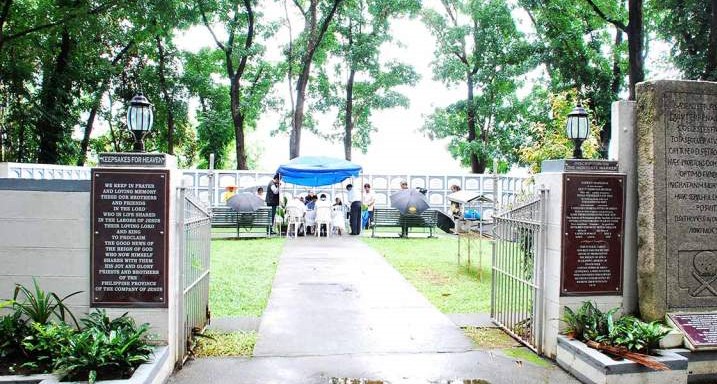
The entrance to the Jesuit Cemetery at the Sacred Heart Novitiate (est. 1932) in Novaliches, Quezon City.
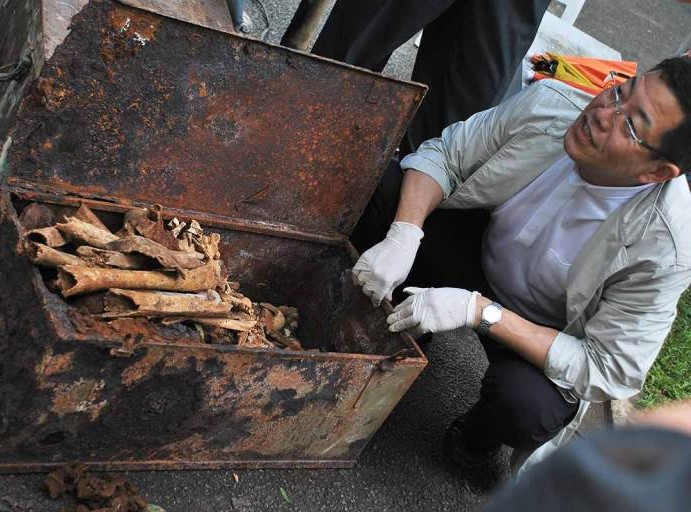
◘ |||(OPTIONAL) — A side trip to Takayama’s putative gravesite at the Jesuit Cemetery at the Sacred Heart Novitiate in Novaliches, Quezon City, where the remains of Jesuit niches (including presumably the bones of Lord Ukon Takayama and Lord Tocuan Naito) at the bombed-out San Ignacio (II) Church in Intramuros were transferred in December 1945.
Kyoto Bishop Paul Yoshinao Otsuka, Chairman of the CBC/Japan’s Commission for the Promotion of Saints, inspects US Army ammunition box containing boners collected from the Jesuits’ San Ignacio (II) Church in Intramuros
After bringing back to Japan in 2012 a number of bones from the two putative crypts, Kyoto Bishop Paul Yoshinao Otsuka (b. 1954- ), Chairman of the CBCJ Committee for the Promotion of Saints, concluded they could not make a definite determination – if indeed Takayama’s bones were among the remains in the crypts. But many Japanese pilgrims still opt to visit the Novaliches Jesuit Cemetery.)
For over 400 years, the Jesuit/PLM Compound in Intramuros has been the educational center of ‘Old Manila.’ Today, the Pamantasan ng Lungsod ng Maynila (PLM) is a City of Manila-funded scholars’ university — no tuition fees for students — attracting the best and brightest graduates from public schools.
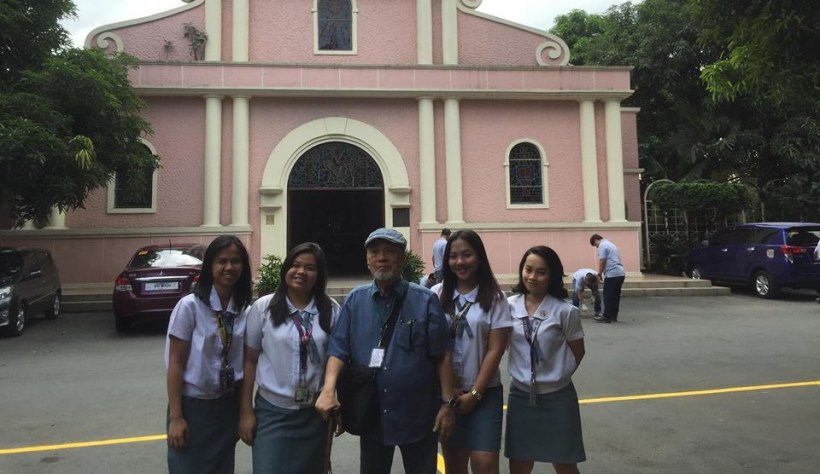
◘ |||Note to Japanese Pilgrims and their Tour Coordinators: PLM is a public university with a ‘gated’ campus. You do not walk in — unannounced. Proper representations must be made beforehand with PLM authorities to visit the PLM University Chapel — which is for the use of its own campus residents.
On Feb. 3, 2018, the first 60 Takayama Pilgrims from Japan visited the old Jesuit compound where the ‘Kirishitan Samurai’ Justo Takayama died on Feb. 3, 1615. For the first time, they trod on ground where Blessed Takayama (1552-1615) spent the last 44 days of his life. (Photo by Robert Queddeng)The PLM University Chapel — the religious center of the PLM campus — stands in the Jesuit Compound where Lord Justo Takayama died on Feb. 3, 1615. It was also in this compound where he was buried. (Photo by Yuya Cruz, Ars Dream Manila.)
◘ ||| Now that — after 403 years — Japanese Pilgrims have ‘discovered’ the PLM University Chapel, this will be an important pilgrimage destination — with the permission of the PLM University Regents. It was ‘hallowed ground’ for the 60-man Takayama Pilgrim Group, led by two Japanese Archbishops, four Bishops, and six Priests who attended the celebration of the First Feastday of Blessed Takayama on Feb. 3, 2018.
To Japanese pilgrims making this tour, we present BRONZE MEDALLIONS with the legend: “IN THE FOOTSTEPS OF / JUSTUS UKON TAKAYAMA.”◘
Dr. ERNESTO A. DE PEDRO
Managing Trustee
Lord Takayama Jubilee Foundation


 The first mosque named “Mariam, Umm Eisa (Mary, Jesus’ Mother) Mosque.”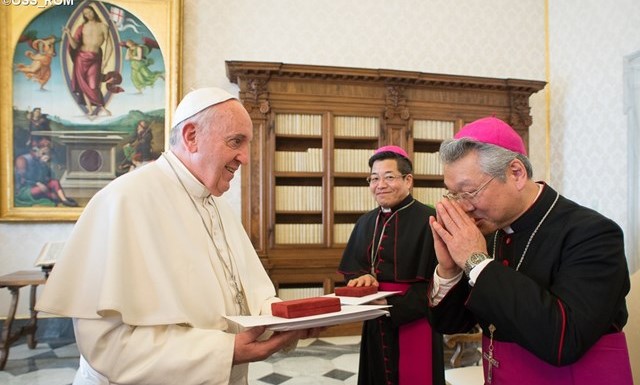


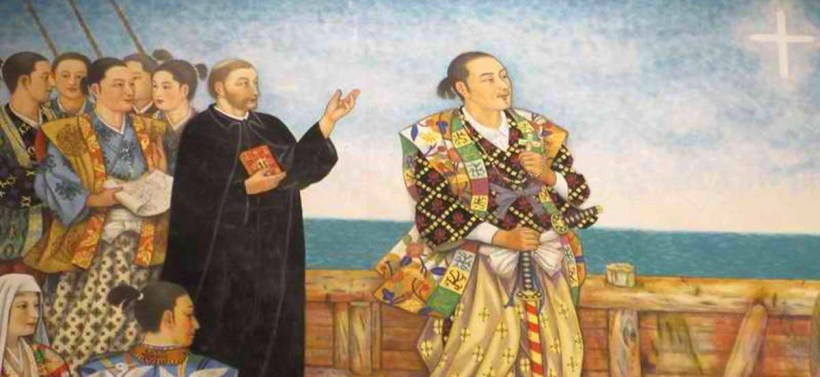

 Blessed Justo Takayama Ukon