►Following the end of World War II, an Urakami-born Trappist priest, Father Kaemon Noguchi (†2001), visited the ruins of the destroyed Urakami Cathedral. He wished to find something in the rubble that he could take as a memento, but could not find anything suitable. He stopped and prayed for a blessing.
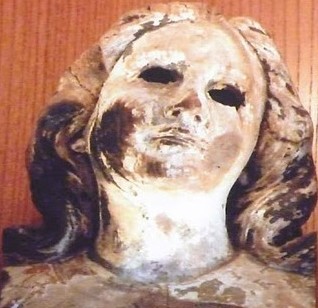
When he opened his eyes, he saw the charred face of a wooden statue of the Virgin Mary, looking at him with a “sad and familiar” regard. The priest immediately recognized that it was the head of the statue of the Immaculate Conception placed over the main altar of the cathedral.
Wood Carving — Based on Murillo Painting
The original Marian statue, carved from wood, was brought to Urakami Cathedral in the 1930s from Italy This image is based on the painting by the Spanish painter, Bartoleme Esteban Murillo (1618-1682) of the Immaculate Conception motif. It stood two meters tall.
This was the statue that he had seen regularly as a child and before which he had prayed for guidance and protection and for his vocation, the statue he had never forgotten even after entering the monastery.
The Trappist priest brought the burnt head of the statue back to his monastery in Hokkaido and kept it in his room, praying in front of it. He finally returned it to Urakami Cathedral when he attended a ceremony held there to mark the 30th anniversary of the atomic bombing.
A Return to Urakami Cathedral
On the occasion of the 60th anniversary of the bombing, the statue, which has come to be called “Hibaku no Maria” (‘Atomic-Bombed Mary’), was installed in a newly-erected small chapel at the cathedral.
Five years later, in 2010, Hibaku-no Maria accompanied Archbishop Mitsuaki Takami of Nagasaki on his world peace pilgrimages to the Vatican and Spain, where the head was presented at a memorial ceremony held for air raid victims in Guernica.
The statue was then taken to the United Nations in New York in time for the Non-Proliferation Treaty review conference.#
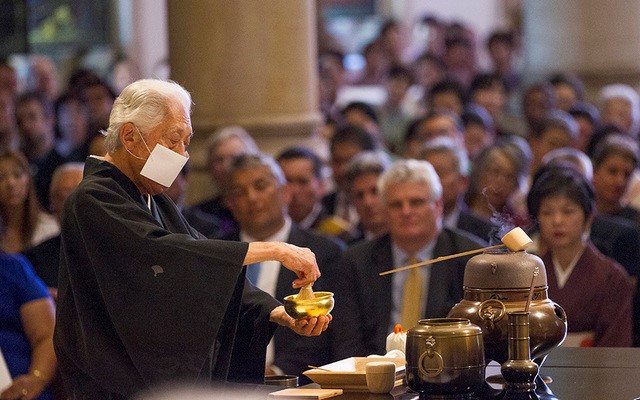
Could Lord Takayama – a.k.a. Minami-no-Bô TAKAYAMA Hida no-kami – have shown the Manila-based religious missionary orders the refinements of the Japanese tea ceremony? Actually, there is no archival account, but there is a titillating anecdote. (Photos from Urasenke International.)
►When Lord Justo Ukon Takayama (1552-1615) arrived in Manila with 350 Japanese Christian exiles on Sunday, Dec. 21, 1614 — tea, coffee and ‘tsokolate’ were the hot drinks of choice in the Walled City. The Chinese traded and settled in the Philippines for hundreds of years before the Spaniards came, so tea was just another health drink, available by the kettle at the bazaars of the ‘Parian de los Sanglayes.’
Tea from China was being served in Manila like an everyday beverage. There was no ceremony like the Japanese developed.
Certainly, Lord Takayama was the first Japanese authority on the Japanese Tea Ceremony to arrive in Manila. But the Jesuit accounts did not contain any reference that Takayama had introduced the ceremony. It is unlikely that Takayama would have thought of the Manila Cathedral as a proper venue for such a cultural encounter.
Did Ukon Takayama Bring Utensils for the Japanese Tea Ceremony to Manila?
When Ukon Takayama bade goodbye in February 14, 1614 to Lord Toshinaga Maeda (1562-June 7, 1614) — who was uncertain whether Takayama would fight the Tokugawa deportation order – Maeda accepted the proffer of gold nuggets Ukon earned for the previous year, but declined the tea utensils which Takayama prized so much. Presumably, Ukon brought with him these utensils (and a supply of green tea) on his voyage to exile.
Sen no Rikyū, the leading teamaster of the regent Toyotomi Hideyoshi, is perhaps the best-known — and still revered — historical figure in tea ceremony. He followed his master Takeno Jōō‘s concept of ichi-go ichi-e, a philosophy that each meeting should be treasured, for it can never be reproduced. His teachings perfected many newly developed forms in architecture and gardens, art, and the full development of the “Way of Tea.” The principles he set forward — harmony (和 wa), respect (敬 kei), purity (清 sei), and tranquility (寂 jaku) — are still central to tea ceremony today.
Ukon Takayama was one of seven prized pupils of Sen no Rikyū (1522 – April 21, 1591), who is considered the historical figure with the most profound influence on the development of Chanoyu. Ukon, who is always included in the variable list of the celebrated Rikyushichitetsu (Rikyu’s Seven), was credited with refining the tea ceremony into a serene celebration, with ritual movements “almost like a Mass.” The spirit of the art of tea – characterized by the qualities of harmony, reverence, purity, and tranquility — found in Ukon Takayama its Christian transfiguration.
Japanese Tea Ceremony at the Manila Cathedral
During Cardinal Jaime Sin’s stewardship as Manila Archbishop (1974-2003), he permitted some Japanese teamasters from the Urasenke School to celebrate their tea ceremony at the Manila Cathedral – right in front of the main altar. They brought the story that Lord Takayama had been the first to celebrate the Japanese tea ceremony in Manila – at the Manila Cathedral itself.
The Japanese tea ceremony, also called the ‘Way of Tea,’ is a Japanese cultural activity involving the ceremonial preparation and presentation of matcha (抹茶), powdered green tea. In Japanese, it is called chanoyu (茶の湯) or sadō, chadō (茶道), while the manner in which it is performed, or the art of its performance, is called (o)temae ([お]手前; [お]点前). As demonstrated by Dr. Genshitsu Sen XV,15th Grand Master of the Urasenke Tea School at the Manila Cathedral, the elaborate and refined Japanese tea ceremony is meant to demonstrate respect through grace and good etiquette.
Since the 16th Century, the Japanese tradition of tea ceremony has aimed at attaining serenity through the sharing of a bowl of tea. Dr. Genshitsu Sen XV travels all over the world to promote his idea of achieving “Peace on Earth — Through a Bowl of Tea.” As he did at the Manila Cathedral, he conducted a formal tea offering service at St. Peter’s Roman Catholic Church in New York, in a prayer for World Peace. The church was filled with attendees, who joined with Dr. Sen in this solemn service praying for “Peace on Earth — Through a Bowl of Tea.”
He has participated in numerous other events focused on fostering peace, for instance in the United Nations (the Millennium Assembly in 2000, and the General Assembly in 2010) and in Pearl Harbor (Hawaii).
‘Corroborative Blog’?
I CHANCED upon a “corroborative” blog, “Adnilem’s Journey” <www.adnilemel.blogspot.com> by a Filipina resident of Japan. After two decades in Japan, she had finally decided to enroll in a class on the tea ceremony in 2009. The class was conducted by Prof. Shizuo Mochizuki of Urasenke International Association.
“At long last… after my 20 years stay here in Japan… I had the chance to attend the Japanese culture of CHADOU or known as tea ceremony class… The class is sponsored by Shizuoka City Association for Multicultural Exchange. Our class is lucky to have a good and humorous instructor, Prof. Shizuo Mochizuki of Urasenke International Association. In the course of the lecture on “Chadou,” Prof. Mochizuki discussed its history, philosophy and manners. He taught us that the “Chadou” (literally, “Way of Tea”) translation of tea ceremony is not proper. It should be “tea gathering.” Tea ceremony refers to the Buddist priests or monks who formally offer tea to the temple or shrine’s Buddha. Tea gathering is to enjoy the spirit of tea in a warm and relaxed atmosphere.
“Learning that I came from the Philippines, Prof. Shizuo Mochizuki told the class that he had been to Philippines with his tea associates and his memorable experience was at the Manila Cathedral where they were shown an antique feather brush used as one of the tools in tea preparation. It was presented to the church [Manila Cathedral] by a well-known Japanese Catholic tea master — Minami-no-Bô TAKAYAMAHida no-kami, better known as Takayama Ukon — who was exiled to Philippines in the old era.”
That anecdote would mean Lord Takayama Ukon – who was known in tea circles as Minami-no-Bô TAKAYAMAHida no-kami — had performed the tea ceremony for a select group during his 44-day sojourn in Manila. At the Manila Cathedral (III) itself.
A Sen-no-Rikyū Souvenir?
What sort of ‘antique feather brush’ was the Sen no Rikyū sovenir?
The ‘antique feather brush used as one of the tools in tea preparation’ belonging to Ukon Takayama is well-remembered in Japanese tea-circles. It had been given to Ukon as a gift from Sen no Rikyū.
Lord Takayama was credited with refining the tea ceremony into a serene celebration, with ritual movements “almost like a Mass.”
Could it be true? The Manila Cathedral of 1614 was the THIRD edifice on the site. The Manila Cathedral in post-war Manila is Cathedral No. 8. Could the tea implement have survived the transition from Manila Cathedral #3 (in 1614) to Cathedral #8 (during Cardinal Sin’s stewardship in 1974-2003)?#
The ‘fumi-e’ test was a periodic ritual — to find out who, in a village, was a Christian.
►To ferret out “Hidden Christians” and their sympathizers, the Tokugawa Shogunate (1603-1868) instituted the annual ‘fumi-e’ test in 1629.
As part of its aggressive campaign to find these hidden Kirishitans – and stamp out the Christian religion, the Tokugawa government required:
◘ All citizens to be registered as members of their local Buddhist temple.
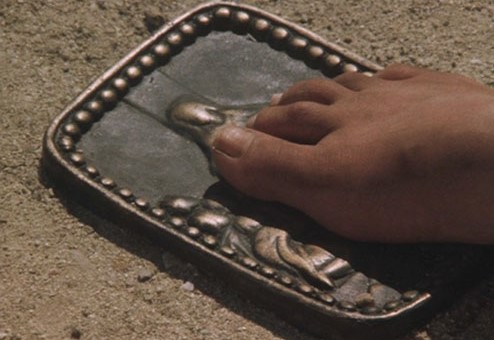
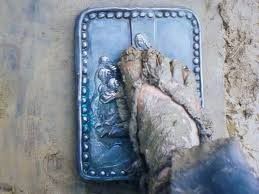
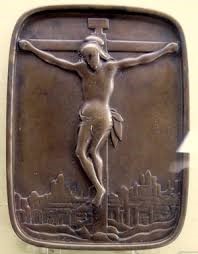
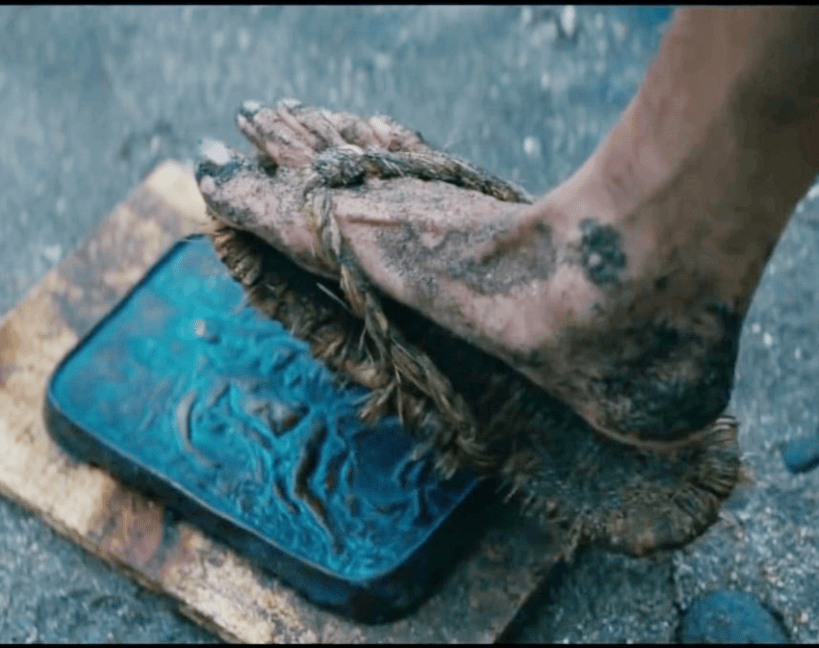
◘ They instituted the ‘fumi-e’ system — public rituals on a regular basis where everyone was ordered to trample on ‘fumi-e’ which were Christian images usually made of bronze depicting Jesus Christ or the Virgin Mary. This system, introduced in Nagasaki in 1629, continued until February 12, 1858.
Death for Refusal to Stomp on Christian Image
Anyone who refused to step on the ‘fumi-e’ (踏み絵 fumi “stepping-on” + e “picture”) was put to death. Catholics who refused to change their religion were tortured. As many of them still refused to abandon the religion, they were killed by the government. Many executions took place at Nagasaki’s Mount Unzen, where some were boiled in the hot springs. Many Kirishitans went bravely to their deaths this way – as, with no missionaries to forgive them of their sin – they preferred martyrdom over the sin of abandoning their faith.
Not all who trampled on the holy or venerated images were apostates. Some philosophized as they grappled with the test of faith. For instance, one ran home to wash the offending foot, boil the water, and drink it – to expiate the offense.
However, some Kirishitans complied and trampled the images while secretly holding onto the faith they had publicly renounced. The rite of contrition took on a new prominence among secret Kirishitans as a way of dealing with the guilt.
Ruthless Campaign Forces Christianity to be Practiced Underground – Even Without Priests
The persecution of Kirishitans was ruthless. Informers were rewarded, and whenever Kirishitans were discovered, even their neighbors were put to death. This forced the Kirishitan believers to go underground.
The use of the ‘fumi-e’ test was officially abandoned when ports opened to foreigners on April 13, 1856, but some remained in use until Christian teaching was placed under formal protection during the Meiji Period.
In modern Japanese literature, treading on the ‘fumi-e’ is a pivotal plot element of the novel ‘Silence‘ by Shusaku Endo.
Many theologians have tried to contemplate the role of the ‘fumi-e’ to Japanese Christians, some seeing the treading of the ‘fumi-e’ as a sign of the love and forgiveness of Jesus Christ.
Grim Toll for Japan’s Martyr Church
How many martyrs lost their lives because of the ‘fumi-e’ test? Nobody really knows. But the estimates reach as many as 30,000 martyrs.
‘Fumi-e’ were usually carved out of stone, but others were painted and some were wooden block prints. Many, if not all, of these works were made with care, and they reflected the high artistic standards of the Edo period.
There are very few existing ‘fumi-e,’ as most were simply thrown away or recycled into other uses. Some surviving examples were displayed by the Smithsonian Institution, in Washington DC, in their 2007 exhibition “Encompassing the Globe: Portugal and the World in the 16th and 17th Centuries.”
A Genuine ‘Fumi-e’ Is In Manila — At U.S.T.
A copy of the ‘fumi-e’ was presented to Dr. Ernesto A. de Pedro, Takayama Trustee, by the renowned Kyoto Catholic layman, Ryohei Fujimoto. This, in turn, has been presented to Rev. Fr. Rolando dela Rosa, OP, then Rector Magnificus of the University of Santo Tomas (UST). Father dela Rosa has kept the framed ‘fumi-e’ at his office at the UST Ecclesiastical Faculty.#
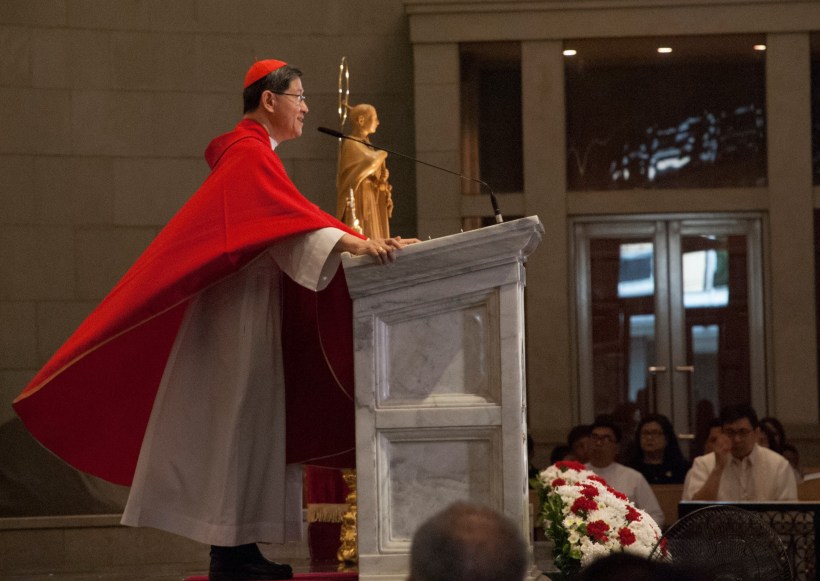
Cardinal Tagle extolling the heroic virtues of Blessed Takayama at Thanksgiving Mass celebrating his first Feastday. (Photo by Erwin M. de Pedro, Trustee, Blessed Justo Takayama Canonization Movement)
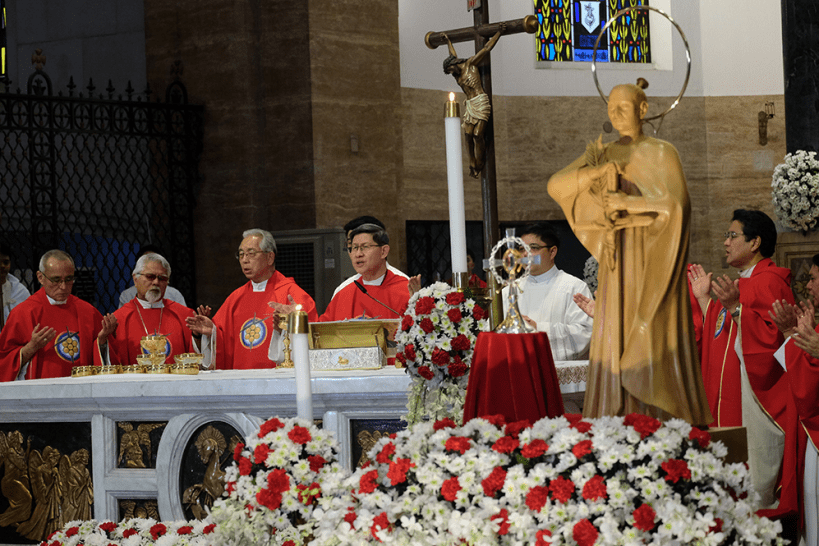
►The Thanksgiving Mass to mark Blessed Takayama’s first Feastday was concelebrated at the Manila Cathedral Basilica, where Ukon Takayama and his exiled family had worshipped in 1614-1615. Manila Archbishop Luis Antonio Cardinal Tagle was the lead celebrant – with three Archbishops, four Japanese Bishops and 25 Priests concelebrating.
* * * * *
MY DEAR BROTHERS and sisters in Christ, we give thanks and praise to God for this day. We thank God for giving us the opportunity to be one community so that we could be renewed by his word, by his presence, by his spirit and also, by the gift of holy men and women to the church and to society.
Today, we give thanks to God for the gift of Blessed Ukon Justo Takayama and we welcome all of you. We welcome especially our dear bishops from Japan and all the pilgrims from Japan. Welcome, welcome. Welcome to the Manila Cathedral, the Minor Basilica of the Immaculate Conception. We hope you will enjoy your stay in the Philippines. We hope also you will experience a renewal in discipleship in following Christ as we remember Blessed Ukon.
And to the Filipinos, we hope that we will receive Blessed Ukon Takayama who died as a martyr here in Manila. From Japan he blessed our soil, our land testimony of faith and of heroism. I’m sorry I cannot speak in Japanese, I cannot translate my homily into Japanese. But those of you who understand English maybe you can tell your friends later what I reflected upon.
Some people wonder whether Christians glorify suffering. The say how come you worship Jesus on the cross and you venerate the memory of martyrs those who have suffered? Are we making suffering some sort of a fashionable or glamorous thing? Is it an excuse for all the pain that the world experiences? I think the readings for the feast of Blessed Ukon gives us the Christian understanding. It is not in order to encourage inflicting suffering and pain on other people.
But we look to Jesus how did he look at suffering. And we see in the Gospel that Jesus has an integrated suffering within his mission. It is not accepting suffering in itself but in the context of mission, he finds meaning in suffering. His mission is to fulfill the will of the Father that humanity maybe saved. Jesus glorifies the Father by fulfilling his mission.
And if suffering is involved in fulfilling his mission He says yes. He is saying yes to the mission and if suffering is included in the mission, He will accept it too as He accepts His mission. And so it becomes a moment to glorify God. It is also a moment for him to be the seed of grain that falls to the earth and dies. It is a suffering with other people, by his suffering He becomes one with the earth, one with human beings, one with suffering creation.
His suffering is an act of solidarity. So, it is not just enjoying suffering. It is a suffering that has a meaning. It is a suffering for a mission. It is a suffering for the others. And so, it is not just a suffering it is giving of my life so that others may live. The world sees suffering but Jesus sees a gift of life. That’s a totally different perspective that’s why in the Eucharist we remember that; this is my body for you. This is my blood for you. May I know who among you here are parents with children?
Well you have a mission to be a good parent and part of the mission is a lot of suffering. You work hard not for yourself but for them. You get sick but still go to work. And you embrace that suffering because of your mission for them. Even if they are already grown up you are worried about them. You suffered daily because of your concerned for them. But it is because of your mission and because of your communion, solidarity with them. It is not useless. It is a gift of life for them, for others. So, it is not looking for suffering because we enjoy suffering. No, it is love. It is mission. It is gift of self that gives someone like Jesus the strength to suffer and die. With love you can suffer meaningfully and in the manner that gives life to others.
That’s why St. Paul in the first reading reminds us, when you suffer for God, when you suffer for others, when you suffer because of a mission, when you suffer because you’re giving yourselves out of love then, you are united with God. Some people when they suffer, they ask where is God? Has God abandoned me? But St. Paul says, nothing can separate us from the love of God. Jesus in the Gospel says, “Where I am I want you to be there too.” Jesus is loving us unto death and He wants us to be united with him. Nothing can separate us from the love of Christ who first love us and who loved us with all the sufferings that love can endure. So, why will we fear?
Have no fear. Love. And when you love you will have the strength to suffer People who love but are afraid of suffering do not know how to love. It is love for God, for others that gives someone the strength even to die. We are celebrating the love of Christ manifested to us in and through Blessed Ukon Justo Takayama. He knew the dangers. He was given a chance to turn away from Jesus and his faith. But he said no. I will keep my faith. I will remain faithful to Jesus. The world will say, Ukon, are you crazy? Why not save your life? Yes, he might be crazy. Crazy, because of love. He became foolish because he loved. And he paid the price of his love. But now his foolishness is wisdom for us. His weakness is strength for us. He’s telling all of us. Have no fear love. Love, love. And when you love, you know nothing can separate you from the strength that comes from Christ.
With Cardinal Tagle as lead celebrant, the Eucharistic Mass was concelebrated by three archbishops — ♦ Apostolic Nuncio, Archbishop Gabriele Giordano Caccia ♦ Nagasaki Archbishop Joseph Mitsuaki Takami, and ♦ Tokyo Archbishop Tarcisio Isao Kikuchi, SVD; four Japanese Bishops: ♦ Kyoto Bishop Paul Yoshinao Otsuka (Chair of the CBCJ Commission for the Promotion of Saints), ♦ Sapporo Bishop Bernard Taiji Katsuya, ♦ Kagoshima Bishop Paul Kenjiro Koriyama, and ♦ Naha Bishop Emeritus Berard Toshio Oshikawa, OFM — and 25 priests, six of them from Japan.#
We are invited to be martyrs, witnesses every day. We don’t need to wait for martyrdom by blood. Every day, in our state of life we are asked by Jesus, “be with me witness to my love”. Give yourself to your mission, for others. Be united with sufferings. Nothing should separate you from the love of Christ. When we were singing the “Gloria,” you hear a lot of bells and bells. That’s okay, because according to the historical records when Ukon and his family and companions landed here in Manila the bells of the churches were rang including the bells of Manila Cathedral. And the missionaries, the Spanish missionaries, the Jesuits and the Christians here welcomed him. Already at the time they considered him a martyr, a witness to the love that won’t say no even to the point of suffering. So, now we are happy that the church had recognized him and from Japan, Philippines he will give witness to the whole world to the universal church.
So let us rejoice, give thanks to God and let us be one. Through Ukon, through Lorenzo Ruiz — Japan and the Philippines will always be one. Let us give witness to the world of the power of love that comes from the heart of Jesus. Let us now pause and continue thanking God for the gift of Jesus, the gift of mission and the gift of the great martyrs like Blessed Ukon.#
Organized by Signis Philippines, Jesuit Communications Foundation, TV Maria, Catholic Media Network, Pauline Sisters, and Radio Veritas, the panel discussion also featured ♦ Bishop Mylo Hubert Vergara, chairman of the CBCP Commission on Social Communications, ♦ John Nery of the Philippine Daily Inquirer, and ♦ Howie Severino of GMA Network 7 as reactors. (Photo by Aida M. de Pedro).#
►Signis Philippines has spearheaded a forum open to all Catholic media practitioners to understand and appreciate the challenge of social media. New digital media have allowed everyone who has access the ability to publish their own content and choose what matters to them.
They have considerably changed journalism and the public space where information is derived.
How can church groups use these digital platforms to spread ‘The Word” Or their application in the promotion of Causes for Beatification and Canonization, for instance?
Keynote Address by Cardinal Tagle
The keynote address for the forum on “Catholic Media in Challenging Times” on Jan. 19, 2018, was delivered by Manila Archbishop Luis Antonio Cardinal Tagle at the Layforce Auditorium, San Carlos Seminary, Guadalupe in Makati City.
Manila Archbishop Luis Antonio Cardinal Tagle gives the keynote talk at a panel discussion on “Catholic Media in Challenging Times” at the Layforce Auditorium, San Carlos Seminary, Guadalupe, Makati City, Jan. 19, 2018.#
He recalled the prescient observations on mass communications media that were included in the records of Vatican Council II (convened as a means of spiritual renewal for the Catholic Church, 1962-1965), written in 1963 before the emergence of many of today’s digital media, evaluating the challenges, opportunities and pitfalls of new information technologies. While he praised social media and its great potential for evangelization, Cardinal Tagle observed that modern man’s immersion in the digital world could be leading him back to silence and reflection.
Tagle also conceded that while social media opens up opportunities for “solidarity, growing in unity” as well as the “deepening of faith through prayer and through formation,” constant digital exposure has a downside. “…There are also some threats. Being hooked constantly is the contemporary version of ‘noise.’ You don’t hear any noise, but you are constantly being bugged… It is the new form of noise, the lack of silence,” he explained partly in Filipino.
The prelate related how a priest revealed that whereas previously, the first thing he did in the morning was to pray, now it is to check his cellphone for messages.
Warnings from 1963
The Manila Cardinal pointed out how as early as 1963, the Second Vatican Council was already calling on the faithful, particularly parents, “to help the youth learn moderation and self-control in the use of the means of social communications.”
“Now they’re talking about addiction to the gadgets and it is a form of addiction…,” said Tagle.
But as algorithms that can’t tell fact from fake news took over the critical editorial role of deciding what people see in the new public conversation spaces, they fostered the rise of a disinformation ecosystem that distributed falsehood: from the simply misleading (due to the rush to print or post) to outright fabrication.
The forum laid bare the nature of disinformation and misinformation online. It also urged constant vigilance in an age of selfies, bots, fake accounts, and trolls. It sought to promote a better understanding of how social media and other digital platforms work – which even Filipino Bishops two generations older than millennials, had to learn from scratch, with the help of such mentors as the tech-savvy Pauline Sisters (Daughters of St. Paul).# — Based in part on CBCPNews
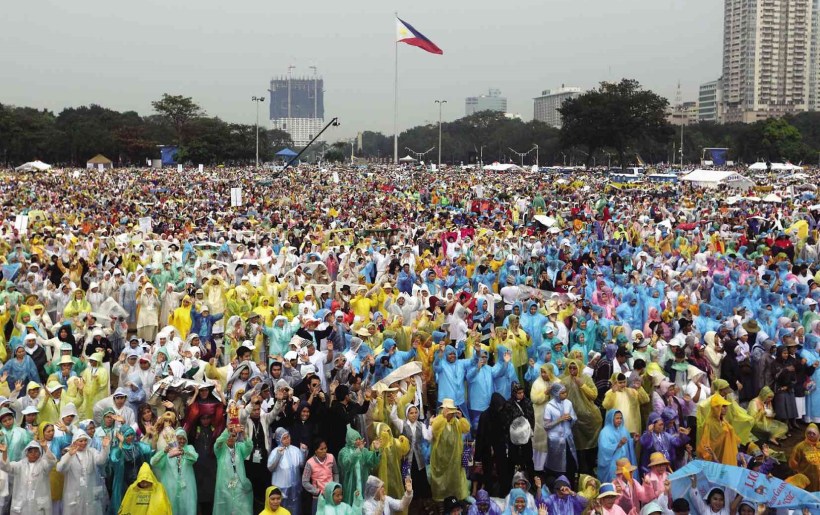
When a Pope visits the Philippines, he draws some six to seven million Filipinos for the final Mass at the Luneta — larger than anywhere else in the world. Pope Francis drew a crowd of up to seven million people, the largest ever for a papal event.
Vatican spokesman Fr. Federico Lombardi said the Office of the President told the Vatican that between six and seven million attended the Mass in Manila’s Rizal Park and surrounding areas. “We are not able to count all these people, obviously, or to verify this, but in any case, we have seen so many people that we believe that it is possible,” Lombardi shared with reporters.
“If this is true — and we think it is — this is the largest event in the history of the Popes,” he said, noting that an earlier pope, Pope John Paul, drew some five million to the same area in 1995.
With the terrible motor traffic in Manila, the threat of ill-willed elements, plus the rains — how do authorities, both Church and government, manage to pull off such an event?
Pope John Paul II’s helicopter flies 15 January 1995 over the huge crowd in Manila’s Luneta Park prior to celebrate an open-air mass to an estimated crowd of over two-million people gathered for the 10th World Youth Day congress. The pontiff was visiting from 11 to 21 January Philippines, Papua New Guinea, Australia and Sri Lanka. (it was his 63rd Internatinal Pastoral visit). AFP PHOTO JUN DAGMANG
Faced with tremendous logistical problems, they can never hope to field enough Portalets, nor enough plastic ponchos to ward off the rain – but they can count on an army of first-aid volunteers to be on the ready. It is a demonstration of group dynamics at its best.
Wearing a transparent yellow poncho over his white cassock, the Pope was driven through the ecstatic crowd in a “popemobile” modified from a jeepney, the most popular mode of transport in the Philippines which is based on a U.S. military vehicle used in World War II.
He stopped often along the route to kiss children and bless religious statues on the day the Philippines celebrates the feast of the infant Jesus. The faithful, also wearing ponchos, held up rosaries in a forest of uplifted arms as he passed by.
Some people had waited all night for gates to open at dawn.
Traditional Life-long Devotions
Without the drawing power of a Pope – how do Catholic crowds rate?
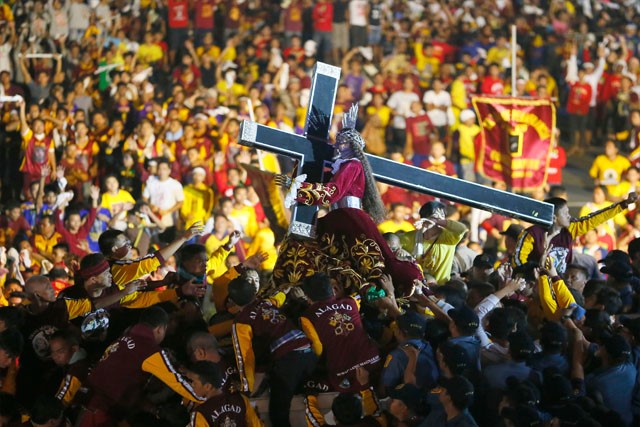
Catholic devotees wave white handkerchiefs as they prepare for an annual procession of the black image of Jesus Christ, known as the Black Nazarene, Saturday, Jan. 9, 2010 in Manila, Philippines. Hundreds of thousands of Filipino Catholic devotees seeking redemption from sins, miracle cures for illnesses and a better life poured into the streets of the Philippine capital in the procession to honor a centuries-old dark image of Jesus Christ. (AP Photo/Bullit Marquez)
The Procession of the Black Nazarene – on January 9 at Quiapo Church in Manila – draws some two million devotees. The Black Nazarene is a life-sized statue of Christ, carried through town by barefooted men yelling, “Viva Señor, while huge crowdd try to touch the statue. The statue was bought by a priest from Mexico and brought to Manila in 1606. Since 1787 the statue has been housed at Quiapo.
Huge crowds attend in the hope of being able to touch the statue, or its processional carriage, in the hopes of bringing good luck to themselves.
Local media reported that – at its height — the throngs reach an estimated five million people at its height. Because of the crowds, the procession, which is some 6.7 km long, takes around 20 hours to complete. The procession is expected to return to the statue’s home base, the Minor Basilica of the Black Nazarene, at around midnight local time.◘
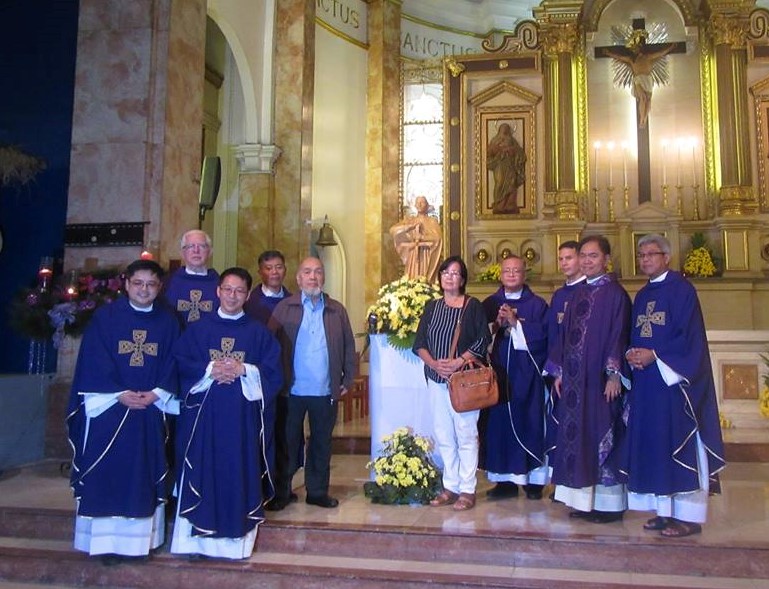
The Thanksgiving Mass was celebrated by Rev. Msgr. Rolando dela Cruz, Paco parish priest — with seven priests from four nations concelebrating.
(Photo credit: Robert Queddeng)
►For the first time in 403 years, Paco Parish Church (est. 1580) commemorated the Dec. 21, 1614 arrival of Justo Ucondono (Lord Justo Takayama Ukon) – and ‘350 Japanese Christian Exiles.’
A halo — symbolizing the holiness of Saints and Angels — was added by Msgr. R. dela Cruz.
The Thanksgiving Mass was concelebrated by Rev. Msgr. Rolando de la Cruz, parish priest – with seven other priests: ♦ Fr. Carlo del Rosario, parochial vicar; ♦ Fr. Iwao Ikegami, FMVD; ♦ Fr. Vincent Guinoo, FMVD; ♦ Fr. Antonius Harnoko, CICM (a Tagalog-speaking Indonesian missionary in Ofunato, Iwate Prefecture); ♦ Fr. Luke Moortgat, CICM; ♦ Fr. Celso Alcantara, and ♦ Fr. Wilfredo C. Talavera.
After the Mass, memento photos were taken of the eight concelebrants, with Dr. and Mrs. Ernesto A. de Pedro, Takayama Trustees. Members of mandated Catholic organizations similarly took souvenir photos. Then parishioners were allowed to take ‘selfies.’
The Japanese contingent of Manila-based nuns was made up of: Sr. Therese Fukatani, of the Congregation of Marie Auxiliatrice (MA); Sr. Kinue Maura, MA; and Sr. Ma. Therese Chiba, of the Handmaids of the Sacred Heart of Jesus (ACI), and lay Japanese: Masako Yamamoto; Mrs. Risa (Ishii) Peralejo, and Sakiko Ishida.
The Paco parishioners’ response was superb — and augurs well for the spread of devotion to Blessed Takayama de Manila.
The San Fernando de Dilao Parish in Paco counts with 27,000 parishioners (according to census data of 2010 — but Msgr. Dela Cruz estimates the number in 2017 at 95,000) — making Paco PARISH larger than any DIOCESE in Japan: ►Archbishop Joseph Mitsuaki Takami (Nagasaki – 67,729 Catholics), ►Bishop Paul Yoshinao Otsuka (Kyoto – 19,198), ►Bishop Bernard Taiji Katsuya (Sapporo – 17,993), ►Bishop Tarcisio Isao Kikuchi, SVD (Niigata – 7,711), ►Bishop Paul Kenjiro Koriyama (Kagoshima – 9,291), and ►Bishop Berard Toshio Oshikawa, OFM (Naha – 6,118). (It should be noted that the Paco Catholic School, adjacent to the church, has the largest student enrollment among Catholic schools in the Philippines.)
This altar-statue, presented to the Paco Catholic Church by the Prayer Warriors of Blessed Takayama, was carved by the celebrated Paete woodcarver Paloy Cagayat, and financed with contributions from the family and relatives of Dr. Ernesto A. de Pedro — who wanted the honor of producing the first Takayama statue in the Philippines.
It is the first Takayama altar statue with the “Palm of Martyrdom” – and a saintly halo. ◘
Dr. Ernesto A. de Pedro
Lord Takayama Jubilee Foundation
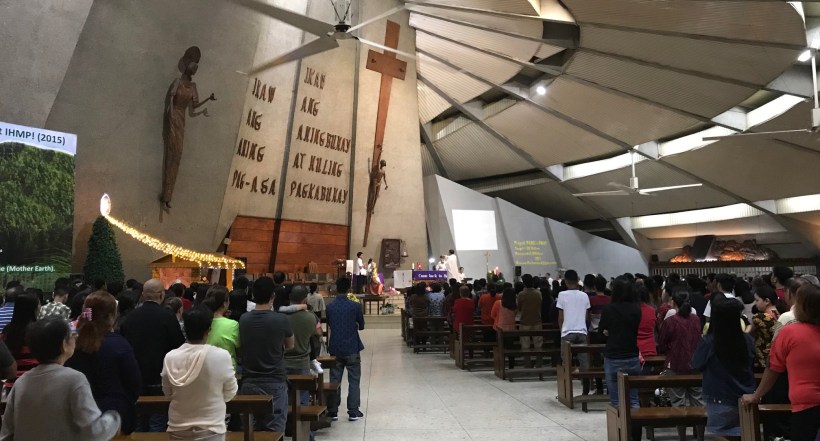
Holy Mass at Claret Church, Quezon City, Philippines
►With the Feastday of Blessed Justo Takayama de Manila included in the Catholic Church’s liturgical calendar on February 3 every year – may we request that photos of the celebration in your parish church (anywhere in the world) be shared with our Movement?
Send photos to our email address: blessedtakayama@gmail.com — If possible, please include the ♦ name of the priest who celebrated the Mass, and the ♦ name of the church and city.
We hope we can receive some photographs of the worldwide celebration of Blessed Takayama’s first feastday on February 3, 2018 — from churches in these top ten countries. ◘
Ó DEUS, que em sua maravilhosa Providência,
escolheu Justus Takayama Ukon
para ser promotor singular de seu Reino,
e testemunha intrépida da fé católica.
RECOMPENSA, nós vos suplicamos, seu zelo pela sua glória,
conceda-nos o que humildemente pedimos
por sua intercessão.
CONCEDE-NOS também que, seguindo seu exemplo,
possamos aceitar todas as dificuldades
por causa da nossa santa fé católica.
Por nosso Senhor Jesus Cristo. Amén.
►The rustic views of Takayama village are still there – four centuries later. The ancestral Takayama village is in the background.
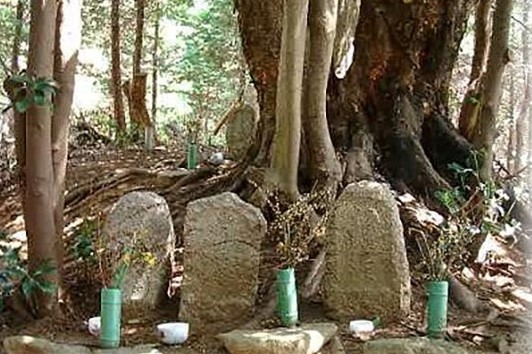
No wonder the mother of Blessed Justo Takayama Ukon — Maria Takayama — insisted on being buried in the old Takayama village — when she died in Kanazawa in 1596. The gravesite of Maria Takayama still draws domestic tourists today to the ancestral Takayama Village in Toyono-cho. (Photo from the office of Maria Leona D. Nepomuceno, of the Philippine Department of Tourism-Osaka)
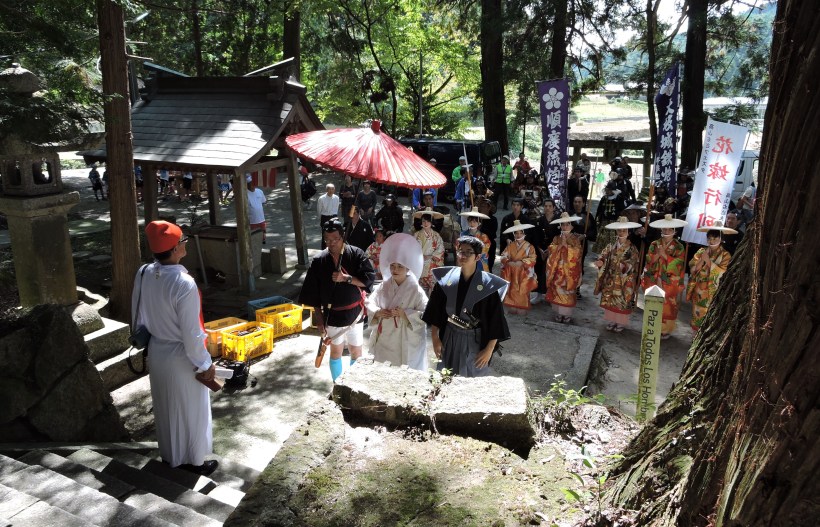
For this commemorative procession during the ‘Ukon Festival’ (Oct. 1, 2017), the villagers wear — NOT everyday street wear – but traditional apparel worn on special occasions.
Commemoration of Ukon’s wedding at the ‘Ukon Festival.’
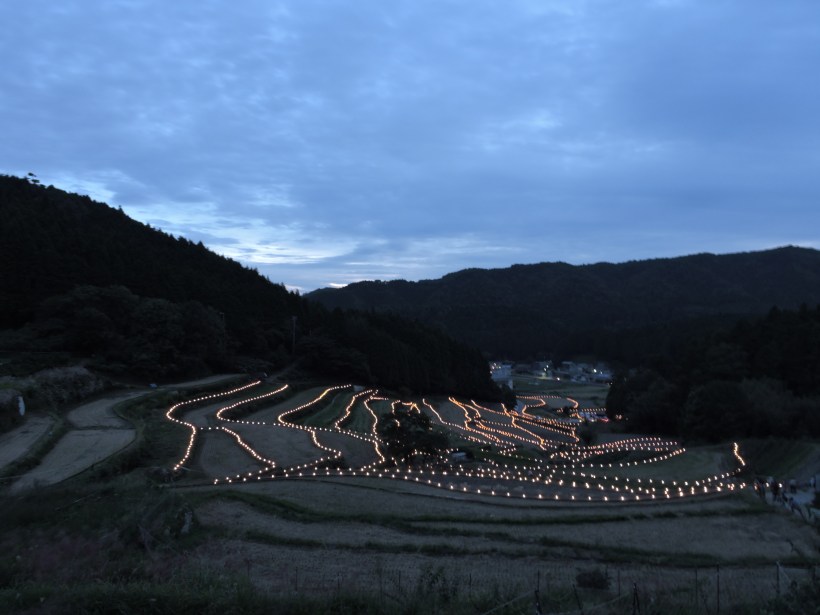
The terraced paddies of Takayama village at dusk
The photographs were shared by Mr. Takaki Ohnishi of the municipal government of Toyono-cho – which is also famous for a brew of ‘Sake’ wine labelled ‘Takayama’ — NOT after Ukon, but after the Takayama village. Mr. Ohnishi headed a delegation that brought a granite marker from Toyono-cho — to “add a stone” — to the Takayama Memorial at the Graduate School of the University of Santo Tomas (UST). ◘












 Blessed Justo Takayama Ukon