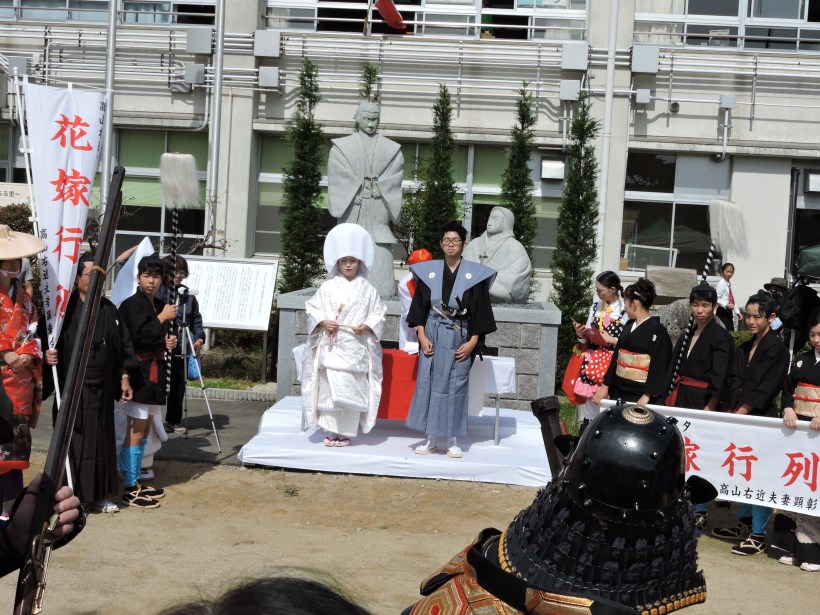
The granite statues of Lord Justo Ukon Takayama (born in Toyono-cho in 1552) and his Lady, Doña Justa (Japanese name: ‘Shino,’ a posthumous title) was built by donation by Toyono-cho inhabitants in 2016, to mark Ukon’s 400th death annniversary. The granite was mined from Takayama Village, in Toyono-cho – By Takaki Ohnishi
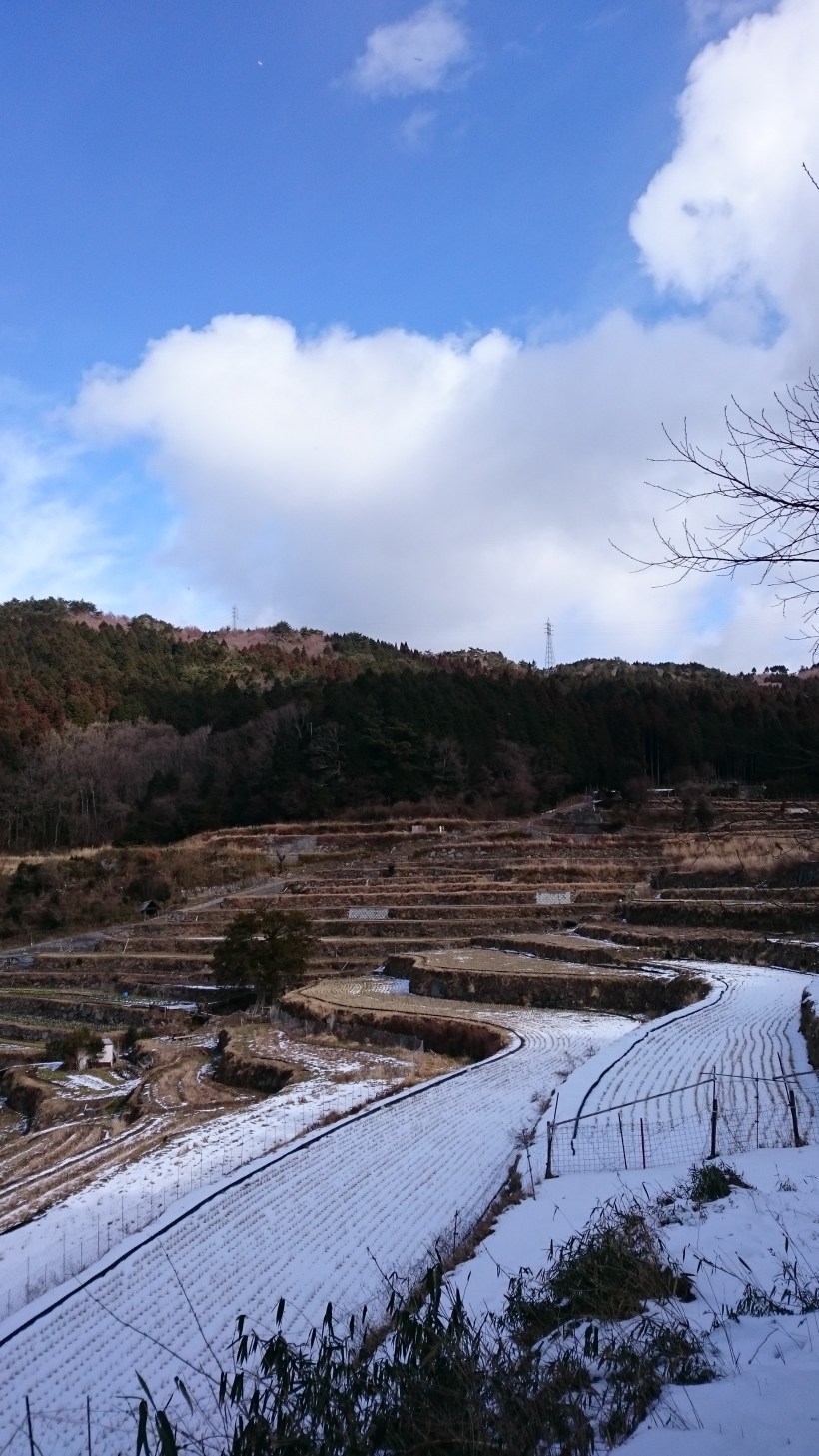
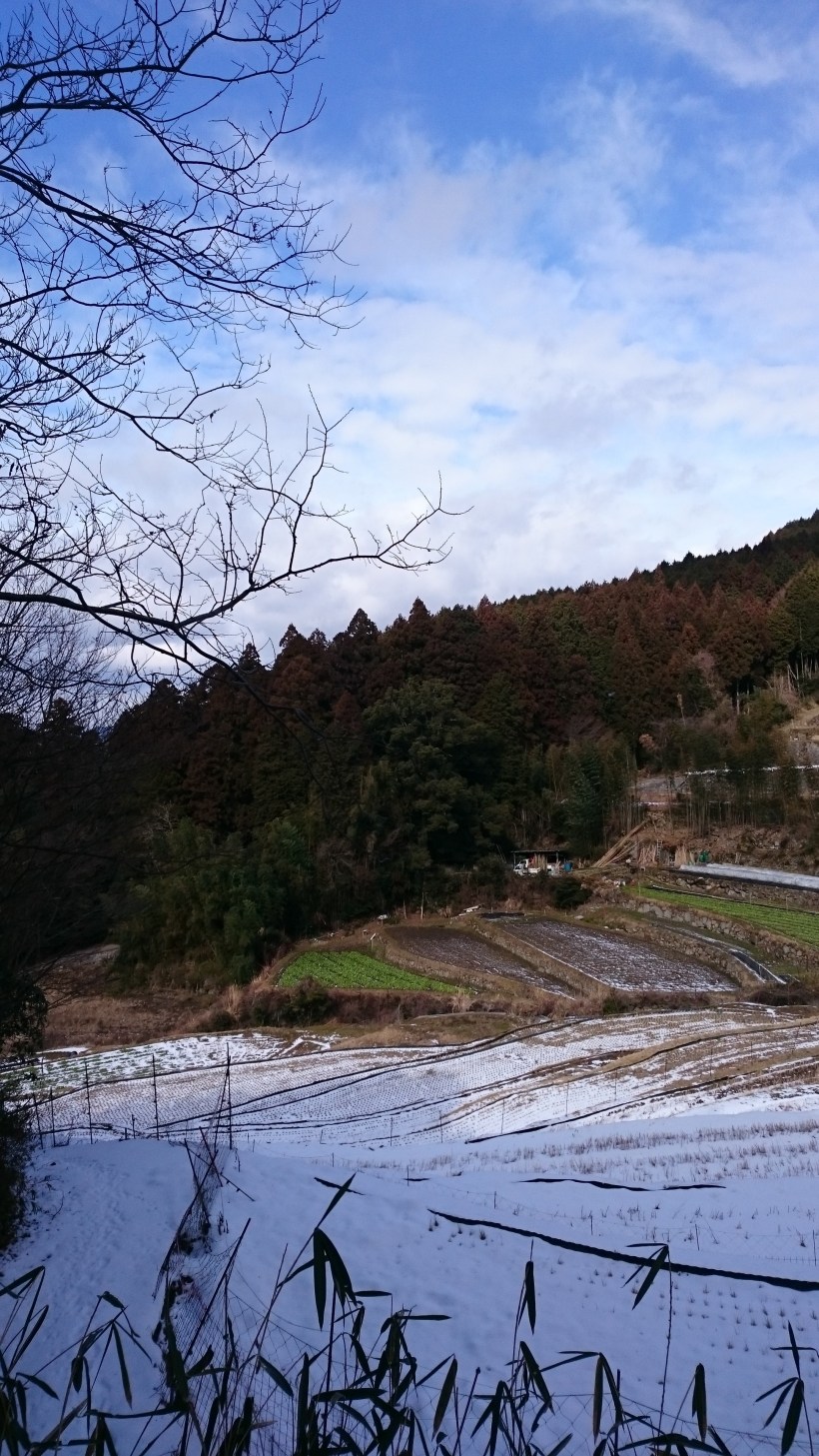
►These photographs offer sceneries of Ukon’s birthplace on Feb. 3, 2018 – 403rd death anniversary of Ukon — which the town wishes to share with Takayama devotees in the Philippines.
Tono-cho has, of course, no Catholic Church for a Memorial Mass. As in Takayama’s time, it has been 99.63% Shinto/Buddhist, but the town is very proud of their ‘Kirishitan Samurai’ who has been hailed as ‘the epitome of the Japanese spirit.’
In lieu of a Thanksgiving Mass – ‘as you are having at the Manila Cathedral’ — ‘we had a memorial Ukon musical performed by residents of Toyono on February 3 and 4.’
Toyono-cho on February 3 was ‘covered by some snow.’
These terraced paddies must have looked exactly like these some 400 years ago.
A stone marker claims that Ukon Takayama was born in Takayama Village in Toyono-cho, Osaka Prefecture.
In the far background, Takayama Village may be seen.
Takaki Ohnishi, Manager of the Agriculture, Forestry, Commerce, Industrial and Tourism Division, of the Toyono-cho Government, writes about the February environment in Toyono-cho:
‘Here in Toyono-cho, it gets very cold and snows quite often.
This climate makes vegetables sweet and ambrosial!’
* * * * *
Indeed! When Toyono-cho residents make a pilgrimage to Manila this April — to visit the places in Old Manila associated with Blessed Takayama — Trustees of Takayama will be waiting to welcome them!#
Dr. Ernesto A. de Pedro
Managing Trustee
Blessed Takayama Canonization Movement
First altar-statue of Blessed Takayama was enshrined at Paco Catholic Church (est. 1580) by Msgr. Rolando dela Cruz, Paco Parish Priest, on Dec. 21, 2017,
►The ‘Samurai of Christ,’ Justo Takayama, is the third Beatus (Blessed) of the Philippines, his adopted country. Under the rubrics of the Catholic Church, “where one dies, is where one is born to Heaven.” Thus, Blessed Takayama is a “Son of Manila.” He was proposed for sainthood by the Manila Archdiocese on Oct. 5, 1630 – the first Catholic of heroic virtue to be proposed as saint by Manila – and he was a Japanese layman!
After Takayama’s Cause for Beatification had lain dormant for 333 years at the Vatican, the Catholic Bishops’ Conference of Japan (CBCJ) offered in 1963 – on the sidelines of the Second Vatican Council (1962-1965) — to revive the ancient cause and do the spadework. With the Philippine Church not having a native Filipino canonized a Saint yet, Manila Archbishop Rufino Cardinal Santos (1908-1973) – the Philippines’ first Cardinal — seconded the Takayama Cause to the Church of Japan on April 24, 1963.
Cardinal Rufino Santos — the Philippines’ first Cardinal — at the Vatican in 1963
In 12 years, the CBCJ’s Historical Committee produced the necessary supporting historical documents, all 30 chapters, and submitted these to the Jesuit General Postulator — in loose form — in 1975. These lay dormant – unread — for 11 years.
In a fortuitous development – a ‘happy accident’ — Manila had a part in the final preparation of the Takayama ‘Positio’ when a Filipino layman, researching at the Vatican on the Japanese daimyo, Don Justo Ukondono, was asked by the Jesuit General Postulator to undertake the translation of the entire Takayama documents — written in German, Spanish, Portuguese, Latin, and Japanese — into English. When Prof. Ernesto A. de Pedro, of the UST Graduate School, completed this task in 1994, the Jesuit General Postulator, Fr. Paulo Molinari, SJ, acknowledged: “Thanks to your much appreciated collaboration, all the essential materials for this important ‘Cause’ are by now available.”
The 1994 ‘Positio’ on ‘Justus Takayama Ukon, Servus Dei’ (648p) was laser-printed by Dr. Ernesto A. de Pedro — and shipped directly to the Jesuit General Postulator.
That first ‘Positio’ proposed beatification for Takayama, as a Confessor (not as a Martyr). For the first time in Japanese church history, a candidate for sainthood was being proposed as a Confessor. (All previous Japanese candidates for sainthood were Martyrs.) Also, Takayama’s ‘Cause’ was also being promoted – for the first time in Japanese church history — on an individual basis, not as part of a group. All the previous 42 Japanese Saints and 383 Blessed were group martyrs.
Cardinal Sin endorsed the Beatification Cause of Don Justo Takayama at a Synod on Family he was attending in Rome
In Rome, attending a Synod on Family, Manila Archbishop Jaime Cardinal Sin endorsed the Cause of Beatification for the ‘Samurai of Christ,’ Justo Takayama.
The Jesuit General Postulator, Fr. Paulo Molinari, SJ, submitted the bookbound ‘Positio’ — “JustusTakayama Ukon, Servus Dei” (1994, 648p) — to the Congregation for the Causes of Saints (CCS). The Takayama ‘Positio’ was granted a “Nihil Obstat” on June 8, 1994, giving Takayama the title “Servant of God” — the first of three formal steps to Sainthood.
After surveying the path forward, the Japanese Bishops decided that a Cause of Martyrdom for the Servant of God, Justo Takayama, was the quicker pathway – not requiring a years-long examination of Takayama’s life and heroic virtues – going back to the day of his baptism at 12, through his many battles as a samurai-general, his record as a pillar of the early Church of Japan, and his death in Manila. They submitted that Takayama’s accumulated trials resulted in his death in Manila just 44 days after his arrival. A death by martyrdom.
Pope Francis issued a Decree of Martyrdom (Jan. 21, 2016) declaring Takayama as a “loyal Japanese layman, who was martyred in Manila in 1615.” The Japanese Bishops quickly shared the development with Manila and acknowledged the help given by the Philippine Church to this four-centuries old campaign to elevate Takayama to the honors of the altar: “With your help, we have realized our hope. We are deeply thankful for your help.”
Bypassing the prescribed second step – Venerable — Takayama was beatified on Feb. 7, 2017 in Osaka (the prefecture where Takayama was baptized) – as the 426th Japanese Martyr venerated in the Roman Catholic Church – and the third Blessed of the Philippine Church.
Archbishop Luis Antonio Cardinal Tagle of Manila was the only other Cardinal invited by the Church of Japan to join Cardinal Angelo Amato, SDB, Prefect of the Congregation of the Causes of Saints, at the Concelebrated Mass at the historic Takayama Beatification Rites.#
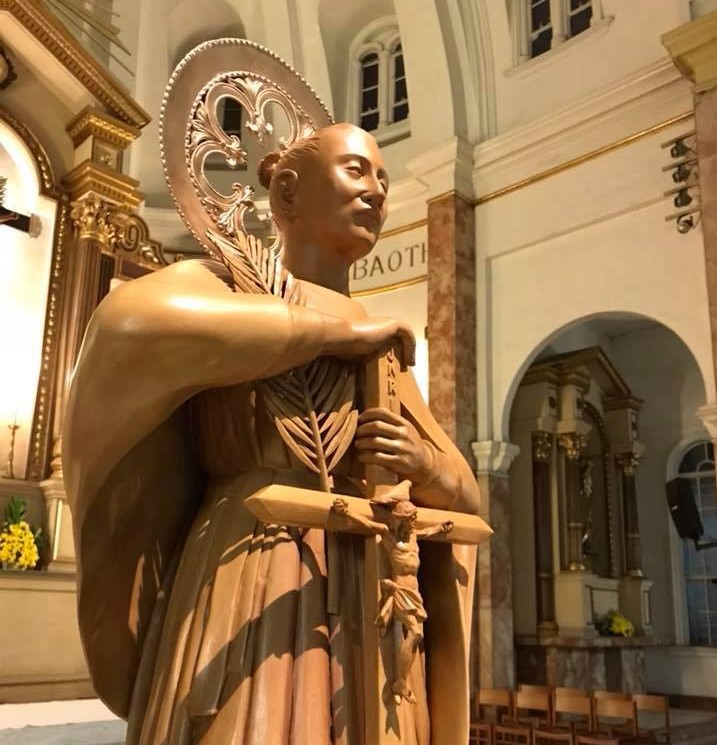
The first altar statue of Blessed Takayama, carved by Paete artist Paloy Cagayat, was installed at the Paco Catholic Church on Dec. 21, 2017 by Rev. Msgr. Rolando dela Cruz, Paco parish priest.
►”Błogosławiony Ukon Takayama pojawia się w momencie, gdy Kosciół w Japonii jest dotknięty kryzysem, atakowany, jak na całym świecie, przez globalną cywilizację relatywizmu moralnego i wieloznaczności ról i postaw (…) Banita wraca do kraju, w którym liczba chrześcijan jest znikoma – pisze dla KAI o. Zygmunt Kwiatkowski, jezuita.”
* * * * *
Outreach Through Takayama Website
A devotee of Blessed Takayama in Poland said he learned about the ‘Samurai of Christ’ through Polish newspapers and the Takayama website – <www.takayamaukon.com> — which is the only Takayama website in English. Aside from audiences in the Philippines, the United States and Japan — there’s some interest too in: ►Singapore; ►Australia; ►Hong Kong; ►Brazil; ►Poland; ►Canada and ►Romania. (These are the Top Ten countries visiting the Takayama website.)
Lord Takayama was a celebrated Christian Daimyo — who placed God above all else, offending his overlords who demanded loyalty over everyone else.
For the first celebration of the Feastday of Blessed Takayama – set in the Church’s liturgical calendar on February 3, Manila Archbishop Luis Antonio Cardinal Tagle and the Apostolic Nuncio, Archbishop Gabriele Giordano Caccia will concelebrate Mass at the Manila Cathedral on Saturday, Feb. 3, at 11:00 AM with other Filipino Bishops and clergy. Also on hand are: ►Archbishop Joseph Mitsuaki Takami (Nagasaki), ►Archbishop Tarcisio Isao Kikuchi, SVD (ex-Niigata, now Tokyo), ►Bishop Paul Yoshinao Otsuka (Kyoto), ►Bishop Bernard Taiji Katsuya (Sapporo), ►Bishop Paul Kenjiro Koriyama (Kagoshima), and ►Bishop Berard Toshio Oshikawa, OFM (Naha). (That’s ONE THIRD of Japan’s 18 Bishops.)
While earning acclaim as a valiant samurai-general, Lord Takayama was also a pillar of the early Church of Japan — builder of churches and seminaries across Japan.
In addition to the six Japanese prelates, a 60-man ‘Takayama Pilgrimage Group’ will be flying in from Japan – composed of six priests, Sisters and other ‘Consecrated Persons.’#
By Dr. Ernesto de Pedro
Managing Trustee
Blessed Justo Takayama Canonization Movement
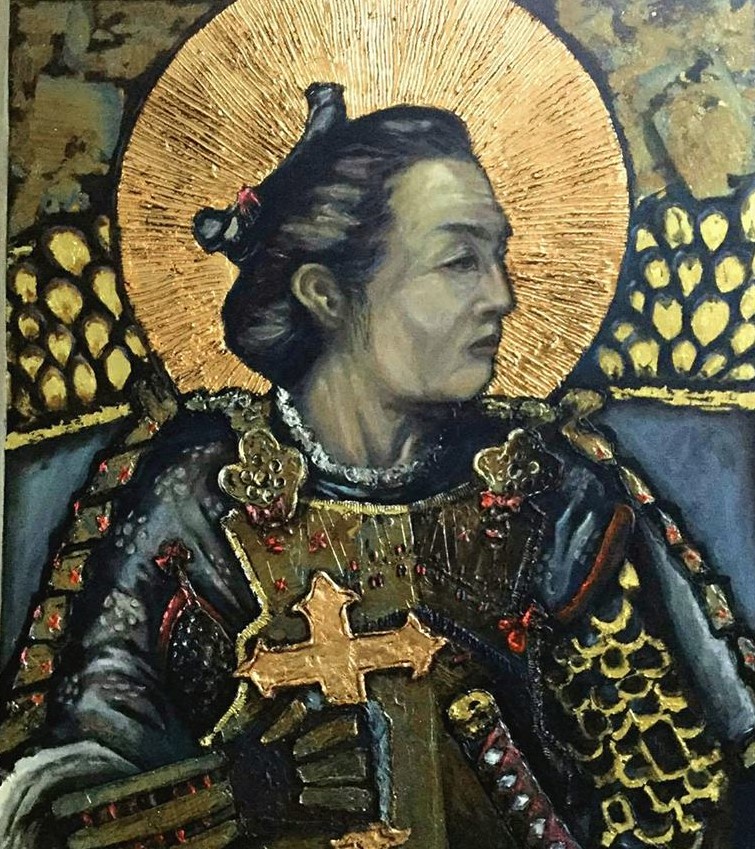
A painting of Blessed Takayama de Manila made in Japan by Filipino artist John Andrew Sustaita, of Real Catholic Art
►This painting of Blessed Justo Takayama was made by Texas-based John Andrew Sustaita, owner of Real Catholic Art. Note that the venerated Martyr wears a halo, but not the ‘Palm of Martyrdom.’
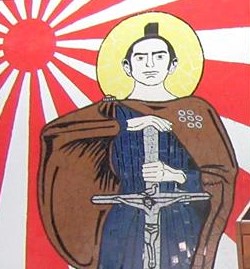
This poster/painting of Blessed Takayama was created by a team of U.S.T. Seminarians led by Elson Santos, who exhibited it during the Fourth Philippine Conference on New Evangelization (PCNE-4) on July 24-28, 2017 at the U.S.T. Campus.
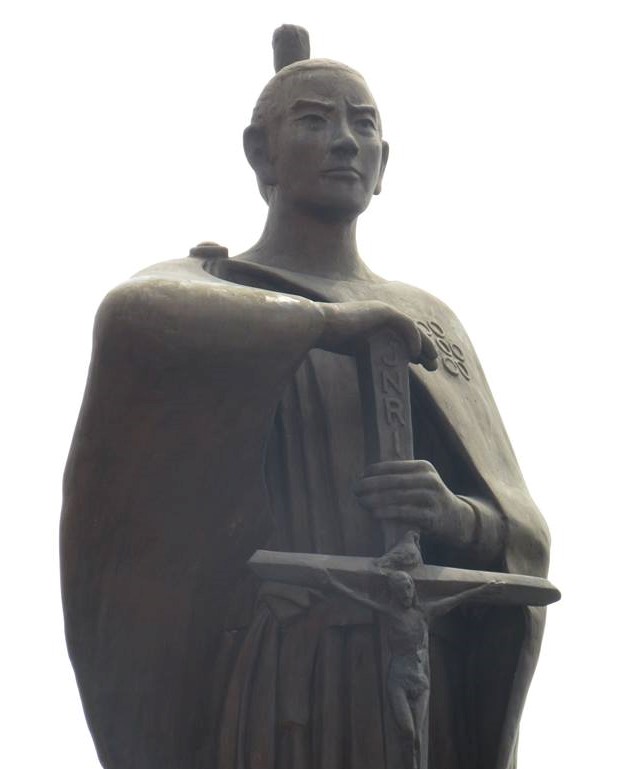
Manila Archbishop Luis Antonio Cardinal Tagle extols the importance of Blessed Takayama de Manila to the bilateral relations between Japan and the PhilippinesOn Feb. 7, 2017 — Beatification of Lord Takayama in Osaka — Photographer Robert Queddeng visited the Takayama Memorial at Plaza Dilao to take this memento picture. Since then, the statue has been wrapped in mufti and caged with a wire screen — as construction for Skyway-3 Overpass proceeds. By then, the statue had stood at Plaza Dilao for 40 years, collecting grime and dust from the street traffic.Different artists, different interpretations. Can your art group re-imagine this revered figure of Philippine-Japanese history? Email these to us.
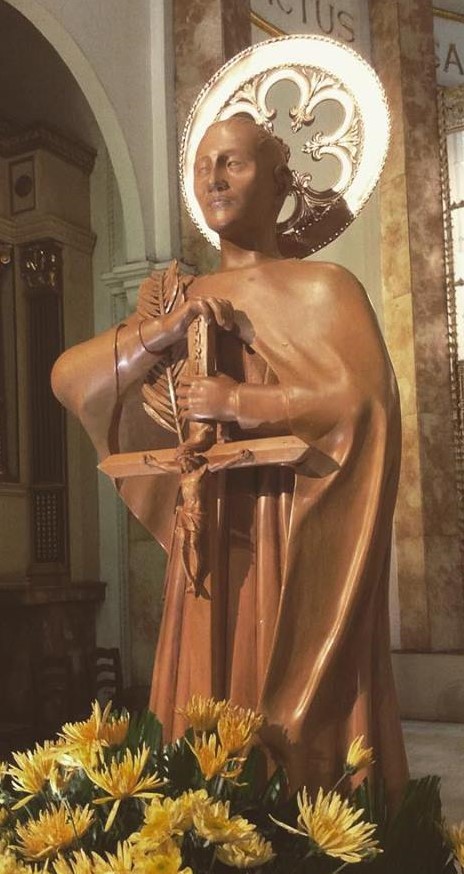
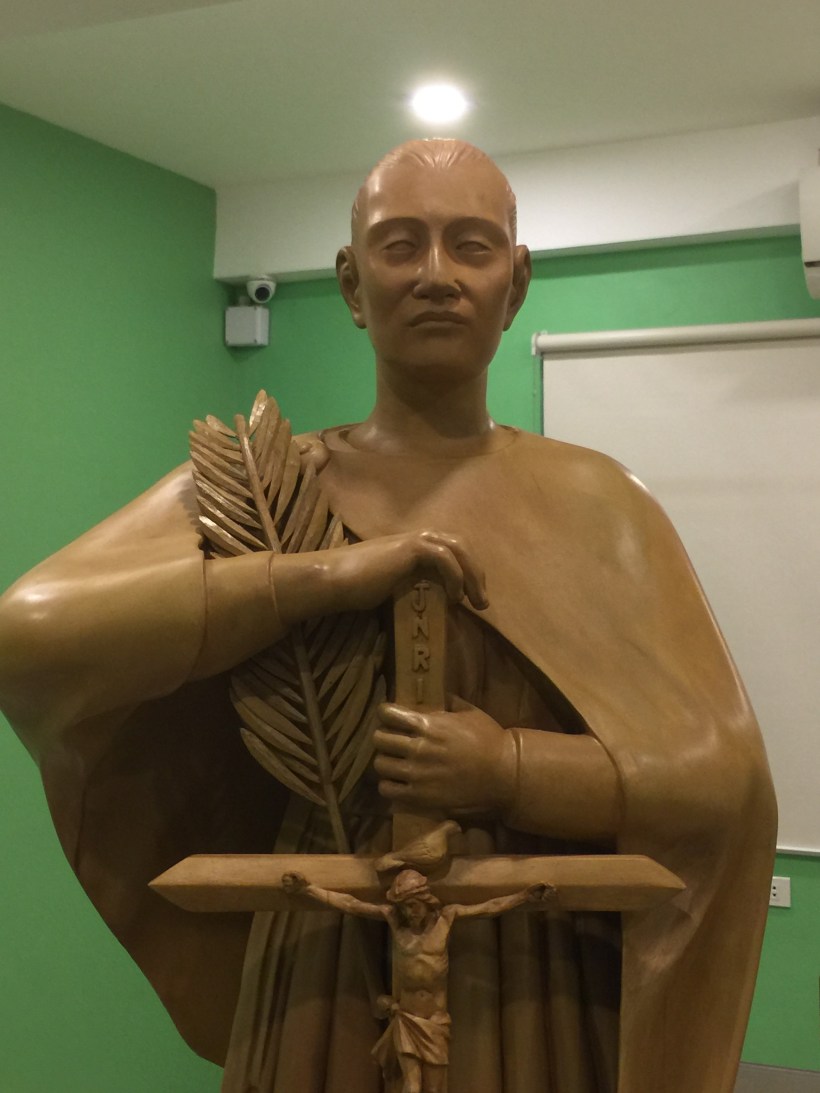
Altar Statue of Blessed Takayama, carved by the celebrated Paete artist, Paloy Cagayat, was installed on Dec. 21, 2017 at the Paco Catholic Church (est. 1580), Manila — showing Ukon with ‘Palm of Martyrdom’ and a metal halo. The Paco Catholic Church is in the pastoral care of Msgr. Rolando R. dela Cruz, parish priest, and Fr. Carlo del Rosario, parochial vicar.#
The Takayama Altar Statue was borrowed by the Manila Cathedral for the Feb. 3, 2018 Thanksgiving Mass marking Takayama’s first Feastday as ‘Beatus’ (Blessed).Blessed Takayama portrait made by +Noel Velez at his Tokyo hospital bed.
Imploring Blessed Takayama’s intercession for his healing — on just the basis of an ‘estampita’ (prayer card), Noel Velez (b. 1951) decided to make his own portraits of what he imagined the celebrated ‘Kirishitan Samurai’ looked like. A Tokyo-based Filipino, Noel Velez was familiar with the lore about this martyred Japanese Christian of great heroic virtue. He prayed fervently — even after his doctors told his family there was no hope from the hospital treatment. Noel died Jan. 14, 2018.
His widow, Puchie Gan, compiled his art works into a slim booklet — and presented this to Cardinal Tagle after the Mass celebrating ther first Feastday of Blessed Takayama.
Another work by +Noel Velez.Book cover of “Kirishitan Daimyo: Takayama Ukon” by Shinzuke Tani (Tokyo: Daughters of St. Paul, 1979).
Photos of new artwork (even old ones) about Blessed Takayama may be emailed to <blessedtakayama@gmail.com> or <ernestodepedro@gmail.com> so we can share them on this blog.◘
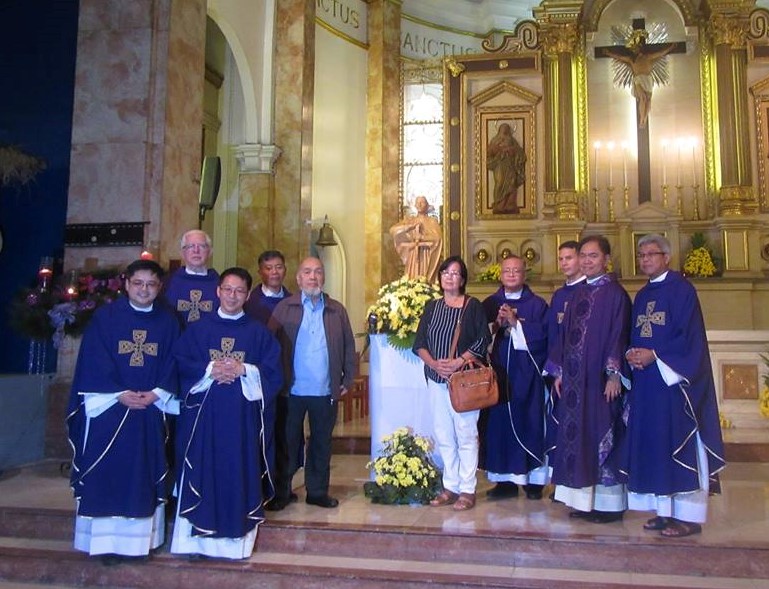
The Thanksgiving Mass was celebrated by Rev. Msgr. Rolando dela Cruz, Paco parish priest — with seven priests from four nations concelebrating.
(Photo credit: Robert Queddeng)
►For the first time in 403 years, Paco Parish Church (est. 1580) commemorated the Dec. 21, 1614 arrival of Justo Ucondono (Lord Justo Takayama Ukon) – and ‘350 Japanese Christian Exiles.’
A halo — symbolizing the holiness of Saints and Angels — was added by Msgr. R. dela Cruz.
The Thanksgiving Mass was concelebrated by Rev. Msgr. Rolando de la Cruz, parish priest – with seven other priests: ♦ Fr. Carlo del Rosario, parochial vicar; ♦ Fr. Iwao Ikegami, FMVD; ♦ Fr. Vincent Guinoo, FMVD; ♦ Fr. Antonius Harnoko, CICM (a Tagalog-speaking Indonesian missionary in Ofunato, Iwate Prefecture); ♦ Fr. Luke Moortgat, CICM; ♦ Fr. Celso Alcantara, and ♦ Fr. Wilfredo C. Talavera.
After the Mass, memento photos were taken of the eight concelebrants, with Dr. and Mrs. Ernesto A. de Pedro, Takayama Trustees. Members of mandated Catholic organizations similarly took souvenir photos. Then parishioners were allowed to take ‘selfies.’
The Japanese contingent of Manila-based nuns was made up of: Sr. Therese Fukatani, of the Congregation of Marie Auxiliatrice (MA); Sr. Kinue Maura, MA; and Sr. Ma. Therese Chiba, of the Handmaids of the Sacred Heart of Jesus (ACI), and lay Japanese: Masako Yamamoto; Mrs. Risa (Ishii) Peralejo, and Sakiko Ishida.
The Paco parishioners’ response was superb — and augurs well for the spread of devotion to Blessed Takayama de Manila.
The San Fernando de Dilao Parish in Paco counts with 27,000 parishioners (according to census data of 2010 — but Msgr. Dela Cruz estimates the number in 2017 at 95,000) — making Paco PARISH larger than any DIOCESE in Japan: ►Archbishop Joseph Mitsuaki Takami (Nagasaki – 67,729 Catholics), ►Bishop Paul Yoshinao Otsuka (Kyoto – 19,198), ►Bishop Bernard Taiji Katsuya (Sapporo – 17,993), ►Bishop Tarcisio Isao Kikuchi, SVD (Niigata – 7,711), ►Bishop Paul Kenjiro Koriyama (Kagoshima – 9,291), and ►Bishop Berard Toshio Oshikawa, OFM (Naha – 6,118). (It should be noted that the Paco Catholic School, adjacent to the church, has the largest student enrollment among Catholic schools in the Philippines.)
This altar-statue, presented to the Paco Catholic Church by the Prayer Warriors of Blessed Takayama, was carved by the celebrated Paete woodcarver Paloy Cagayat, and financed with contributions from the family and relatives of Dr. Ernesto A. de Pedro — who wanted the honor of producing the first Takayama statue in the Philippines.
It is the first Takayama altar statue with the “Palm of Martyrdom” – and a saintly halo. ◘
Dr. Ernesto A. de Pedro
Lord Takayama Jubilee Foundation
The celebrated samurai, born in Toyono-cho, Osaka Prefecture, is recognized as a Christian of heroic virtue.
►As Japanese church historians record it, TAKAYAMA Hikogorō (彦五郎) – (better known as Justo Takayama Ukon (高山右近) – 1552-1615) was born in 1552 in Takayama village, in Toyono-cho, Toyono-gun, Osaka Prefecture.
This is the conclusion of a Historical Commission appointed in 1963 by the Catholic Bishops’ Conference of Japan (CBCJ), headed by Sophia University’s Fr. Hubert Cieslik, SJ (1914-1988) to study the life and times of Takayama. Fr. Cieslik specialized in early Japanese mission history.
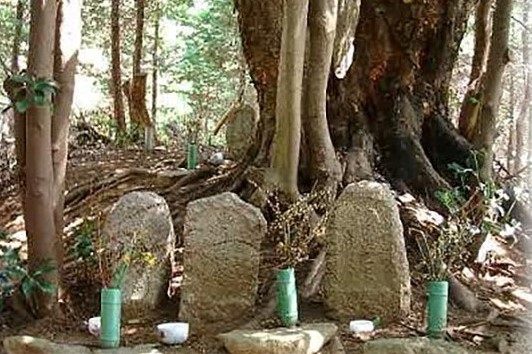
Indeed, the grave of Ukon’s mother — Maria Takayama — wife of Takayama Tomoteru (高山友照), later known as Darius Zusho Takayama, is located here, where it is a tourist attraction to this day. Maria Takayama was the mother of three sons, the eldest being Justus (and thus heir), and three daughters. Maria had joined Ukon during his 27-year domestic exile in Kanazawa which began in 1587, but when she died in 1596, the Takayama family chose to bury her in the ancestral village of Takayama in Toyono-cho, Osaka Prefecture. (That’s an acknowledgement by the Takayama family themselves that Toyono-cho, Osaka Prefecture was their hometown.)
The gravesite of Maria Takayama (d. 1596), mother of Blessed Justo Takayama Ukon, still draws domestic tourists today to the ancestral Takayama Village in Toyono-cho, Osaka Prefecture. (Salamat kay YUI YAMADA, Philippine Department of Tourism-Osaka).
But two other places claim the honor:
►SECOND CLAIMANT: Sawa Castle in Haibara-cho, Nara Prefecture. In this claim, Ukon was born at Sawa fortress, stronghold held by Ukon’s father, Takayama Tomoteru (1531–1596), a samurai in the service of the Daimyo Matsunaga Hisahide (松永 久秀), 1508–1577, in Yamato Province (today in Haibara-cho, Nara Prefecture).
►THIRD CLAIMANT: Takayama Castle in Settsu Province (now in Ibaraki City), Osaka Prefecture. — (P. Luis Frois, SJ).
Father Frois (1532-1597), who was the second of eleven (11) contemporary Jesuits who reported on the life and times of Takayama Ukon while Ukon was still alive, is best remembered for writing “The First European Description of Japan,” 1585. (This was the earliest systematic comparison of Western and Japanese cultures.)
Toyono-cho is definitely the birthplace of Takayama Ukon. ◘
Dr. ERNIE A. DE PEDRO
Managing Trustee
Lord Takayama Jubilee Foundation
A Brief History of His 402-Year Journey to Beatification as a Martyr in 2017
Lord Justo Takayama Ukon, daimyo of Akashi, is confronted by the Kwampaku, Toyotomi Hideyoshi, to renounce his Catholic Faith. (Actually, the 2m x 2m artwork is an artistic composite, as the confrontation was through an intermediary, the renowned tea master, Sen no Rikyū. Ukon declined — and he lost his fief and his army. He and his family had to leave Akashi Castle and seek the protection of friends. For the next 27 years, they lived in domestic exile in Kanazawa.
►Blessed Justo Takayama Ukon (高山右近) was the most celebrated “Kirishitan Samurai” during Japan’s so-called Christian Century (1549-1650). His life intersected the rule of Japan’s three hegemons – Oda Nobunaga (織田 信長) — (1534-1582); Toyotomi Hideyoshi (豊臣 秀吉) – (1537-1598), and Tokugawa Ieyasu (徳川 家康) – (1543-1616) — acknowledged as the “Unifiers of Japan” who ended a century of fractious civil war.
No other Japanese Christian convert has been as thoroughly written about by Jesuit missionaries as Takayama Ukon — from the time he was baptized Justo – with as many as six Jesuit missionaries writing about him in one particular year — until his death in Manila in 1615. He was celebrated for his governance of Takatsuki (in Settsu Province) where he introduced a form of Catholic charities. During the 13 years he ruled there, some 18,000 of its 25,000 population converted to Christianity – an example unmatched anywhere else in Japan, except in Nagasaki.
Japan Turns Hostile to Christianity
When Japan’s government turned hostile to Christianity — the “religion of the West” — all daimyo (feudal noblemen) were ordered to recant their Christian faith, and return to Shinto or Buddhism. Wholesale martyrdoms cast a grim toll on the faithful.
But Takayama Ukon chose to stand fast, preferring to be stripped of his fief in Akashi (in Harima Province) rather than abjure his religion. Ukon told Hideyoshi’s messenger he would visit Hideyoshi unarmed and convey his thoughts, adding that if he should be killed, he would accept his fate willingly. Takayama’s reputation as an outstanding defender of the faith was so widespread in Europe (where all foreign missionaries in Japan came from) that Pope Sixtus V (r. 1585-1590), was moved to send him a Breve (papal letter) dated April 23, 1590 exhorting Takayama to remain strong in his faith.
From Daimyo to Retainer
For the last 26 years of his life, Takayama lived in domestic exile as a ronin, first seeking safe haven in the island of Awaji (in the Inland Sea) where his fellow Catholic, Gen. Konishi Agostinho Yukinaga (1555-1600) – overall commander of Hifeyoshi’s invasion of Korea — received him. Later, in 1588, he went to Kaga as a retainer of the Maeda clan who ruled the Kanazawa Domain, which covered the provinces of Kaga, Noto and Etchū in modern-day Ishikawa Prefecture.
While the Maeda themselves were not Christian converts – though some family members were! – their territories offered safe asylum, and in these scattered districts the work of Christianity proceeded secretly while openly interdicted. Despite the general persecution, Ukon continued to involve himself in Church and missionary activities. His life led many to the Gospel, as he remained active in converting fellow Japanese, building churches, and continuing to support Jesuit underground missions — until the final prohibition edict of January 27, 1614 was rigorously enforced.
Exiled for His Faith
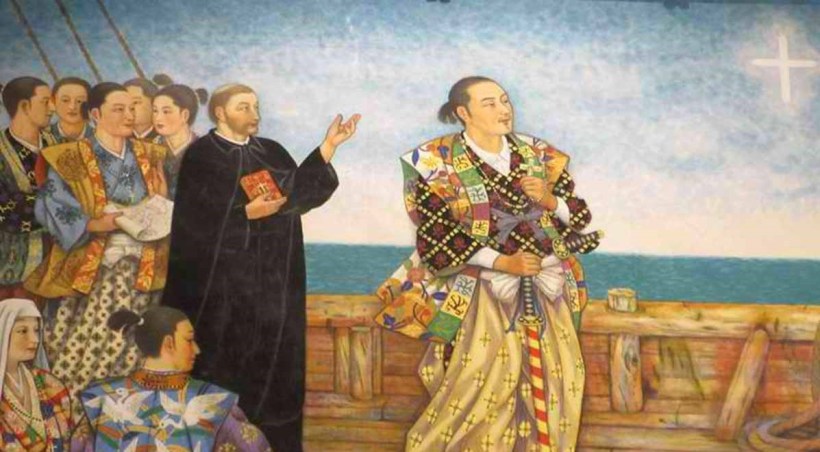
Takayama Ukon and his family — (his wife, Dona Justa, a married daughter Lucia Yokoyama, and five grandsons) — were exiled to Manila with 350 other Christians, among them Lord Juan Tocuan Naito (Hideyoshi’s ambassador to the Ming Court in China during the truce, 1594-1596, between two Korean Wars); the Japanese and Korean nuns of the Jesuit-chaplained Beatas de Miyako [Kyoto], and the sons and daughters of other Christian nobles.
(Takayama also brought on the exile ship the statue of Our Lady of the Holy Rosary — [more popularly known as “La Japona”] — from the Dominican Church of Our Lady of the Rosary in Nagasaki. This Marian image had accompanied the first Dominican mission that left for Satsuma, Japan on June 1, 1602. Since its return in 1614, the image has been enshrined at the Santo Domingo Church in Intramuros; during WW2, at U.S.T., and by 1954, in Quezon City.)
After 43 days at sea (during which howling winds, heavy rain and huge seas snapped the exile junk’s main mast just off the coast of Bataan), then 44 days on land in Manila, Takayama died on Feb. 3, 1615 of “a tropical ailment” which the doctors of the Spanish Governor-General, Don Juan de Silva, were unable to deal with.
Accorded State Honors in Manila
Amid great public lamentations, the “Samurai of Christ,” Lord Takayama Ukon was accorded a state funeral with nine days of Requiem Masses at the churches of Intramuros.
Son of Manila
In 1630, the Manila archdiocese, considering Takayama as a true “Son of Manila,” under the doctrine that “where one dies is where one is born to Heaven,” petitioned the Vatican to elevate him to sainthood — making a Japanese Catholic the first candidate of the Philippine Church for saint. But in 1963, with no native-born Filipino candidate being proposed as the first saint of the Philippine Church, and with its own Archdiocesan Archives devastated during the Japanese Occupation of the Philippines (1942-1945), the Manila Archdiocese seconded the Takayama Cause to the Church of Japan.
Church Historians Accumulate Supporting Documents
As the “Cause” had been dormant for 333 years, Japanese historians set about assembling the supporting papers for the “Causa Historica” of Takayama Ukon as a “Confessor of Christ” – not as a Martyr. The historical team was headed by Sophia University’s Fr. Hubert Cieslik, SJ (1914-1988) who wrote in German, English and Japanese, but chose to write the Takayama study wholly in German. Other historical documents were written in six other Western languages, plus Japanese too. The Congregation for the Causes of Saints needed the documents translated to an official Vatican language – such as Latin, Italian, Spanish or English — before the Cardinals could evaluate them.
Takayama’s Cause and U.S.T.
Takamatsu Bishop Francis Xavier Osamu Mizobe, SDB (1935-2016), chairman of the Japanese Bishops’ Special Committee for Canonization and Beatification, wrote about the undue delay in the processing of the “Positio”: “It had taken quite a long time — [the papers at the Vatican were dormant for 11 years!] — to find a suitable translator. Dr. Ernesto A. de Pedro, professor of Santo Tomas University (U.S.T.) in Manila, agreed to undertake the task of translation. He finished his work in 1994, so from that time on, the Congregation could move on.” The Jesuit Postulator General, Fr. Paulo Molinari, SJ (1924-2014) acknowledged: “Thanksto your much appreciated collaboration, all the essential materials for this important ‘Cause’ are by now available.”
The official “Positio” – “JustusTakayama Ukon, Servus Dei” (1994, 648p) — was then presented to the Congregation for the Causes of Saints which gave its “Nihil Obstat” on June 8, 1994. Now — 364 years after Manila initiated the process in 1630 — Takayama Ukon had at last reached the first step to sainthood: “Servant of God.”
Takayama Ukon – A Martyr
When a beatification ceremony for 188 Japanese martyrs was held in Nagasaki on Nov. 24, 2008 – the fourth batch of Japan’s group martyrs — the Japanese Bishops sought to include the Servant of God, Takayama Ukon, among the martyrs to be beatified. However, the Vatican did not, at that time, recognize Takayama Ukon as a martyr. But with the evolution of the theology of martyrdom, the Vatican’s Congregation for the Causes of Saints has indicated a willingness to accept Takayama as a Martyr.
In 2010, the Catholic Bishops’ Conference of Japan (CBCJ) re-initiated the process of beatification on the basis of Martyrdom. Bishop Mizobe pointed out that the then Archbishop of Manila [Msgr. Miguel Garcia Serrano, OESA] recognized that the cause of Ukon’s death was “exhaustion and the fatigues of the exile” and that “Justus had died as a consequence of the exile, and therefore, in the proper sense of the word, was to be regarded as Martyr for the sake of the Faith.” St. Alphonsus Maria de Ligouri, CSsR (1696-1787) — who was himself canonized in 1839 – came across the Takayama papers at the Vatican during Japan’s closed years, likewise concluded, in “Victories of the Martyrs” (1775, 1887, 1954), that, despite dying in bed surrounded by his family, Takayama Ukon was indeed a Martyr.
In August 2013, the Japanese Bishops presented to the Vatican a petition for the beatification of Takayama Ukon — as a Martyr. Pope Francis on January 21, 2016 authorized the change from “Confessor” to “Martyr” through the promulgation of a decree on the martyrdom of the Servant of God Justo Takayama Ukon — a “layperson … from Japan [who] died from the hatred of the Faith on Feb. 3, 1615 in Manila, Philippines.” Fr. Anton Witwer, SJ, Postulator General of the Society of Jesus, explained the Pope’s decree of martyrdom: “Since Takayama died in exile because of the weaknesses caused by the maltreatments he suffered in his homeland, the process for beatification … is that of a Martyr.”
Beatified in Osaka on Feb. 7, 2017
Skipping the prescribed second step – “Venerable” — the Servant of God, Justus Takayama Ukon, was directly beatified as a Martyr on Feb. 7, 2017, in Osaka, Japan, by Cardinal Angelo Amato, SDB, Prefect of the Congregation for the Making of Saints, on behalf of Pope Francis, making Ukon the 394th in Japan’s galaxy of 42 Saints and 394 Blessed. ◘
By Dr. Ernie A. de Pedro
Managing Trustee
Lord Takayama Jubilee Foundation
Lord Takayama and his family left Kanazawa in northern Japan on Feb. 15, 1614 to board a Chinese junk in Nagasaki — with 350 Japanese Christian exiles — bound for Manila, where he died on Feb. 3, 1615
►1614 — (Feb. 15) – Start of 353-day ‘Trek to Martyrdom’ of Lord Justo Takayama Ukon (1552-1615) from Kanazawa — to Death in Manila on Feb. 3, 1615.
►1614 – (Dec. 21) — Lord Justo Takayama Ukon arrived in Manila with the first group of 350 Japanese Christians who sought refuge in the Philippines. The refugees were warmly welcomed by the Spanish Governor General, and the Archbishop of Manila.The Jesuits of the Philippines were hosts not only of Lord Takayama and his family, but also the “350 Japanese Christian exiles.”
►1615– (Feb. 3) — After only 44 days in Manila, Lord Takayama died “of a tropical fever” on Feb. 3, 1615. The city declared nine days of mourning for him. He was interred near the High Altar of the Jesuit-owned Santa Ana Church in Intramuros, Manila.
►1630 – (Oct. 5) — The Manila Archbishop proposed to the Vatican that Takayama be declared a saint – a Japanese Christian was being proposed to be the Philippines’ first saint! According to the rubrics of the Catholic Church — “where one dies, is where he is born to Heaven.” Thus, in the reckoning of the Catholic Church, Lord Takayama was a “Son of Manila.”
►1937 – (Feb. 3 — 322nd death anniversary of Takayama) – The XXXIIIrd International Eucharistic Congress in Manila (Feb. 3-7) resolves to promote the “Cause for the Beatification of the Confessor of Christ, Justo Takayama Ukon.” The resolution was presented by the Japanese delegation co-headed by Rev. Fr. Paul Yoshigoro Taguchi, Director of the Japanese Catholic Press Bureau, and later Archbishop-Cardinal of the Diocese of Osaka.
►1942 – (Sept. 20) – Memorial Mass to promote awareness that the Confessor of Christ, Justo Takayama Ukon, died in Manila in 1615. The Mass was celebrated at the San Marcelino Church (St. Vincent de Paul Parish Church) by Osaka Bishop (later Cardinal) Paul Yoshigoro Taguchi.
►1963 – (April 24) – Japanese Bishops attending the Second Vatican Council (1962-1965) in Rome, visited Manila Archbishop Rufino J. Cardinal Santos (1908-1973) — at the Pontificio Collegio Filippino — to petition him to revive the ‘Cause for Sainthood of Takayama.’ With historical documents lost with the destruction of the Manila Archdiocesan Archives during WWII (1942-1945), Cardinal Santos deeded over the responsibility for the promotion to Osaka Archbishop Paul Yoshigoro Cardinal Taguchi. The Catholic Bishops Conference of Japan (CBCJ) formed a historical committee, headed by Fr. Hubert Cieslik, SJ, to write the official “Positio” about Takayama – as a “Confessor of Christ.”
►1977 — (Nov. 17) – After joint Philippine-Japanese development in 1973-1977, with land donated by the City of Manila, and private contributions from the Japanese. the Takayama Memorial was inaugurated as the centerpiece of the Philippines-Japan Friendship Park, at Plaza Dilao, Paco, Manila. Lord Takayama was the historical figure chosen to exemplify Philippine-Japanese friendship. Takayama Ukon was recognized as “the epitome of the Japanese spirit”: Takayama’s “life illustrates a happy union of the valor of a Japanese warrior and the fidelity of an ardent Catholic. His brilliant military achievements, his moral integrity and deliberateness in critical moments, his dauntless spirit combined with a meek soul, his earnest zeal and piety expressed in his generosity and charity — all these should be noted as a fruit of the Christian missions.”
►1979 — (Jan. 25) — The Manila-Takatsuki Sister City Pact was signed on Jan. 25, 1979. Takatsuki was the fief governed by Takayama for over 13 years. Here, he converted 18,000 of the castletown’s 20,000 inhabitants to Christianity. Since 1979, all Manila Mayors – Mayor Ramon S. Bagatsing (1972-1988); Mayor Gemiliano “Mel” Lopez (Appt. 1986-1987; elected 1988-1992); Mayor Alfredo S. Lim (1992-1998; 2007-2013); Mayor Jose “Lito” Atienza (1998-2007), and Mayor Joseph “Erap” Estrada (2013-2019) — have laid floral wreaths at the Takayama Memorial to commemorate Philippine-Japanese Friendship.
►1992 — (Nov. 17) – Takayama Memorial was recognized – and listed — as a National Monument by the National Historical Commission of the Philippines (NHCP).
►1994 — (June 8) — The Roman Catholic Church declares the Christian Samurai, Justo Takayama Ukon, as a “Servant of God” — the first step to sainthood.
►2014 – (July 14) — CBCJ submits a revised “Positio” about the Servant of God, Justo Takayama Ukon to the Congregation for the Causes of Saints – this time, as a Martyr.
►2016 – (Jan. 21) – Pope Francis issues a Decree of Martyrdom for the Servant of God, Justo Takayama, recognizing that although he died in bed surrounded by his family, he had died a Martyr. The Jesuit Postulator-General, Fr. Anton Witwer, SJ, who presented the “Cause of Takayama” before the Congregation for the Causes of Saints, pointed out: “Since Takayama died in exile, because of the weakness caused by the maltreatments he suffered in his homeland, the process for beatification is that of a martyr.”
►2017 – (Feb. 7) – Beatification of Justo Takayama Ukon in Osaka, by the Congregation for the Causes of Saints.
►2017 — (March 28) — Second Takayama statue is installed and blessed at University of Santo Tomas (UST) — at the entrance of the Thomas Aquinas Research Complex (TARC), home of the UST Graduate School, which has been the center of Takayama Studies since 1989.
Paco Catholic Church, Manila
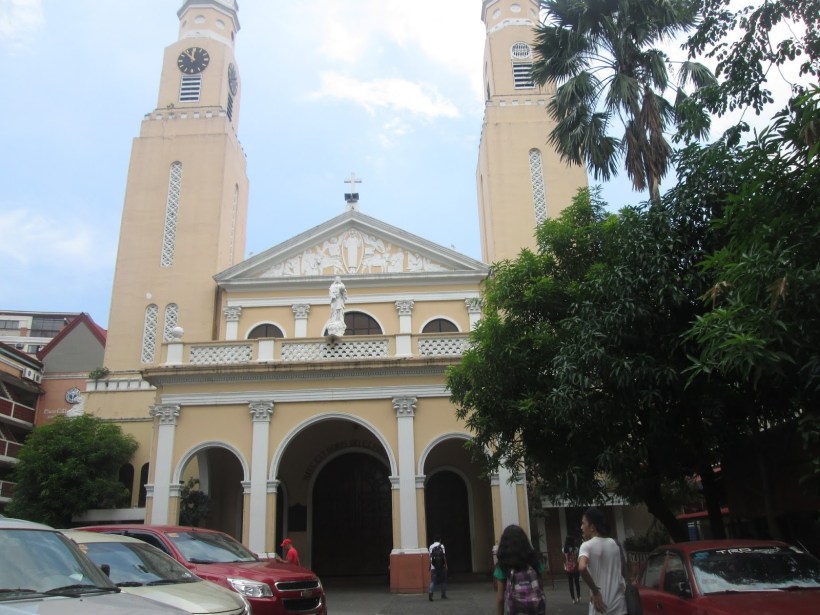
►2017 – (Dec. 21) — On the 403rd anniversary of Lord Takayama’s arrival in Manila in 1614, the first altar-size statue is installed at the Paco Catholic Church. The first Catholic church made of nipa was built by Franciscan missionaries in 1580 for Japanese expatriates. The swampy settlement had no name but as ‘Paco’ or ‘Paquito’ were the diminutives for Francisco, Paco became the name of the district. The present church was reconstructed from the ruins of World War II (1942-1945).
(On February 7, 2012, the Paco Catholic Church was designated as “Pro-Cathedral of the Archdiocese of Manila” until the structural renovations of Manila Cathedral-Basilica of the Immaculate Conception were completed on April 9, 2014.)
►2018 – (Feb. 3) — FIRST FEASTDAY for Blessed Takayama. The liturgical calendar of the Roman Catholic Church designates February 3 as Ukon’s feastday – not only in the Philippines and Japan, but throughout the Catholic world. ◘
Dr. Ernie A. de Pedro
Managing Trustee
Lord Takayama Jubilee Foundation
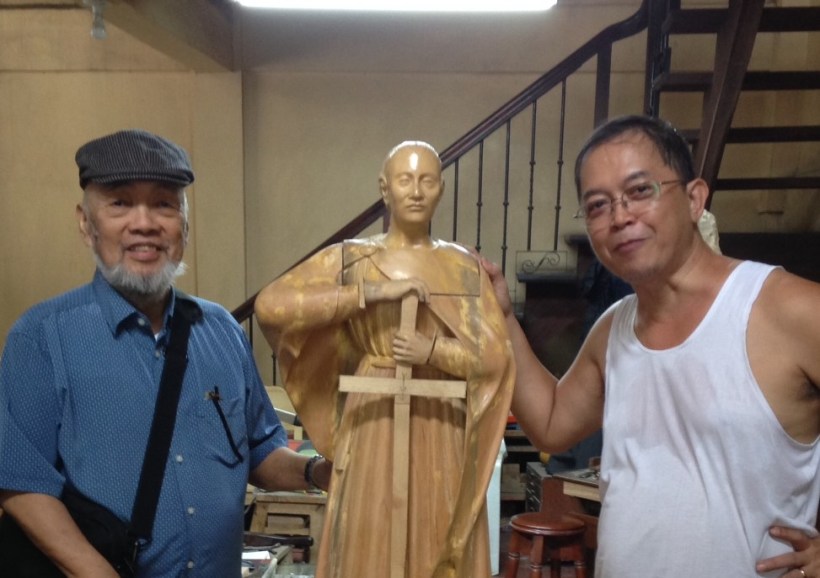
Celebrated Paete woodcarver, Paloy Cagayat, in workclothes, presenting his ‘first cut’ of the Takayama statue to Dr. Ernie A. de Pedro, Managing Trustee, Lord Takayama Jubilee Foundation
By Dr. Ernie A. de Pedro
►Paete (Laguna Province) is acknowledged as the wood-carving capital of the Philippines. This reputation dates back to the town’s founding in 1580 when Franciscan friars discovered that residents had a talent for wood-carving, using ‘batikuling’ wood (“Elaeocarpus calomala”), a native tree species ideal for making religious images or “santos.” The town’s name in fact comes from “paet” or chisel, an essential woodcarver’s tool.
As the Spanish evangelization progressed across the archipelago, the town was tapped to supply the religious statuary needed for new houses of worship — and has not stopped carving ‘santos’ since then.
Today, there are around 500 woodcarvers working in some 50 wordcarving shops. The town’s masterpieces — in statues, pulpits, murals and bas relief — are found in churches, palaces and museums all over the world – among them St. Peter’s Basilica in Rome, St. Patrick’s Cathedral, in New York, the Mission Dolorosa in San Francisco, the San Cayetano Church in Mexico, the St. Joseph’s shrine in Sta. Cruz, California, and various churches and chapels in the Philippines.
Paloy Is Commissioned to Make St. Calungsod Statues
When statues of St. Pedro Calungsod (c1654-1672) were required for the canonization rites in Rome (Oct. 21, 2012), the Jesuits (who promoted the Calungsod Beatification & Canonization) turned to Paloy Cagayat — Justino ‘Paloy’ A. Cagayat, Jr., a third-generation woodcarver – to carve the first statue. Though a graduate of Mining Engineering from Mapua University, Paloy has preferred to live and thrive by his inherited craft – which he is now sharing with his sons. He has supplied churches and chapels with his carvings of various saints, crucifixes and Biblical tableaux – but it was his near-monopoly of statues (in wood or resin) of St. Pedro Calungsod that he is best known for. In fact, the Vatican houses one of Paloy’s works and, in the way that the Vatican cares for such art treasures, the wood carving is bound to last for centuries.
His home and studio is in Paete, Laguna. No street address is necessary as he is such an institution that everyone in town knows where his shop is.
First Takayama Statue
It was an easy decision to commission Paloy to make the first 3-ft (altar-size) statue of Blessed Takayama. Sight unseen. Just by e-mail.
Fr. Joel E. Tabora, SJ, president of the Ateneo de Davao University, had gushed about Paloy’s work. That was enough recommendation for us.
Then I remembered a niece who lives in Isesaki (伊勢崎市) in Gunma Prefecture, whose name is Leticia Pedro Cagayat. Were they by any chance related? Yes, they were – but “malayong mag-kamaganak na.” But Letty and her family have visited Paloy in his workshop in Paete, to commission a Marian statue for the Carmelite Convent in Laoag, Ilocos Norte. Small world, indeed.
Visiting Paete
When we visited Paloy in Paete for his ‘first cut” of the Takayama statue, we were impressed with the quality of his work. We added four details: ♦ Blessed Takayama must sport the traditional topknot of a Japanese Samurai; ♦ wear the halo of a ‘Beatus’ (Blessed); ♦ wear the ‘Palm of Martyrdom’ across his chest. The final statue should have a ♦ bronze finish.
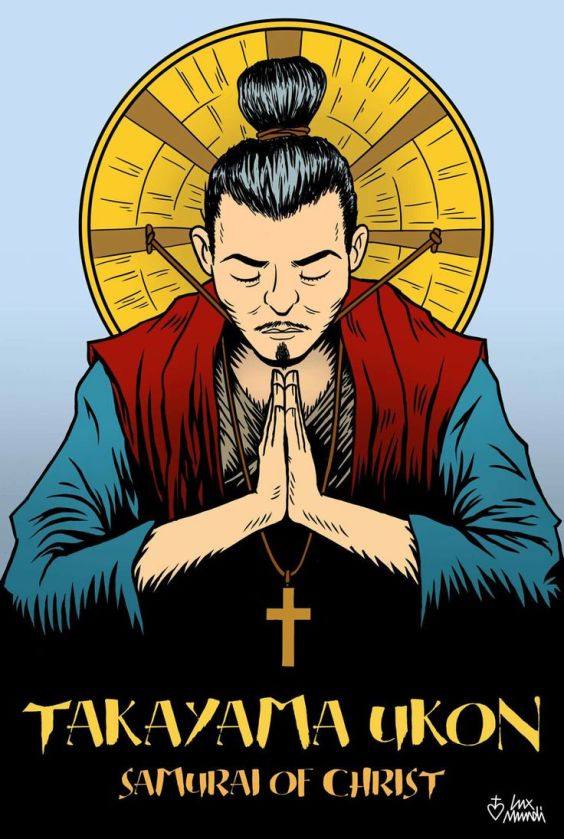
This ‘estampita’ shows Blessed Justo Takayama Ukon with a Samurai topknot and a saintly ‘halo.’
Paco Catholic Church
THIS FIRST STATUE will be enshrined at the Paco Catholic Church – of which Dilao (the first ‘nihon-machi’ or Japantown) was a part. For Rev. Msgr. Rolando R. dela Cruz, Paco parish priest, it will be a ‘coming-home’ for Blessed Takayama. This will be on Thursday, Dec. 21, 2017 — the 403rd Anniversary of the arrival of ‘Lord Takayama Ukon and 350 Japanese Christian Exiles’ in Manila on Dec. 21, 1614.
Wood-carved statue of Blessed Justo Takayama Ukon, enshrined at the Paco Catholic Church, Manila
Parishes desiring Takayama statues can contact the Takayama Canonization Movement at (ernestodepedro@gmail.com). Individual devotees who want statuettes for their homeshrines can order too – when these are available by December 2017. ◘
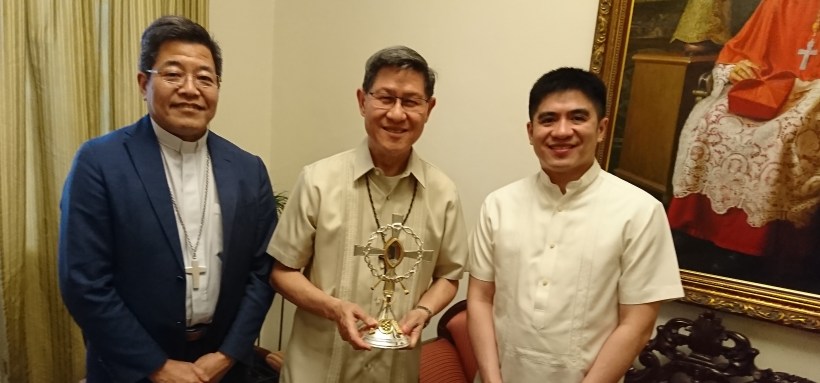
At the Arzobispado de Manila: Kyoto Bishop Otsuka, Cardinal Antonio Luis ‘Chito’ Tagle (holding Takayama relic encased in a golden reliquary) and Fr. Reginald ‘Regie’ Malicdem, Rector of the Manila Cathedral. (Cellphone photo by Fr. Albert Fuyuki Hirabayashi, SJ)
►A piece of the vest of Blessed Justo Takayama (1552-1615) was presented to Manila Archbishop Cardinal Luis Antonio Tagle by Kyoto Bishop Paul Yoshinao Otsuka, chair of the CBCJ Committee for the Promotion of Saints. The presentation was made at the Arzobispado in Manila, on Thursday, Oct. 19, 2017.
The full Takayama vest had been presented as a second-class relic during the Takayama Beatification Rites in Osaka on Feb. 7, 2017, which was presided by Cardinal Angelo Amato, SDB, Prefect of the Congregation for the Causes of Saints, on Pope Francis’s behalf.
Other pieces (uniformly encased in a golden reliquary) have been presented to the principal Catholic churches in Osaka, Takatsuki and Kanazawa – all cities that figured in the life and career of the Christian daimyo Justo Takayama Ukon. The presentation in Manila – where Blessed Takayama died on Feb. 3, 1615 — completes the obligation to share the relics with Takayama devotees.
Another relic from the same cloth has been presented earlier to the Vatican.
Rev. Fr. Reginald R. Malicdem, Chancellor of the Archdiocese of Manila, Rector of Manila Cathedral, and Secretary of Cardinal Tagle, has announced that as of Oct. 27, “we have not yet decided on where the relic is going to be displayed and on the times it will be available for veneration. Once we have decided on this, we will let [the faithful] know.” ◘
Dr. Ernie A. de Pedro
Managing Trustee
Lord Takayama Jubilee Foundation
















 Blessed Justo Takayama Ukon