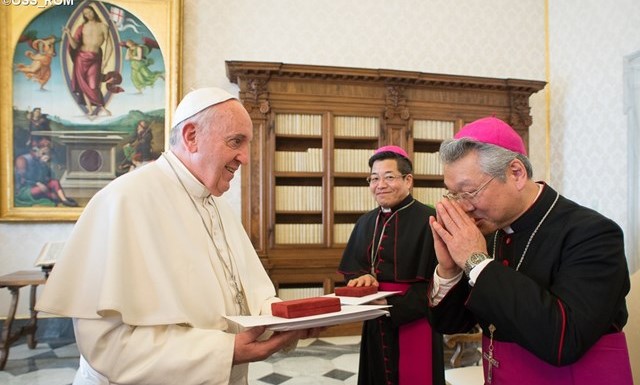
Pope Francis meeting Japanese Bishops on their Ad Limina visit to the Vatican – (17/09/2017). The Catholic Church of Japan has 42 Saints and 394 Beati (Blessed) — all Martyrs!
►(Vatican Radio) — Pope Francis has urged Christians in Japan to face current challenges bearing in mind the witness of their many martyrs.
In a letter addressed to the Bishops of Japan, on the occasion of Cardinal Fernando Filoni’s pastoral journey to the Land of the Rising Sun, the Pope held up the memory of Japan’s many martyrs and ‘hidden Christians’ whom, he said, from the 17th to the mid-19th centuries lived clandestinely so as not to have to repudiate their faith.
Cardinal Filoni, the Prefect of the Congregation for the Evangelization of Peoples, has undertaken a pastoral journey to Japan lasting from 17 to 26 September.
Japanese Christians facing current challenges
In the letter, the Pope pointed out that Japanese Christians are facing “the challenges that current times pose” and he invited them not to be “resigned,” nor to resort to “an ironic or paralyzing dialogue even although there are problematic situations that raise not a few concerns.”
Amongst the situations that arouse concern, the Pope mentioned the “high rate of divorce” in Japan, “the number of suicides, even among young people,” the phenomenon of the ‘hikikomori’ – people who choose to live completely disconnected from society, “religious and spiritual formalism, moral relativism, indifference towards religion, an obsession for work and earning”.
It is also true, the Pope continued, that a society that is a frontrunner in economic development leaves many behind: the poor, the marginalized, the excluded – not only those who are excluded in a material sense, but also those who are spiritually and morally in need.
Need for constant renewal in the Church
Within this particular context, Francis pointed out that it is necessary and urgent that the Church in Japan be constantly renewed, always bearing in mind “Jesus’ mission which is salt and light.”
The Pope concluded pointing out that the true evangelical force of the Japanese Church stems from the fact that it has been a Church of martyrs and confessors of the faith, and this “is a great asset to be safe-guarded and developed.” ◘
In Grim Protest Against Grievous Extra-Judicial Killings (EJT) of the Poor and Defenseless
Agence France Presse
►Church bells tolled across the country for five minutes beginning Thursday night (Sept. 14) – and for the next 40 nights — as Catholic bishops rallied opposition to the “reign of terror” that has left thousands dead in President Rodrigo Duterte’s drug war.
The Philippine National Police has reported killing more than 3,800 people to fulfill Mr. Duterte’s vow to rid the Philippines of narcotics, with the 15-month crackdown triggering wider violence that has seen thousands of other people found dead in unexplained circumstances.
Forty Nights
Church bells tolled at 8 p.m. to honor the dead and remind the living that the bloodshed must stop. The ritual will continue for 40 nights.
“We cannot allow the destruction of lives to become normal. We cannot govern the nation by killing,” the archbishop of Manila, Luis Antonio Cardinal Tagle (in photo), said in a pastoral letter last week launching the campaign.
The president of the Catholic Bishops’ Conference of the Philippines (CBCP), Lingayen-Dagupan Archbishop Socrates Soc Villegas, followed up this week with an even stronger pastoral letter. “For the sake of the children and the poor, stop their systematic murders and spreading reign of terror,” Villegas wrote.
Mr. Duterte won last year’s presidential election on a brutal law-and-order platform in which he promised an unprecedented campaign to eradicate illegal drugs in society by killing up to 100,000 traffickers and addicts.
Top Priority
He has made the drug war the top priority of his administration, and has regularly encouraged more bloodshed with comments such as describing himself as “happy to slaughter” three million addicts. Nevertheless, Mr. Duterte and his aides reject allegations they are overseeing a crime against humanity.
Self-Defense?
They say police are killing only in self-defense, and the thousands of other unexplained murders could be due to drug gangs fighting each other.
Many Filipinos looking for quick solutions to crime continue to support Duterte, according to polls, and he enjoys majority backing in both houses of Congress.
But the Church has emerged as the leader of a growing opposition in recent months.
The killings of three teenagers, two of them at the hands of Caloocan police, sparked rare street protests against the crackdown.
Church officials say the tolling of bells is a direct throwback to the Crusades in the Medieval Age, when Christian nations of Europe sent military expeditions to reclaim holy places in the Middle East.
The Catholic Church, to which eight in 10 Filipinos belong, has a history of influencing politics in the Philippines and helped lead the Edsa People Power Revolution that overthrew dictator Ferdinand Marcos in 1986. —AFP
As soon as we get a clear photo of the Chiba Memorial, we will replace the flags!
Earliest Philippine-Japanese Friendship Memorial — Antedated Plaza Dilao by 19 Years!
►The Philippines-Japan Friendship Park was inaugurated at Plaza Dilao, in Paco, Manila on Nov. 17, 1977 – after being planned since 1973.
But unknown even to the Filipino and Japanese developers of the Plaza Dilao project, there was an earlier “Monument of Filipino-Japanese Friendship” dedicated in 1958 — 19 years before Plaza Dilao — in Chiba City, across the bay from Tokyo, honoring three revered personalities from three different time-frames of Philippine-Japanese history: ♦ Lord Takayama Ukon, ♦ Gen. Artemio Ricarte and ♦ President Elpidio Quirino.
►The first is, of course, Lord Justus Takayama Ukon (1552-1615), who exemplified the Japanese immigrants who came to the Philippines and were warmly received 400 years earlier.
►The second is Gen. Artemio Ricarte (1866-1945), the unreconstructed Filipino nationalist who refused to swear allegiance to the empire-building Americans when they subverted the Filipinos’ fight for independence against Spain at the turn of the 20th century.
►The third is President Elpidio Quirino (1890-1956), who is remembered for his magnanimity in granting full pardon in 1953 to the last 106 Japanese war criminals, after they had served several years of their prison sentences at the New Bilibid National Penitentiary in Muntinglupa, Rizal. Japanese leaders remember the Christian dimension of this presidential decision, “emanating from the sublime Christian spirit as well as motivated by friendly sentiment to restore more cordial relations between the two countries” — in the words of the then Foreign Minister Katsuo Okazaki (April 1952-December 1954).
Engraved on the marble block is a poem by Tatsuo Terashita, who served with the Japanese Propaganda Corps in the Philippines during World War II:
Our two nations under different skies,
Rising nobly above the mournful past,
Firmly pledge ourselves to friendship and love.
May this bond of hearts of millions endure
Like the sacred fire devoutly kept
Burning ceaselessly from age to age! ◘
Dr. Ernesto A. de Pedro
Managing Trustee
Lord Takayama Jubilee Foundation
Fr. Toru Nishimoto Devoted His Manila Assignment (1973-2010) to Funding Scholarships for Filipino Children — and the ‘Beatification Cause of Takayama’
►In the last years of his ministry in the Archdiocese of Manila, Fr. Toru Albert Nishimoto, CSsR (Aug. 29, 1933 – Aug. 21, 2010) – the first Japanese Redemptorist priest — had to have blood transfusions from Filipino friends during his long bout with kidney disease and leukemia. As Fr. Rolando V. de la Rosa, OP (former Rector Magnificus, University of Santo Tomas) relates it: “‘Father Nishi’ considered his sickness as God’s way of turning him into a full-blooded Filipino. He once told his niece, Mako, after several dialysis sessions: “Not a single drop of Japanese blood flows in my veins now. It is the blood of my Filipino donors that keeps me alive.”
‘Father Nishi’ came to Manila in 1973 to further his studies in Missiology at the East Asian Pastoral Institute (EAPI) at the Ateneo de Manila upon the recommendation of his former professor at the Gregorian University in Rome. After his studies at the EAPI, he paid a visit to Cardinal Jaime Sin to share his findings on the missionary challenge presented by Japanese tourists. Manila was a major tourist attraction in those days and Archbishop Sin was very much aware of the influx of Japanese tourists. Cardinal Sin asked him to stay and continue taking care of the Japanese nationals in the country. Thus started Father Nishimoto’s missionary work in the Philippines.
For the Beatification Cause of the Christian Samurai Martyr, Justus Takayama Ukon, Fr. Nishimoto — as Chairman of the Lord Takayama Jubilee Foundation — supervised the translation work (from six European languages and Nihonggo) of the original ‘Positio’ — “Servus Dei, Justus Takayama Ukon: Materia Praeparata Pro Propositione Super Virtutibus Servi Dei Justi Takayama Ukon.”
UCAN posted a story on Father Nishimoto in 1999 – 11 years before he passed away in 2010. That means there are 11 years of activities not yet reported on.
First Japanese Redemptorist
►MANILA — (UCANews – Jan. 12, 1999) — A Japanese Redemptorist priest’s sabbatical in the Philippines turned into a permanent ministry here that includes evangelizing Japanese nationals through encounters with Filipino communities.
Since he arrived in Manila in 1973, Father Toru Nishimoto of Kyoto, Japan, has counseled hundreds of married Filipino-Japanese couples and facilitated visits of Japanese students to poverty-stricken areas in the Philippines.
The 65-year-old priest also established a scholarship program for Filipinos that has helped more than 26,000 students pursue various professions and vocations including the priesthood.
Beginning with teaching Sunday catechism to Japanese families in Manila between his classes at the Jesuit Ateneo de Manila, Father Nishimoto went on to visiting jails, hospitals and nightclubs frequented by Japanese tourists.
“When I reported to (Cardinal Jaime Sin of Manila) at the end of my sabbatical leave, he welcomed me to (his) house saying, ‘Father of the Night, welcome to the House of Sin,’” he told UCA News. [In fact, “Father By Night” was the title of one of five books ‘Father Nishi’ wrote.]
He said the cardinal knew of his work at nightclubs, asked him to stay and assured him that as long as he was cardinal of Manila, the Japanese priest could continue his apostolate in the archdiocese.
Father Nishimoto officially began serving Manila archdiocese in 1975. He said the Catholic Bishops´ Conference of the Philippines asked him to extend his program´s services to all of the Philippines in 1990.
Pre-Evangelization Program
According to Father Nishimoto, the Pre-Evangelization Program (PEP) office offers Japanese nationals “a Christian experience in a Christian country.”
Aside from caring for troubled Japanese in the country, the priest counsels couples before marriage and conducts a youth exposure program for Japanese students.
Figures at his office indicate that intermarriage between Japanese men and Filipino women increased from 650 couples in 1987 to 6,840 by 1997.
Father Nishimoto said that he visits such couples who settle in Japan twice a year as a way to protect the faith of the Filipino spouse.
“Most Japanese have no sense of God,” he said, adding that he has organized groups in Japan similar to the Philippine-based Couples for Christ to monitor the marriages and build a community of married couples.
Scholarship Programs
In 1982, Father Nishimoto established a scholarship program that served 40 students. By 1998 it had helped 26,297 Filipinos from elementary to college levels. He said 150-160 students in the program graduate from college yearly.
“Today we have 3,000 scholars, and 1,000 of them are in college,” Father Nishimoto added.
“The reason I started the scholarship program was to let Japanese benefactors be awakened to faith in God by encountering Catholic youth in the country (Philippines) who are materially poor,” the priest explained.
He said he also initiated exposure trips for Japanese nationals so his compatriots could experience life in the Philippines through an exchange program for teachers and students and visits to materially poor communities.
Father Nishimoto said that the trips “aim to give Japanese (participants) a chance to rediscover their hearts through an encounter with a different country.”
In 1997 he hosted 40 groups of 7-40 participants each who interacted with farmers, fisherfolk and other sectors on different islands of the archipelago. ◘
Nota Bene: Father Nishimoto’s activities during the last 11 years of his ministry in Manila are still waiting to be written. ###
Yes, in 1768. The Jesuits were able to return to Manila only in 1859.
► In 1759, Portugal issued a Royal Edict banning the Jesuits. This had a domino effect of Jesuits being exiled from various European countries — France (1764), Malta, Parma, Sicily, the Spanish Empire (1767) and Austria and Hungary (1782). Of course, their foreign colonies were affected too. The historian Ida Altman writes: “Monarchies attempting to centralize and secularize political power viewed the Jesuits as being too international, too strongly allied to the papacy, and too autonomous from the monarchs in whose territory they operated.”
In 1768, the Philippines implemented the Edict, completing the deportations by 1771.
Still later — on July 21, 1773 — Pope Clement XIV published the Papal Brief (“Dominus ac Redemptor”) for the Suppression of the Jesuit Society. At that time there were 22,589 Jesuits, 49 Provinces, 669 Colleges and over 3,000 missionaries worldwide.
Did any Jesuit defy the deportation orders from the Philippines – as they had defied the deportation orders of the Tokogawa Shogunate, by going underground? (No, that was simply unheard of. This was the Pope issuing a Papal Brief!) Alone among all religious orders in the Catholic Church, the Jesuits – as the Pope’s militia — owed special fealty and obedience to papal authority.
After their restoration by Pope Pius VII in 1814, the Jesuits returned to most of the places from which they had been expelled. In the Philippines, it took another 45 years to effect the return — in 1859. ◘
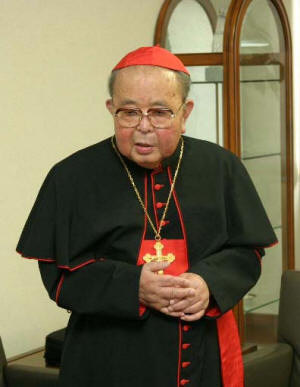
Cardinal Shirayanagi Expresses Church Apology on Takayama Anniversary in Manila
►MANILA — (UCAN, Feb. 9, 1995) — During the 1995 Memorial Mass for the Servant of God, Justus Takayama Ukon (1552-1615) at the Chapel of the University of Santo Tomas (U.S.T.) in Manila, Cardinal Peter Seiichi Shirayanagi of Tokyo — the prelate in charge of the Takayama Beatification Process — apologized for the suffering inflicted by Japan during World War II, which he described as the “darkest period” in his country´s modern history.
In his homily Feb. 1, Cardinal Shirayanagi said that Japanese Catholics, “as parties involved in the war, share in the responsibility for more than 20 million (war) victims in Asia and the Pacific.”
Japanese Bishops Ask Forgiveness ‘From God and Our Brothers’
“We, the Catholic bishops of Japan, as Japanese and members of the Catholic Church, sincerely ask forgiveness from God and from our brothers and sisters of Asia and the Pacific for the tragedy brought by Japan during World War II,” said the Cardinal, who was then president of the Catholic Bishops´ Conference of Japan.
The Memorial Mass at the University of Santo Tomas, sponsored by the Movement for the Beatification of Ukon Takayama headed by Prof. Ernesto A. Pedro, commemorated both the 380th death anniversary of Lord Justo Takayama Ukon, a Japanese Catholic nobleman who died in exile in Manila on Feb. 3, 1615, as well as the 1945 Battle of Manila (Feb. 3 – March 3, 1945).
Some 100,000 civilians were killed in the month-long battle that began Feb. 3, 1945, in which U.S. forces retook the city from occupying Japanese troops.
This February 3, Manila city officials marked the 50th anniversary of the beginning of the battle with simple ceremonies at Luneta Park including wreath-laying, photo exhibits and a Mass at which Cardinal Jaime Sin of Manila presided.
At centuries-old Santo Tomas, where the Japanese interned thousands of U.S. and other Allied civilians during the war, Cardinal Shirayanagi expressed “determination to keep Japan from committing the same crime again.”
“As the Church of Japan, we renew our commitment to work toward the realization of human liberation and genuine peace in Asia and the Pacific,” he said, adding that Japanese Catholics constantly pray for victims of the war.
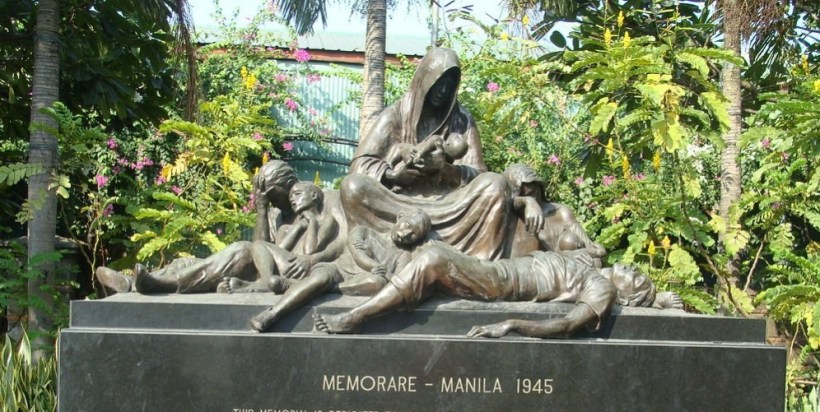
“Memorare Manila 1945” commemorates the death of some 100,000 Filipinos during the Battle for the Liberation of Manila Feb. 3-March 3, 1945. February 3 is the anniversary of Lord Takayama’s death in Intramuros, Manila.
Apostolate Among Overseas Filipino Workers in Japan Needed
One way the Japanese Church seeks to mend the damage inflicted against Filipinos by the war, the cardinal said, is through its apostolate with some 500,000 Filipino contract workers in Japan.
Even though Christianity reached Japan in 1549, but Catholics represent a small minority in his country, “only half a million among 120 million Japanese,” Cardinal Shirayanagi noted. It arrived in the Philippines in 1521.
The faith of Japanese Catholics, however, “has been tempered by centuries of relentless persecution … the most notorious in the world,” he added.
Also in his homily, the cardinal expressed gratitude for the “spontaneous response of the Filipino people” after the devastating earthquake in Kobe. This has comforted the victims of the January tragedy, he said, particularly as “this solidarity is offered by people who do not enjoy superfluities.”
Call for “Serious Effort for New Evangelization of Asia”
Cardinal Shirayanagi, who was also in Manila during the visit of Pope John Paul II on Jan. 12-16, reminded Filipino Catholics that the joint task at hand is “a new and serious effort for the evangelization of Asia.”
He cited addiction to worldly goods as the greatest challenge to evangelization today, having produced a “new idolatry.”
The cardinal observed that in Japan, people’s highest aspirations are to have more money, a higher standard of living and more material goods. ◘
The Philippines Ranks No. 3 Worldwide With 83.6 Million Adherents
►Half of the world’s Catholics are accounted for by only TEN COUNTRIES. According to Vatican figures (as of 2015), they are Brazil (172.2 million), Mexico (110.9), Philippines (83.6), USA (72.3), Italy (58.0), France (48.3), Colombia (45.3), Spain (43.3), Democratic Republic of Congo (43.2) and Argentina (40.8).
The number of Catholics worldwide increased, from 1,272 million in 2014 to 1,285 million in 2015.
Of every 100 baptized, 49 are from America, 22.2 from Europe, 17.3 from Africa, 11 from Asia, and 0.8 are from Oceania.
Viewed as continents, 63.7 percent of Americans are Catholics, 39.9 percent of Europeans, 19.4 percent of Africans, 26.4 percent of Oceanians, and 3.2 percent of Asians.
To serve them, there are 5,304 bishops, 415,656 priests, 670,320 nuns, and 45,255 permanent deacons. (No numbers for Brothers? No figures for seminarians preparing to serve?)
The grimmest figures are in the number of women religious, which has fallen from 721,935 to 670,320 – in only five years. ◘
Fr. Pedro Tomaselli, a PIME pastor in Ashikaga and Sano — north of Tokyo.
The ‘Coldness’ Is Grim in an Affluent Japan
►Of the total population of Japan of 127 million, more than 99% — THAT’S ALMOST ALL JAPANESE! — are Shinto/Buddhist, leaving a tiny fraction – 0.35% of the population — as Catholics.
But Catholics are OUTNUMBERED — two to one — by Christians of other denominations: Anglican, Baptist, Greek Orthodox, the International Church of the Foursquare Gospel, Lutheran, Mennonite, Methodist, Pentecostal, Presbyterian, Russian Orthodox, the Salvation Army, the Seventh-day Adventist Church, and other persuasions. But even when counted together, ALL CHRISTIANS comprise LESS THAN ONE PERCENT of the population.
A Brazilian missionary of PIME (Pontificio Istituto Missioni Estere) who studied four years in Manila, has shared how “lonely” the evangelical challenge can be at his mission north of Tokyo. On weekdays, this means “only two” worshipers are present at his celebration of the Holy Mass. About a hundred come for Sunday Mass. Only two couples are his real friends. A joyless Japan is centered on itself, competition and success.
The AsiaNews (official press agency of PIME) has posted this story about “Father Pedro and His 25 Japanese Friends”:
►ROME — (AsiaNews) – Father Pedro Tomaselli, 42, is a priest with the Pontifical Institute for Foreign Missions (PIME). He hails from Santa Caterina, southern Brazil, and has lived in Japan since 2008, serving as pastor in two cities — Ashikaga and Sano, in Tochigi Prefecture, north of Tokyo — some 40 minutes apart by car.
About 25 Japanese take part his Sunday Mass. Other worshippers come from the Philippines, Vietnam, Bolivia, Peru, a couple from China, and a few students from Africa. In total, a hundred, no more. On weekdays, “only two” come to church for the service. For Fr. Tomaselli, “it is necessary to leave the outcome in God’s hands, because if one were to rely on one’s own results, one would quit Japan immediately.”
Did you want to come to Japan or did the circumstances of life lead you to it?
I wanted it but had little hope. As a young seminarian, I was impressed by the missionaries I met who talked about their experience in Japan. That’s where my desire was born. I later had the opportunity of studying philosophy in the Philippines for four years, but Japan never left my mind. When Fr. Marc Tardiff (then PIME General Advisor, now missionary in Japan) came to the seminary and met us individually, he asked us to pick three countries for a possible destination. I told him: Thailand, Japan and Mexico. I ended up instead in Brazil as an outreach missionary for three years. One day though, I got a phone call from Rome, from Fr. Francisco da Silva. At the age of 33, I took off for Japan.
Did you speak Japanese already?
No. I started from scratch — two years in Tokyo at the PIME’s regional home. Another year with the local Franciscans. Finally, another 12 months with a Japanese priest in two parishes in Gunma Prefecture. Still, after nine years, I still have trouble communicating.
How is your daily mission?
I arrived in Ashikaga, north of Tokyo, where I am in charge of a multinational parish. I also deal with another parish, not far away. I live alone in the rectory. About 25 Japanese come to Sunday Mass, though my parish registry has 187 names. In addition, we have Filipinos, Vietnamese, Bolivians, Peruvians, a couple of Chinese and some African students. I always read the Mass in Japanese once. Alternatively, I do it in Vietnamese, Tagalog, or English. The songs are in Spanish. On weekdays however, only two come.
Are there any integration issues?
Foreigners help and enrich the Japanese Church. Without them, most communities would not survive. Foreigners are fundamental to evangelization.
Who are your friends?
Two families have especially opened their hearts to me and I to them. This is quite rare. In fact, the Japanese see friendship as an exchange of favors. I give you something or do something for you and you give something to me or do something for me, then we are friends. It is not bad, but it is different from the free love that Jesus taught us. It must also be said that they are not in the habit of opening their homes. Once I was happy when I finally received an invitation. I thought I was going to the house of these people, but instead they came to pick me up to go to a restaurant.
What about the two cases you mentioned?
What happened is that thieves broke into the church and the rectory three times. They told me that in Japan if a person violates private property then he is capable of any violence. I was so scared that I could not sleep any more. A bit selfishly I prayed, “Lord, I do not want to die martyred in such a petty way.”
Then, my Japanese friend showed up at the rectory one night and said, “I’ll spent the night here with you. You are tired and you have to rest.” A bit ceremoniously, Japanese style, I told him: “No, no! you have your family; you must go home to them.” But he insisted, and for some nights he came to keep me company. He is 70 years old and converted to Christianity about 20 years ago. He has four children, one of whom is a priest.
How did you befriend the other family?
They come from Nagasaki. He was already a Catholic, she was not a Christian. Or, better, she said she was a bit Shintoist and a bit Buddhist. She said she liked being free. “Come on,” I would tell her, “then your heart must be Christian.” She laughed.
Having strong feelings for the poor, she expressed some admiration for Mother Teresa of Calcutta, but nothing would bend her. I did not insist. After three years (about a year ago), she came to me and said, “Let’s start studying.” Eventually, she asked to be baptized.
Why is it so difficult to pass on the Christian message in Japan?
Being Japanese is almost like a religion. I asked one kid, “What is your religion?” And he answered: “My grandparents were a bit Shintoist and a bit Buddhist; my parents a bit Buddhist and a bit indifferent, I am Japanese.” Given such syncretism he confided in me and said that he liked Catholic weddings.
The Church has put greater efforts in Japan than in Korea. Yet Catholicism is more widespread in the latter. Why?
No bishop or priest in Japan would ever say that we must imitate Korea. Pride prevents it. Unresolved historical events that have come to the fore again in recent weeks also prevent it. It is undeniable that the situation is different. If I think about Brazil, its 500 short years of history, its melting pot — I certainly see greater openness to new things.
However, we cannot say that Japan’s ancient culture is in itself an impediment to the novelty of the Gospel. The point is always about touching people’s hearts. The Japanese mind-set aims at competition and victory, but faced with the inevitable defeat in life, it has no answer, and that is the end. Failures are not an opportunity to grow, but a misfortune that sometimes results in tragedy. Just think of the countless cases of depression and suicide. Many people who come to church go through these problems. For them, we proclaim hope.
Yet, the proclamation must also be valid for everyone caught up in the frenzy of everyday life
The idolatry of money and work is widespread. Often what matters the most is not the family, but the company one works for. There is even a tendency to show that one is busy even when one is not. The Japanese propensity of seeing themselves in a group rather than as individuals is still very strong. If you ask, “Who are you?” The answer is, “Ask my neighbor.” Still, it would be wrong to focus on these flaws. First, one has a lot to learn and share. I remember their kindness, honesty, cleanliness, order… We need to listen to them.
One gets the impression that joy is missing in Japan…
Indeed. At the Shinjuku railway station, employees must exercise their facial muscles to learn to smile before working with the public. Although it does not seem very honest, they say it does a lot of good.
Of course, with the great joy of the Gospel, this would not be necessary. ◘
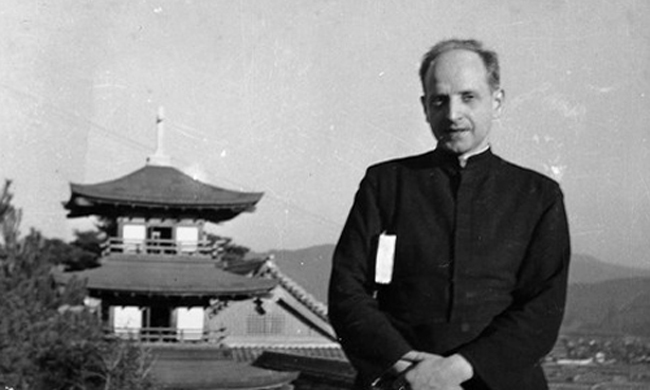
Fr. Arrupe led first-response team to aid hapless victims of the A-Bomb
Fr. Pedro Arrupe Led Response to the Thermonuclear Carnage
►Saul of Tarsus, a zealous Pharisee who was a relentless persecutor of early Christians, was so active in pursuing Christians that he was even present at the stoning to death of St. Stephen, the Protomartyr or first martyr of Christianity. But he had his “Damascus” moment (circa AD 33–36) – “on the road to Damascus” — when he was felled by a blinding light and heard a voice say to him, “Saul, Saul, why do you persecute me?” — an event recorded in the New Testament. He became an ardent follower of Jesus and is venerated in Christendom as Paul the Apostle.
Emperor Constantine had his “Chi-Rho” (ΧΡ) moment in AD 312 when, marching to battle, he saw a cross of light above the sun, and with it some Greek words, rendered into Latin as “In Hoc Signo Vinces” (“In This Sign, You Will Conquer”).
Fr. Pedro Arrupe, SJ (1907-1991), Father Superior of Jesuits in Japan during World War II, had his “Hiroshima” moment – when the First Atomic Bomb was dropped on humans as an instrument of mass destruction on Aug. 6, 1945. Fr. Arrupe described that event as “a permanent experience outside of history, engraved on my memory.”
The Jesuits were at the rectory of the Church of Our Lady of the Assumption when they heard the sirens warning of the approach of a hostile bomber. After an ominous explosion they felt the concussion that blew the doors and windows of the rectory. Led by their Father Superior, the Jesuits ventured out to see Hiroshima engulfed in a “lake of fire.” He later recalled: “I shall never forget my first sight of the result of the atomic bomb: a group of young women, 18 or 20 years old, clinging to one another as they dragged themselves along the road.”
Knowing nothing about the dangers of atomic radiation, the Jesuits brought into their damaged rectory some 150 of the wounded and dying, under the direction of Arrupe, who had some medical training. Arrupe recalled, “The chapel, half destroyed, was overflowing with the wounded, who were lying on the floor very near to one another, suffering terribly, twisted with pain.”
Whereas thousands of people had been immediately vaporized in one blinding instant, Fr. Arrupe and ALL the German Jesuits — including Fr. Hubert Cieslik (1914-1988), who would later be the lead historian for the “Beatification Cause of Justo Takayama Ukon” — continued to live without serious ailments or disabilities for over four decades after the A-Bomb. Fr. Hubert Schiffer, SJ, and his fellow Jesuits believe they survived “because we were living the Message of Fatima and we lived and prayed the Rosary daily in that home.” ◘
Dr. ERNIE A. DE PEDRO
Managing Trustee
Lord Takayama Jubilee Foundation
Lord Takayama, Symbol of Philippine-Japanese Friendship, Guarding the DMCI Equipment Yard
But Will Plaza Dilao Still Be There?
►Plaza Dilao Is Now the Equipment Dump of DMCI, Builder of Skyway-3.
The Plaza Dilao Project, funded by popular subscriptions from Japanese cities, chambers of commerce, breakfast prayer-groups, and Catholic and Protestant churches in Japan — with land and labor donated by the City of Manila — was inaugurated as “The Philippines-Japan Friendship Park” on Nov. 17, 1977.
In brief, Nov. 17, 2017 marks:
►FORTIETH (40th) anniversary of the establishment of the Philippines-Japan Friendship Park at Plaza Dilao in 1977.
►25th (Silver) Anniversary of the proclamation of the Takayama Memorial as a National Monument by the National Historical Commission of the Philippines (NHCP) on Nov. 17, 1992.
►425th year of the founding of the “Dilao” settlement in 1592 as the first Japantown (“nihon-machi”) in the Philippines. The Japantown was resettled in its fourth and present site (in front of the Paco Railway Station) only in 1762. Plaza Dilao has been located in its present spot for 255 years!
►ELEVENTH (11th) year of Plaza Dilao as ONE of Manila’s five Freedom Parks.
All these are great milestones in the history of the Philippines and Japan!
At 10:00 AM (Friday) – Laying of Flowers at the Pedestal of the Takayama Memorial. ◘


 Blessed Justo Takayama Ukon