►After the Beatification of Blessed Justo Ukon Takayama (1552-1615) in Osaka on Feb. 7, 2017 – the Jesuit community at the Ateneo de Manila celebrated a Thanksgiving Mass at the chapel of the Loyola School of Theology on Saturday, March 18, 2017.
Very Rev. Fr. Antonio F. Moreno, then the Jesuit Father Provincial, officiated at the concelebrated Mass, along with Fr. James McTavish, provincial superior of Verbum Dei Missionaries, and Fr. Iwao “Wow” Daniel Ikegami, FMVD.
In the congregation were priests, scholastics, seminarians, lay and religious students, and Japanese nuns from various Metro-Manila congregations — and the former Jesuit Superior General in Rome, Fr. Adolfo Nicolas, who lived in retirement at the Ateneo.
Homily by Japanese Priest Born in Brazil
The homily was delivered by Fr. Iwao “Wow” Ikegami, a Brazilian-born Japanese who was ordained August 2015, sharing his journey to the priesthood and the relevance of Blessed Takayama Ukon to relations between the churches of Japan and the Philippines.
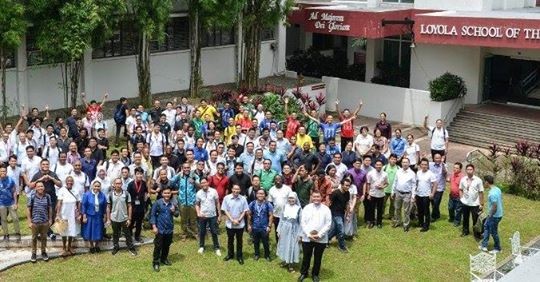
Loyola School of Theology (LST) is an international academic community
Blessed Takayama — A Jesuit “Cause”
►Among 86 Daimyo who converted to Christianity, Lord Takayama, as patron of Jesuit missions, used his resources to support the growth and expansion of the early church of Japan — building churches, chapels and seminaries for the Jesuit missionaries, who were the only Catholic religious congregation in Japan beginning 1549 till 1602 when Manila-based Spanish missionaries started arriving.
It was a Jesuit, Padre Pedro Morejon, who conducted a 30-day “Spiritual Exercises” for Lord Takayama — in preparation for martyrdom — before the exile ship left Nagasaki for Manila with 350 Japanese Christian deportees on Nov. 8, 1614.
It was this same Jesuit, Fr. Morejon — (Takayama’s father-confessor) — who wrote the petition of the Manila Archdiocese dated Oct. 5, 1630 — proposing to the Congregation for the Causes of Saints a Japanese Catholic — who died in Manila; under church rubric “where one dies, is where one is born to Heaven” — as the FIRST saint of the Philippine Church.
It was also a committee of Jesuit historians in Japan, headed by Sophia University’s Fr. Hubert Cieslik, SJ, who prepared in 1963 all the supporting documents for Takayama’s “Positio.”
First as Confessor — Then as Martyr
It was the Jesuit General Postulator, Fr. Paolo Molinari, SJ, who presented the original “Postio” enumerating the heroic virtues of a Confessor — “Servus Dei, Justus Takayama Ukon: Materia Praeparata Pro Propositione Super Virtutibus Servi Dei Justi Takayama Ukon” (Manila: Lord Takayama Jubilee Foundation, 1994) – which resulted in Takayama’s being recognized as a “Servant of God.”
It was another Jesuit General Postulator, Fr. Anton Witwer, SJ, who submitted the revised version for a Martyr – “Positio Super Martirio: Beatificationis Seu Declarationis Martyrii Servi Dei Iusti Takayama Ukon Viri Laici in Odium Fidei, Uti Fertur, Interfecti” (Rome: 2015).
Pope Francis Issues ‘Decree of Martyrdom’
It was another Jesuit, Pope Francis, who allowed the “switching” of the “Cause of Takayama” from Confessor (when Takayama earned the title “Servant of God” on June 8, 1994) to Martyr – by issuing a Decree of Martyrdom on Jan. 21, 2016, recognizing Takayama as a martyr — a “layperson … from Japan [who] died from the hatred of the Faith on Feb. 3, 1615 in Manila, Philippines.”
In an unusual development, the “Servant of God” Justo Ukon Takayama skipped the “Venerable” stage — and went directly to “Blessed.”
Takayama Conference Room
Loyola School of Theology (LST)
Rev. Fr. Jose V. C. Quilongquilong, SJ, President, Loyola House of Studies, shares that the Loyola School of Theology has honored Blessed Takayama by naming a conference room after him. The “Takayama Conference Room” is located in the Lucas-LST Wing.
Loyola School of Theology (LST) is one of the seven (7) English-speaking faculties of theology in the world administered by the Society of Jesus and is the only one in the Jesuit Conference of Asia Pacific. For School Year 2018-2019, the LST has 470 seminarians, priests, lay and religious students (283 Filipino and 187 international students) representing 63 religious congregations, 72 dioceses and 38 countries around the world.
Wanted: One Miracle from God Interceded by Blessed Takayama
Dom Justo Ukon Takayama (1552-1615), Lord of Takatsuki Castle at 21. During his 12-year rule of Takatsuki, 18,000 out of 25,000 residents converted to Christianity
Today, Takayama’s “Cause” is awaiting one validating miracle through the intercession of Blessed Takayama — a requirement to show that indeed Blessed Takayama dwells in the presence of God.
The final step is canonization – or inclusion in the Roman Catholic Church’s Canon of Saints, now numbering over 10,000 Saints.#
►Though the Meiji Constitution (明治憲法) has guaranteed religious freedom since 1889, today (2018), Japanese Catholics comprise only ONE-THIRD OF ONE PERCENT of Japan’s 126.53M population.
If a JumboJet landed in Manila with 330 Japanese passengers, only ONE of them would be Catholic!
There are approximately 509,000 Catholics in Japan. There are 16 dioceses, including three archdioceses, with 1,589 priests and 848 parishes in the country.◘
Tokyo Concert featuring first hymn for Blessed Takayama — in Tagalog
Lingkod ng Pag-ibig Concert
(Based on information posted by Ms Puchie Gan of “The Gathering of Filipino Groups and Communities” (GFGC), co-sponsors of the “Servants of Love” Benefit Concert)
►The “Servants of Love” (Lingkod ng Pag-ibig) Concert, which was held at the Shibuya Cultural Center / Owada (Sakura Hall) in Tokyo, Japan on Aug. 31, 2018, presented a raft of Tagalog hymns, among them the first Takayama Ukon Hymn, composed by Jay Gomez, JMM (HimigHeswita) artist, and sung by Rey Malipot, JMM artist.
The Ateneo-based Jesuit Music Ministry (JMM) has pioneered in Tagalog liturgical music since Vatican II encouraged greater partification of congregations in singing hymns during the Mass.
►Ministries of Music have been an important feature of Eucharistic celebrations throughout the centuries. The Filipino hymn “Salamat sa Iyo” (Tanging Alay) was sung as the Offertory Hymn at the Beatification Rites of Blessed Takayama in Osaka on Feb. 7, 2017. The Tagalog hymn was selected as a nod to Takayama’s being “born to Heaven” in Manila, on account of his “death by martyrdom” in Intramuros in 1615.
PHILMISS Choir
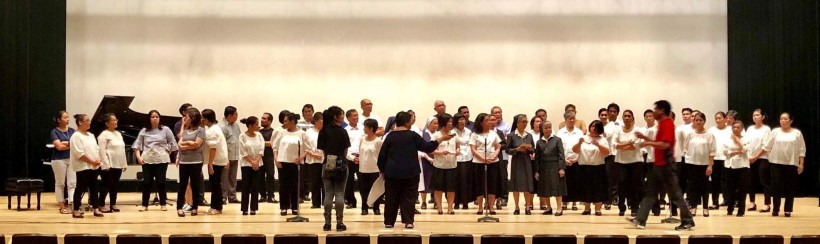
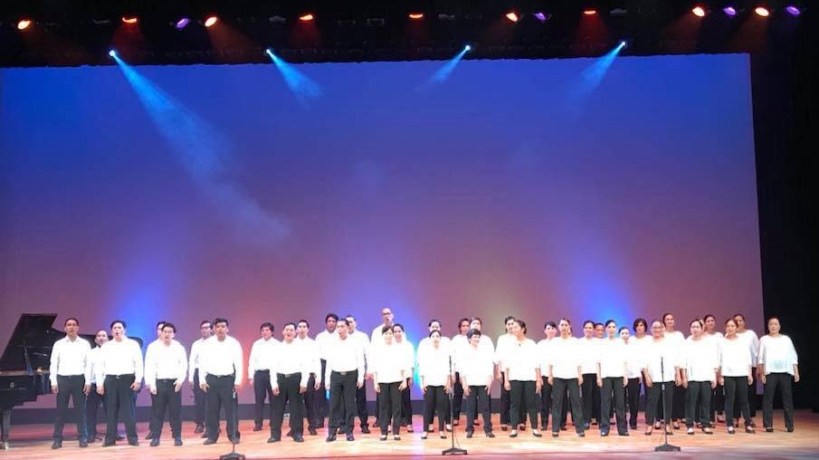
►The ”Servants of Love” concert featured “PHILMISS,” an organization of priests, nuns and lay missionaries in the Kanto area. (The Kantō region [関東地方] includes the Greater Tokyo Area encompassing seven prefectures: Gunma, Tochigi, Ibaraki, Saitama, Tokyo, Chiba, and Kanagawa.)
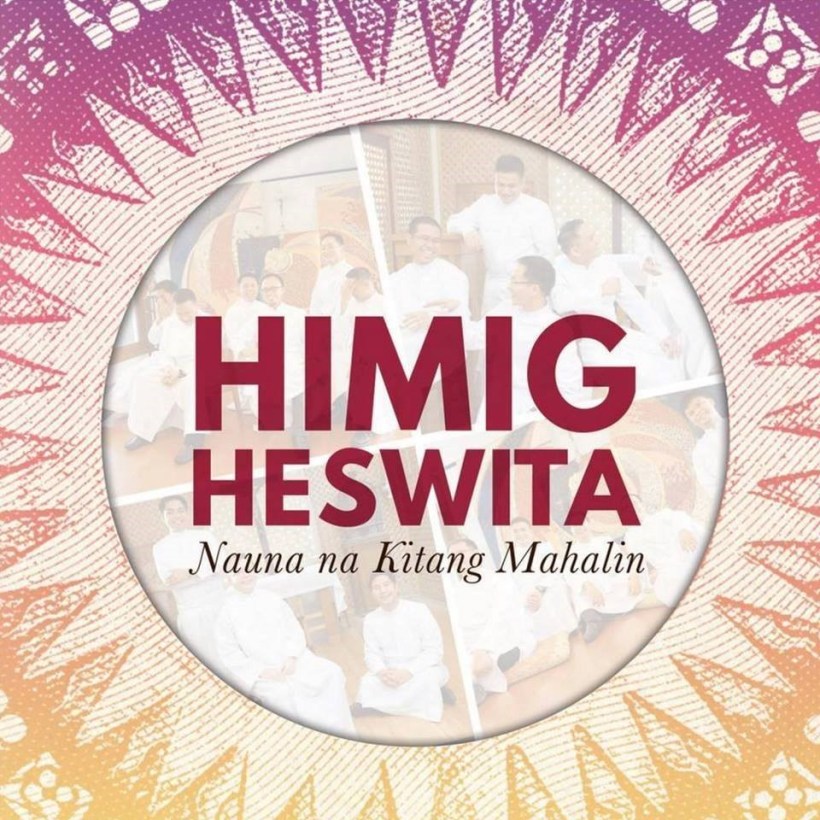
Included in the concert are two recording artists from “Himig Heswita” — Rey Malipot and Jay Gomez. Rey is featured in the latest Himig Heswita album, “Nauna na Kitang Mahalin” and Jay Gome, flutist, in Vesper 7.
Jesuit Music Ministry (JMM)
►The Jesuit Music Ministry (JMM) is a producer and publisher of music for use in the liturgy of the Roman Catholic church. It was established in response to Vatican II’s “Sacrosanctum Concilium” which urged the entire congregation to actively participate in the liturgy that includes singing. JMM songs are now sung in churches not only in the Philippines but throughout the world.
By 1965, JMM began composing songs in the Filipino idiom. Many well-remembered compositions followed throughout the 70’s, resulting in what could be called “classics” of Filipino Liturgical Music: “Ama Namin (Our Father),” “Ang Puso Ko’y Nagpupuri (Magnificat)” and “Pananagutan.” 1981 saw the release of “Himig Heswita,” an album celebrating 400 years since the arrival of the Jesuits in the Philippines. JMM has built on this splendid track record since then.
🎼 🎶 🎵 🎶 ‘TO THE END’ 🎶 🎵
(Takayama Ukon Hymn)
Words and Music by Jay Gomez
——————————–
How do we make the choice
As you have made to hear His voice?
What did you see? What did you know?
All that you had, for Him, you let go.
Takayama Ukon, we will follow your lead.
Together as one, His call, we shall heed.
The life that you lived will show us the way.
Walk us through this journey.
We will not astray.
You honored and loved the Father
In the midst of martial power.
You stood by the church, held on to His word,
Withstanding the draw of this blinding world
Takayama Ukon, your faith is esteemed
A reminder that we, through CHRIST, are redeemed.
Takayama Ukon, you did not bend.
While there’s fear and doubt in others,
You believed in Him to the end.
Bridge:
Isa kang sorpresa, mula bansang Hapon. Sana’y nagkapiling ng mas mahabang panahon. Di man nagtagal ang naging samahan Minahal ka ng bayan, ang Perlas Ng Silangan!#
Photos from the Wall of Jan Michael Acaylar and Fumi Terada:
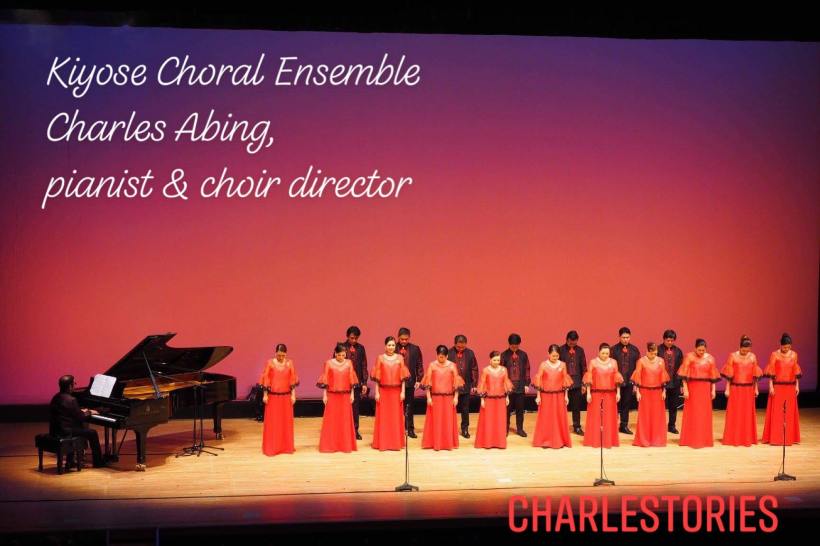
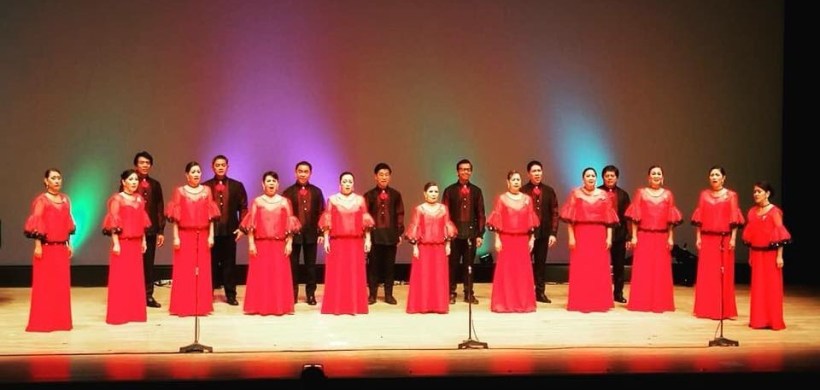
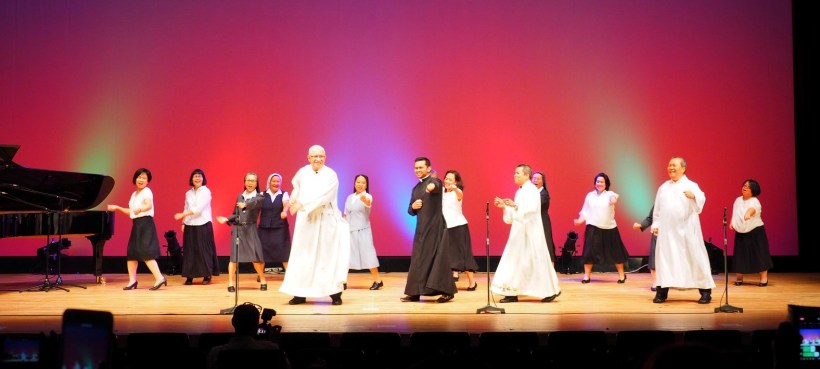
… And they sang their hearts out — for a causeThe Kiyose Vocal Ensemble is the choir of the Kiyose Catholic Church.Philippine Missionaries in the Kanto Region showed they could sing!The Tagalog hymns resonated with an audience that left their hearts in the old country.It was not just one choir that responded to the cause. They all came from the Kanto region.AND THEY DANCED!
►The last piece of the concert — “Ang Puso Ko’y Nagpupuri” (composed by Eduardo Hontiveros, SJ).
Classic hymn by Fr. Eduardo Hontiveros, SJ.
First Ever Concert Rendition of Takayama Hymn
►Here is Rey Malipot, JMM artist singing “To The End” — Takayama Ukon Hymn.
The Takayama Hymn composed by G. J. Herman Gomez was sung for the first time in a concertJMM artist Rey Malipot singing Jay Gomez’s “To The End.”
Credits for a Successful Benefit Concert!
►Great appreciation to Maria Kasuya for directing the entire show and Puchie Gan for teaching the songs and choreography of the grand choir. 💓 💕!!!
►From Blessed Justo Takayama Ukon Canonization Movement to the Jesuit Music Ministry (JMM): Maraming Salamat! 🙏 💓 💕!!!
Compiled by Dr. Ernesto A. de Pedro
Takayama Trustee
►Ordained at San Jose Seminary (inaugurated 1601) at the PLM/Jesuit Compound in Intramuros, Manila, this “Josefino” martyr was beatified in Nagasaki on Nov. 24, 2008.
Blessed Diego Yuki Ryosetsu (1574-Feb. 16, 1636) arrived in Manila with Lord Justo Ukon Takayama’s exile group of 350 Japanese Christian deportees on Dec. 21, 1614. He completed his seminary studies at the San Jose Seminary (now relocated in Loyola Heights, Quezon City), where he was ordained. Knowing full well the risks of martyrdom, he returned to Japan to profess his ministry.
Diego Yuki Ryosetsu was born of samurai stock in Tokushima on the island of Shikoku: his father was a younger brother of Shogun Ashikaga Yoshiaki, who had preceded Oda Nobunaga as head of the realm. He enrolled in the Jesuit seminary upon reaching school age. In 1597, after ten years of study there, he was received into the Society of Jesus.
From 1601 to 1604 he did theological studies in Macao, but was not ordained a priest.
After his return to Japan, he was sent to evangelize in the central provinces of Japan, where he proved to be a very capable and successful missionary. He even traveled as far as Shikoku, where he had the pleasure of preaching to his Ashikaga relatives and even baptizing several of them. In 1612, he moved to Nagasaki to prepare for ordination, but Bishop P. Martinez who was to have ordained him fell ill and died.
Expulsion of All Missionaries and Principal Catholics
In 1614, Tokugawa Ieyasu, the first of the Tokugawa Shoguns, ordered all missionaries to leave Japan. At the same time he ordered the “Kirishitan Samurai” Justo Ukon Takayama to go into exile in Manila. Yuki decided to go with him to Manila, and one year later he was ordained a priest in the Philippines.
Yuki returned secretly to Japan in 1616, and was sent to minister to the Christians in central Japan. For 20 years he continued to do pastoral ministry all through the central provinces.
In the end, Shogun Hidetada’s persecution of the missionaries in central Japan was so effective that Yuki was the only priest remaining to minister to the Christians. (Everywhere he went he was accompanied by his faithful catechist Soan.)
Captured — After 20 Years on the Run
In 1636, Ryosetsu too was captured, in the mountains of Shikoku.
Sent to Osaka for interrogation, he was asked to give the names of those who had given him lodging. But his persistent answer was that no one had given him lodging, that he had lived in the hills and the fields, warding off starvation by eating only what nature provided him.
Seeing the weak and emaciated condition of the old man, his interrogators believed him. Thus, he alone was condemned to death; none of those who had helped him were made to share his fate.
Blessed Diego Yuki Ryosetsu –Upside-down “in the pit”
Death ‘in the Pit’
On February 26, Yuki was condemned to die. He endured torture called “the pit.” Bound tightly with ropes, his body was hung upside down into a hole filled with excrement, until he died of suffocation.
He was 61 years old. His faithful catechist, Soan, who had been beside him all through his travels, was his companion to the end and died at his side.
At Yuki’s beatification, Tokyo Cardinal Seiichi Shirayanagi said: “The persecution in Japan lasted long and its cruelty is unparalleled… The martyrs make us think about fundamental issues, such as the meaning of life and its pains.”
Japan has pantheon of 42 Saints and 394 Blessed
In 2018, the Church of Japan has in fact 42 Saints and 394 Blessed — all martyrs. All lost their lives in Japan – with the lone exception of Blessed Justo Ukon Talayama, who was “martyred” in Manila on Feb. 3, 1615. “These martyrs bless the Japanese Church with their splendid witness,” said Cardinal Angelp Amato, SDB, Prefect of the Congregation for the Causes of Saints (CCS) when he presided at the Beatification Ceremony of Blessed Takayama, Japan’s 436th vererated Martyr, on Feb. 7, 2017.#
Compiled by Dr. Ernesto A. de Pedro Managing Trustee
Bloganuary writing prompt
Write about your first name: its meaning, significance, etymology, etc.
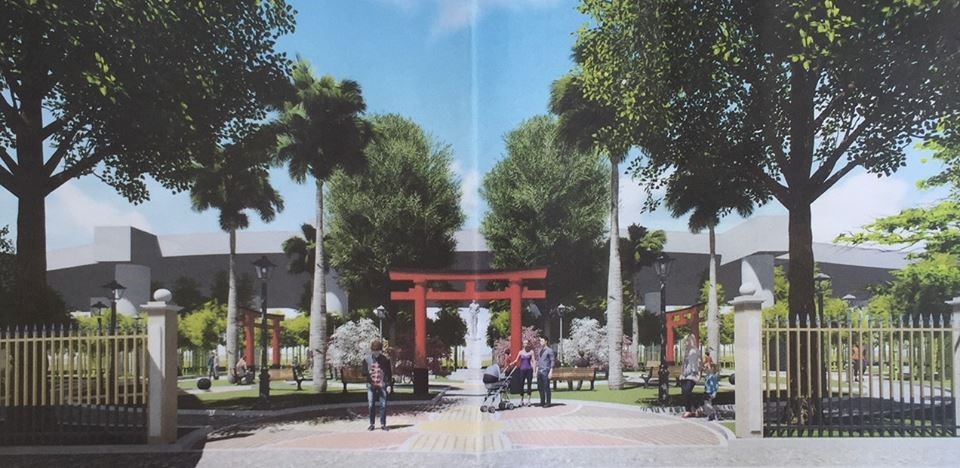
A Japanese “torii,” symbol of Japan, will be added to the Takayama Memorial, standing at a Philippines-Japan Friendship Park, but still in its original location at Plaza Dilao, “nihon-machi” of Japanese migrants and refugees across four centuries.
►With the Metro Manila Skyway Stage 3 Project (MMSS3) in its completion stage, rehabilitation for the Takayama Memorial will start in September 2018. Target completion date is Dec. 21, 2018 – 404th anniversary of the Manila arrival of Lord Takayama and 350 Japanese Christian exiles in 1614.
The elevated expressway, which bisects Plaza Dilao, is designed to ease Metro-Manila traffic through the eight (8) access ramps/interchanges strategically located as follows: ◘ Buendia Avenue, (South Super highway, Makati City), ◘ Pres. Quirino Avenue, (Malate, Manila), ◘ Plaza Dilao (Paco, Manila), ◘ Nagtahan/Aurora Boulevard (Manila), ◘ E. Rodriguez Avenue (Quezon City), ◘ Quezon Avenue (Quezon City), ◘ Sgt. Rivera St. (Quezon City) and ◘ NLEX.
Major Stakeholders in Plaza Dilao
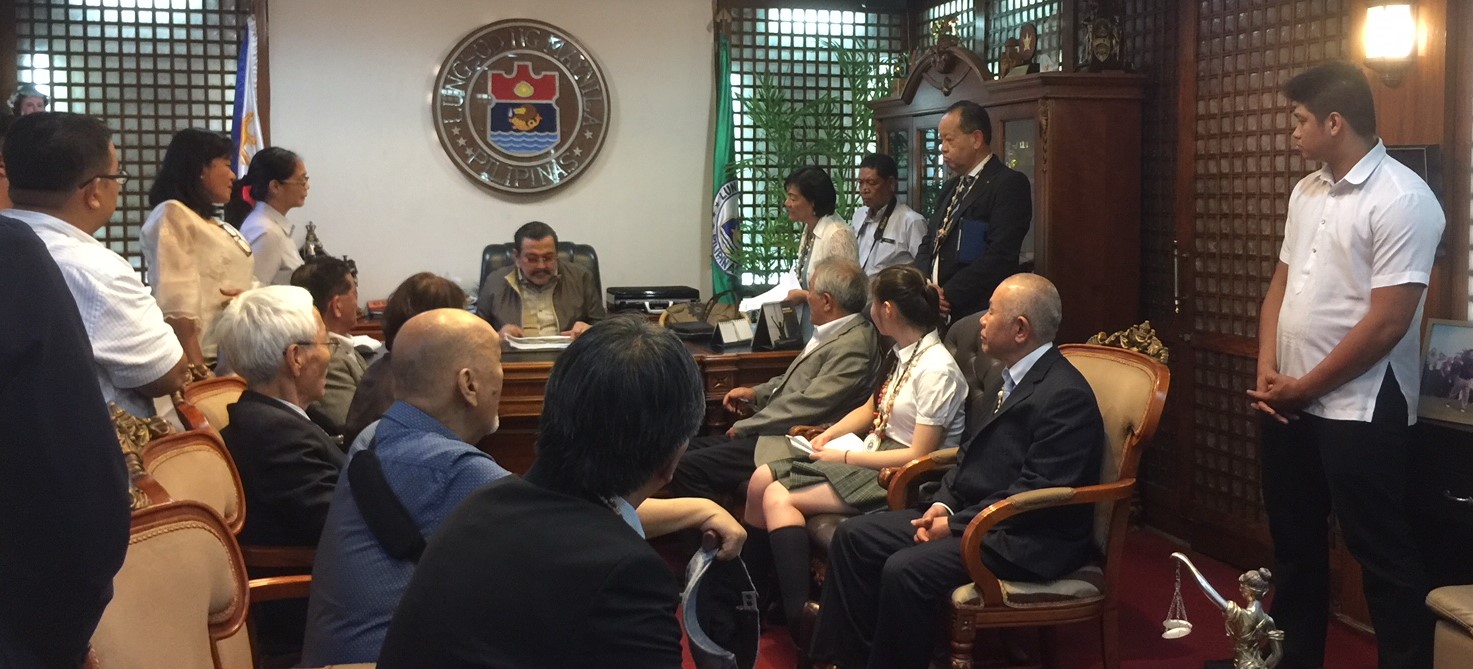
Manila Mayor Joseph “Erap” Estrada discusses plans for the renovation of Plaza Dilao.
The major stakeholders, meeting with Manila Mayor Joseph “Erap” Estrada to plan Plaza Dilao’s renovation are: ◘ The City of Manila, ◘ The Embassy of Japan in the Philippines, and◘ The National Historical Commission of the Philippines (NHCP). Implementing the renovation is the construction consortium behind Metro Manila Skyway Stage 3 Project (MMSS3).
►Overall project coordinator for the renovation of the Takayama Memorial is Director Arsenio Lacson, Jr, of the Manila Parks Development Office which overseas 47 Parks, Plazas and Monuments throughout Manila.
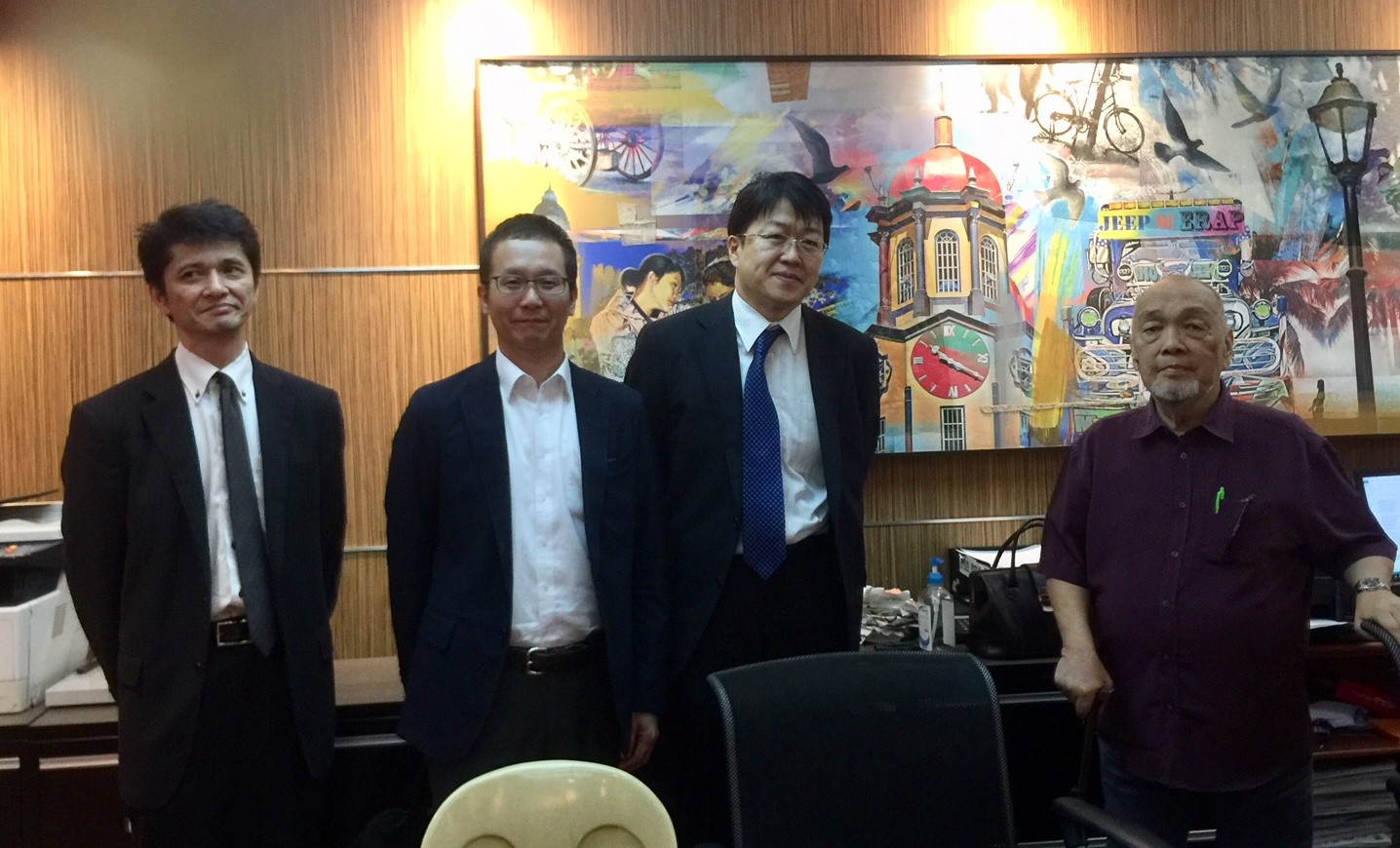
Representatives of the Japanese Embassy in Manila, coordinating with Manila City Hall.
►The Embassy of Japan in Manila was represented by Mr. Atsushi Kuwabara, Minister and Consul-General; Mr. Shinya Yabe and Mr. Tomoyuki Honda, first and second secretaries respectively, and Mr. Ken Nakamura, Director of the Japan Information and Cultural Office.
Historical Background of the 1977 Memorial
►MANILA ENABLERS — The Takayama Memorial was erected in 1973-1977, under the auspices of the Manila Ladies’ Committee — the Kababaihan sa Pagpapaganda ng Lungsod ng Maynila – formed for this project only.
►JAPANESE COUNTERPART –The Counterpart Japanese organization was an ad-hoc group led by Rev. Ryoichi Katoh, director of the Southeast Asian Friendship and Culture Association (SEAFCULA).
►JAPANESE CONTRIBUTIONS — One-hundred percent of the enabling funds came from some 180 Japanese Breakfast Prayer Clubs – supplemented by contributions from Japanese chambers of trade and industry.
Land for Friendship Park Donated by City of Manila
►The City of Manila donated the 2,000-square meters parcel in front of Paco Station of the Manila Railroad in Plaza Dilao — and provided labor.
►The renovation project is being undertaken by a consortium represented at the Manila City Hall meetings by: ◘ Engr. Efren Rabot, Toll Regulatory Board (TRB) ◘ Atty. Jinky Magpantay, CCEC/SMHC ◘ Mr. Jose S. Tanqueco, Jr., CCEC/SMHC ◘ Engr. Rolando M. Recio, CCEC/SMHC ◘ Engr. Rolly Escamilian, DMCI ◘ Engr. Clyde E. Sotto, Gemwealth Construction & Trading ◘ Engr. Chavez, Gemwealth Construction & Trading.
Plaza Dilao — in 1973-1977
►Plaza Dilao was a nondescript plaza that was an eyesore when the First Lady, Imelda Romualdez Marcos, then the Governor of Metro Manila, requested Manila Mayor Ramon Bagatsing to beautify the spot.
Foreign dignitaries visiting Malacanan Palace were bound to pass by the unsightly place which had squatters scrambling all over the place.
The fact that it had once been the resettlement area for Japanese refugees and migrants (since 1593, at its original Manila City Hall area, and since 1764 at its present location in front of the Paco Railway Station) was lost to many. The last time this fact was remembered was in 1942 when the wartime National Historical Commission proposed that a historical marker be installed to denote that this was the site of the first “nihon-machi” – or Japan-town. (No marker was installed.)
To support the call of Mrs. Imelda Romualdez Marcos (1929- ), for a beautification program for Metro-Manila at the start of martial law (1972-1981), Manila Mayor Ramon D. Bagatsing (1916-2006) organized on Feb. 1, 1973, the Kababaihan sa Pagpapaganda ng Lungsod ng Maynila [Ladies’ Committee for the Beautification of the City of Manila].
Their assignment: Beatify the parks and open spaces that dot Metro-Manila. But first: Beautify Plaza Dilao.
Manila Ladies’ Committee
FOR THE RECORD: The members of the Kababaihan were: Mrs. Julita C. Benedicto (wife of Philippine Ambassador to Tokyo, Roberto S. Benedicto), chairman; Mrs. Purita Ponce-Enrile, co-chairman; Mrs. Leonora Pascual, co-chairman; Mrs. Elisa Abello (wife of Philippine Ambassador to Washington, Emilio Abello), vice-chairman, and Miss Lourdes R. Caruncho, executive secretary. Members were Mrs. Carmen P. Caro; Ms Mariquita Castelo; Ms Remedios Francisco (historian); Mrs. Leticia de Guzman; Mrs. Minerva G. Laudico; Mrs. Milagros Sumulong; Ms Albina Tuason, and Ms Juanita Valera.
When the ladies’ research indicated that the Dilao area – the old site, that is — had been reserved by the Spanish colonial government for Manila’s Japanese population in 1593, finally relocating at the Plaza Dilao area in Paco in 1764, the “Japanese connection” crept in. Perhaps a Japanese garden – “with plenty of plants and benches for people to rest and relax especially during the evening when traffic is less” — could be developed?
They decided to consult Japanese Ambassador Toshio Urabe (1969-1974) about the possibilities.
Not readily recognized by the Manila ladies at that time, Ambassador Urabe was the longest-serving Japanese diplomat engaged in rebuilding postwar Philippine-Japanese relations. Ambassador Urabe was a veteran Philippine hand, having been first assigned to Manila in 1953 as Counsellor of the Japanese Overseas Liaison Office. He led the team that negotiated the Philippine-Japanese Reparations Agreement that was ratified by the Philippine Senate in 1956. He was returned to Manila in 1964 as Ambassador, staying on till 1974.
Now in 1973, Ambassador Urabe – who is credited with the Japanese Garden at the Rizal Park and the Japanese Memorial Garden in Caliraya (Laguna) — discouraged the “garden” idea. He was not being a killjoy. Being located at a very busy traffic intersection, he thought “a Japanese garden would not be safe for residents to relax in.”
The Manila ladies countered that, whatever project was suitable, this could be jointly undertaken by the cities of Manila and Yokohama (Yokohama-shi, Kanagawa-ken), a sister city of Manila since July 1, 1965.
Urabe assured the ladies that he would contact the City of Yokohama for funding support, but — now he wanted to enlarge the base of Japanese public involvement and support — “he was quite vocal in saying that Manila’s sister city Yokohama should not be the only one to help in this project, but the other cities of Japan as well,” the Kababaihan reported to the Manila mayor.
AMBASSADOR URABE could not believe his luck. Only 28 years after the war (and only 17 years after the Philippine ratification of the Reparations Agreement), the Manila ladies — entirely on their own initiative — were proposing a joint people-to-people endeavor that the Japanese themselves had not even thought of.
The Japanese Ministry of Foreign Affairs then logically turned to the Japanese sector most concerned: the small minority of Japanese Christians who comprised less than one percent of Japan’s total population. The Gaimusho contacted the Southeast Asian Friendship and Culture Association (SEAFCULA), whose founder and managing director was Rev. Ryoichi Katoh, minister of the Tokyo Ikebukuro Church, an affiliate of the United Church of Christ in Japan (KYO-DAN). Providentially, the SEAFCULA had been founded “on the concept of ‘Redemption’ for the wrongful deeds committed during World War II against the Asian nations.” They set to work at once.
“When they [the Foreign Ministry] approached us, requesting our cooperation on the matter, we were of course glad and ready to accept their proposal, since we thought it proper to cooperate with them fully on the project, as part of the said redeeming activities,” Rev. Katoh would relate to Dr. Ernesto A. de Pedro, Takayama Trustee, some years later.
Lord Ukon Takayama, Epitome of the Japanese Spirit
After Rev. Katoh conferred with Osaka Archbishop Paul Yoshigoro Taguchi, a dedicated promoter of the “Samurai of Christ, Justo Takayama,” a memorial to Ukon Takayama as “the epitome of the Japanese spirit” became central to the SEAFCULA’s beautification plans.
The “Prospectus for the Construction of a Statue of Ukon Takayama and a Memorial Japanese Garden at Manila (SEAFCULA 73-142),” confirms that in Japan, Pastor Ryoichi Katoh and Archbishop Peter Seiichi Shirayanagi, archbishop of Tokyo and chairman of the Catholic Bishops’ Conference of Japan, agreed to sponsor the memorial project “as an ecumenical effort of Protestants and Catholics in Japan and the Philippines.” Certainly, at that time, it was most audacious to propose to the Philippines to erect a memorial to a Japanese personality — a samurai at that! — a scant 32 years after the brutal Japanese occupation of the Philippines.
In Manila, the Kababaihan sa Pagpapaganda ng Lungsod ng Maynila, after studying the possibilities, proposed on March 28, 1973, to Mayor Bagatsing:
“We women recommend that a memorial monument be constructed to honor the Christian feudal lord Takayama at a site of 2,000-square meters in front of Paco Station of the Manila Railroad in Plaza Dilao. This land had been assigned by the former Spanish government to the Japanese refugees. The realization of this plan should pave the way not only for closer fellowship between Japanese and Philippine churches, but also promote better friendship between the two countries.”
With the guaranteed financial support of SEAFCULA; the Executive Committee of Takatsuki City; the Keizai-Doyukai [the Japanese Council for Economic Development]; and Catholic and Protestant churches in Japan, the Kababaihan now proceeded with the project.
Scrambling for an Inauguration Date
The Plaza Memorial (covered by tarpaulin) was already standing for several weeks in early 1977, awaiting its inauguration by Governor Imelda Marcos – but with her busy schedule, the scheduled blessing was cancelled twice — after guests from Japan had already arrived.. After two agreed dates had been scrubbed, the Kababaihan finally set the inauguration date on Nov. 17, 1977 – “with or without Mrs. Imelda Marcos.” The set date was necessary because of the logistics of bringing a hundred invited sponsors from Japan who had to fix their own schedules and hotel reservations.
Finally, the Arc of History is Set
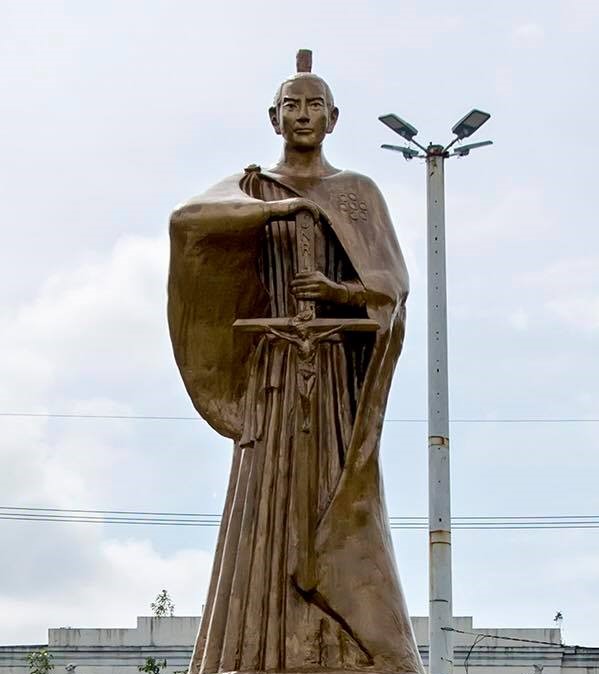
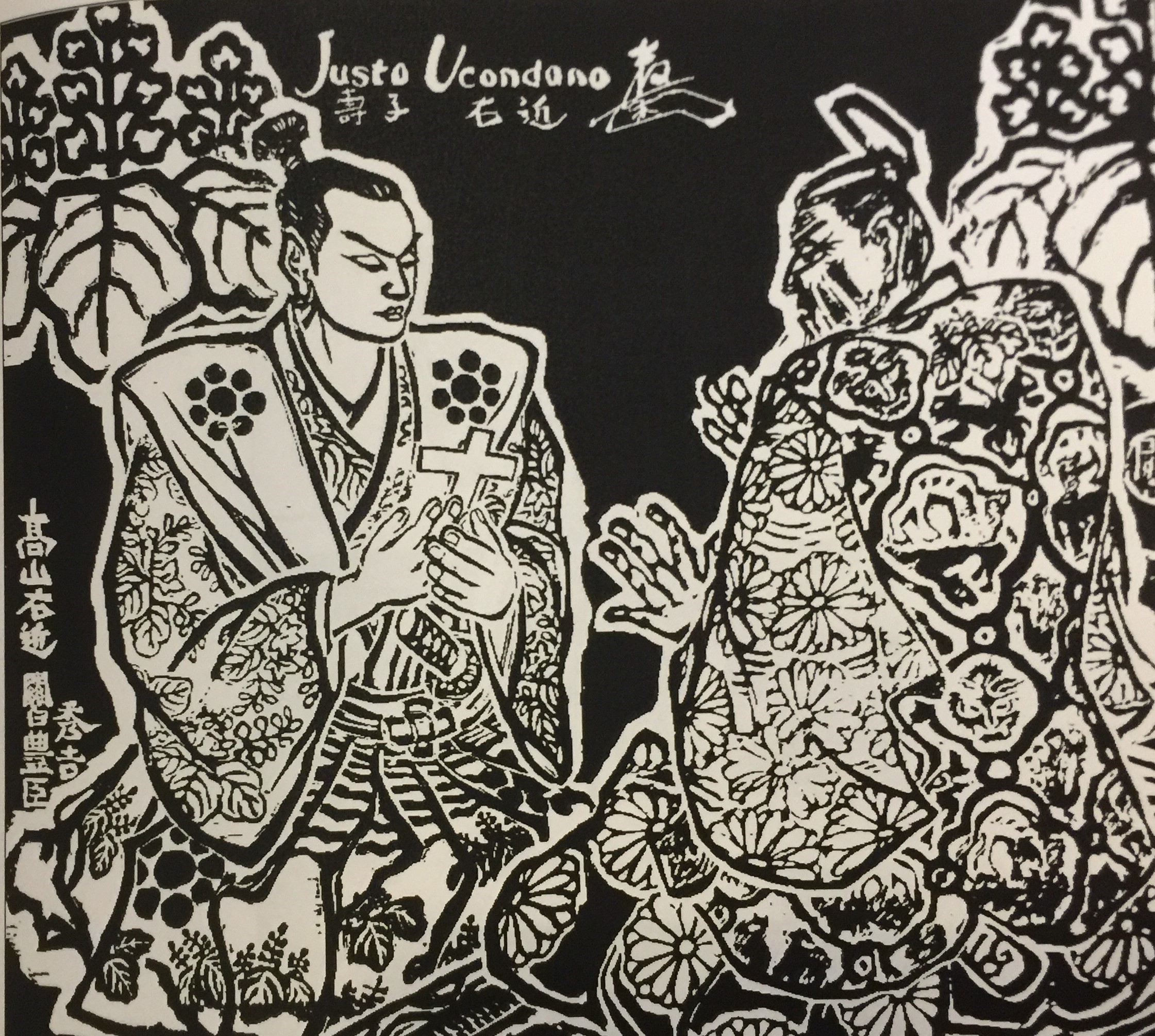
Lord Justo Ukon Takayama (1552-1615), honored at Plaza Dilao as the “epitome of the Japanese spirit.”
1977 – (Nov. 17, 1977) — Plaza Dilao memorializes the checkered Philippine-Japanese history that has spanned four centuries – with Lord Justus Takayama Ukon (高山右近) as the best exemplar of friendship and amity between the two peoples.
1992 – (Nov. 17, 1992) — The National Historical Commission declares the Takayama Memorial a National Monument.
2006 – On May 1, 2006, Plaza Dilao is named by the Department of Interior and Local Government (DILG) as one of five “Freedom Parks” in Manila — where no prior permit will be needed for public protests. On April 25, 2006, the Supreme Court ordered local governments to designate freedom parks in their jurisdictions, as provided for in Batas Pambansa 880 or the Public Assembly Act.
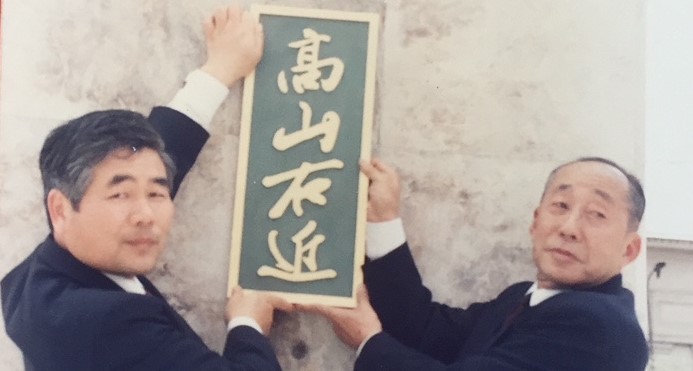
Bronze Kanji Marker (高山右近)
When the Plaza renovation is completed, it will be time to install the bronze marker – donated by Rev. Minoru Yamagata, of Kanazawa and Mr. Teiji Motoki, of Takatsuki.
There was never a chance to install the bronze marker – with Lord Ukon Takayama’s name written in Kanji. Two cast-iron markers were earlier pilfered, so this was replaced by a granite slab on which was engraved Ukon’s name.
With the renovation completed, it will be possible to install a bronze marker donated by Rev. Minoru Yamagata, pastor of the “Jun-ai Christ Church” of Kanazawa City, and Mr. Teiji Motoki (a fervent Buddhist) of Takatsuki City, to replace the black granite slab with Ukon’s name in Kanji.#
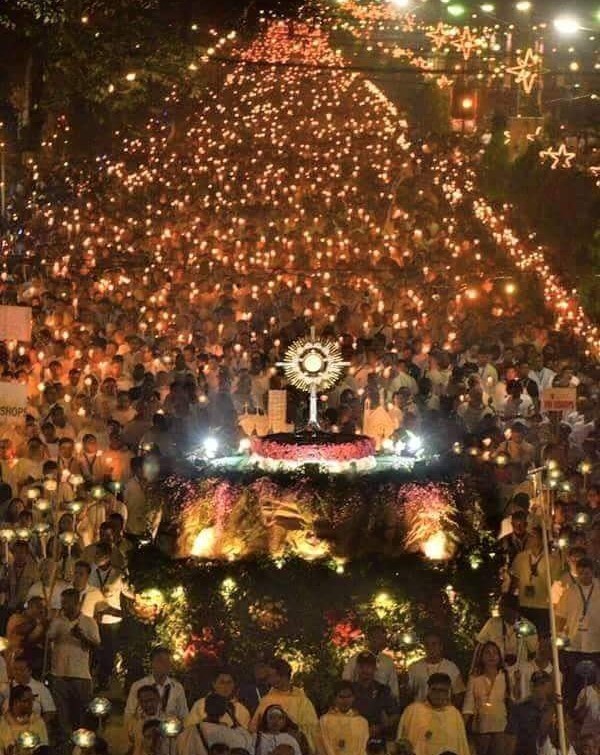
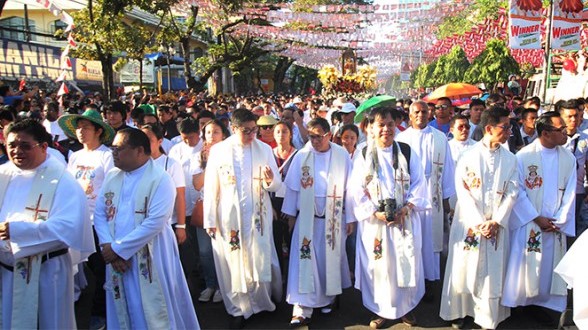
Cebu Catholics, in a splendid procession of Faith.
►2021 will mark the fifth centenary or 500th anniversary of the arrival of Christianity in the Philippines.
The Jubilee Year is considered significant for the Catholic faithful, especially to the Cebuanos, since history has it that Christianity first took root in the shores of Cebu in 1521. Christian faith was then propagated to other islands in the country and is continuing to flourish until today.
Cebu, a Bastion of Christianity
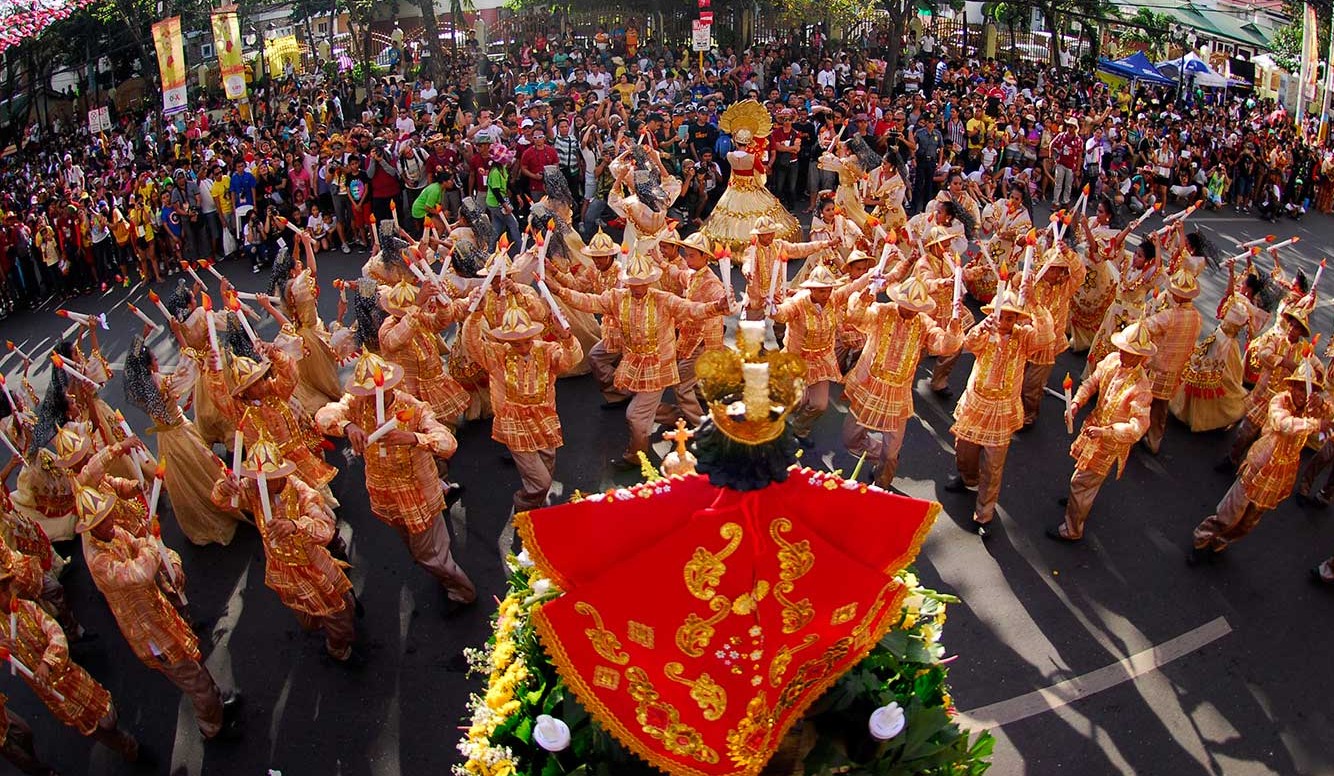
Devotion to the Santo Niño (Holy Child), an image of Jesus as a small boy typically dressed as a king, is a mainstay of Philippine Catholic life.
The oldest and most popular Santo Niño image is the Santo Niño of Cebu –which was brought from Spain by the sojourner Ferdinand Magellan (Fernando Magallanes). That image is particularly revered by Cebuanos, people from the region in and around the city of Cebu, where the Spaniards set up the first colonial capital. But the devotion to Santo Niño of Cebu has spread beyond that region, and images of it are a common sight in home altars around the country and in the Filipino diaspora.
Cebu is recognized as the “cradle of Christian civilization” with the most number of Catholics, seminarians, and priests and its Archdiocese is considered as the largest in the country.
The Cebu Archdiocese, which used to include the Marianas and Guam, has the most number of “Priests and Consecrated Persons” in the Philippines
In the year 2021, Cebu will celebrate the 500th anniversary of the Christianization of the Philippines.#
►THE GOAL we fervently pray for is the CANONIZATION of Blessed Justo Ukon Takayama (1552-1615), “Son of Manila” – the only Japanese “Samurai of Christ” who was “martyred” outside Japan. That can happen only if we pray for Blessed Takayama to intercede with God for the miracle-healing of one of God’s children, through Our Lord Jesus Christ.
Blessed Justo Ukon Takayama (高山右近), 1552 Osaka-1615 Manila) had an illustrious career as a Daimyo (feudal governor) in Japan. A Christian convert from Buddhism at age 11, Ukon became a pillar of the early church of Japan when he became Daimyo of Takatsuki (r. 1573-1585), building churches and seminaries in his territory as well as other domains. He fought battles for Three Hegemons of Japan: Oda Nobunaga; Hideyoshi Toyotomi and Tokugawa Ieyasu. In 1587, Takayama was stripped of his domain in Akashi for refusing to abjure his Faith and went to domestic exile in Kanazawa, where he served as guest-general (“Kyakusho”) of Lord Toshiee Maeda of Kaga. During his exile in Kanazawa, 1587-1614, Takayama built two Basic Ecclesial Communities (BECs) for 600 displaced Christian samurai he gathered in Shika-machi (志賀町) and Shio-machi (志雄町), both located in Hakui District, Ishikawa Prefecture. When ordered expelled from Japan in 1614, along with missionaries and Japanese Catholics, Takayama led the first exile boat with 350 Catholics deportees to Manila, a precursor of waves of Japanese Catholic migrants and refugees over the next 262 years. Only 44 days after his arrival in Manila, Takayama earned his martyrdom with his death on Feb. 3, 1615. Takayama was recognized as a Japanese-born Manileno — and was proposed for beatification in 1630 as the first candidate of the Philippine Church.#
Aida M. de Pedro Auxuliary, Missionary Disciples for the New Evangelization
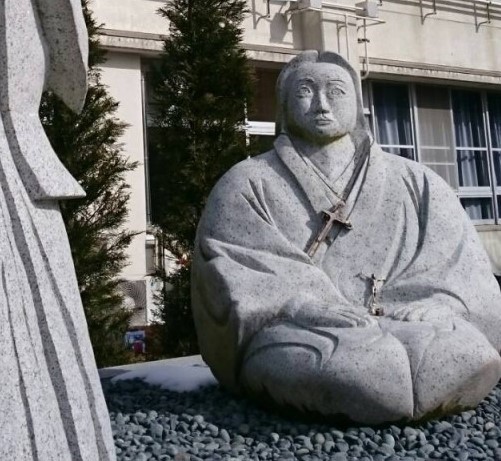
Granite statue of Doña Justa Takayama was installed in Toyomo-cho (Osaka Prefecture) in 2016. It is the first known representation of Doña Justa.
►Her name, for instance: Was her baptismal name “Justa” aligned after Lord “Justo” Ukon Takayama? (No, it was not.) The Kuroda’s eldest daughter was given the Christian name “Justa” when Kuroda Tae (黒田妙)was baptized at age 11 — BEFORE the Takayama couple ever even met. Hikogoro Takayama (Ukon’s boy-name) was baptized “Justo” in 1563 (the year Justa was born) – after St. Justin Martyr (A.D. 100-165). No, there was no effort to align the baptismal names of the Takayama couple.
Aside from what has been written about Sra Justa Takayama (高山ジュスタ)in the Jesuit history of Philippine evangelization, Colin/Pastells, “Labor Evangelica, Ministerios Apostolicos De Los Obreros De La Compania De Jesus, Fundacion, Y Progressos De Su Provincia En Las Islas Filipinas” (Barcelona: 1900) – what else is known about the wife of a celebrated “Kirishitan samurai”?
The Jesuit missionaries — who had a 50-year lead on other Catholic missionaries from the Philippines — studied Japan thoroughly as they sought methods of new evangelization. Fr. Lois Frois, SJ, was among the scholars who wrote studies on how the Japanese were different from, and similar to Europeans.
Fr. Luis Frois, Jesuit Historian
Alone among the contemporary Jesuit missionaries who wrote about Ukon Takayama during various stages of his life — from baptism to his death and funeral in Manila — it is only Fr. Luis Frois, SJ, who has mentioned Justa Kuroda — in Luis Frois (1532-1597), “History of Japan” (Historia do Japõo or Historia de Japam) written from 1583-1597. (The whole five volumes were published in Portuguese only in 1976-1984, and in a Japanese translation in 1977-1980).
The Japanese translation is: フロイス〔著〕松田毅一, 川崎桃太訳, 日本史, 東京, 中央公論社 1977-1980, 12 vols. (Luis Frois, “History of Japan,” trans. by Matsuda Kiichi and Kawasaki Momota.)
As Frois has it: Justa was the eldest daughter of the castle-lord of Yono, named Kuroda (FNU) and his wife Maria, who converted to Christianity – some two months after the Takayama family’s baptism in Sawa Castle. Justa’s mother, Maria Kuroda, was a well-placed noblewoman, being the sister of castle-lord Ikeda Katsumasa. As Ikeda was NOT considered a daimyo, his revenues must have been less than the threshold revenue of 10,000 “koku” of rice.
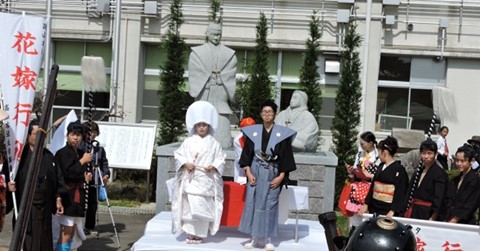
RE-ENACTMENT: Every year, during the “Ukon Festival” presented by the “Ukon-Honoring Association” to mark Ukon’s death anniversary on February 3, the townsfolk attend celebrations in costumes of Ukon’s time.#
From the sources — Ukon was 22, and Justa was 11/12 when the wedding was held in 1573-1574.
Many Details Unknown
Her Japanese maiden-name was Kuroda Tae (黒田妙), but she was baptized and given the Christian name “Justa” – before she had even met Lord Justo Ukon Takayama. Ukon was then 22, the bachelor-lord of Takatsuki for one year when he got married to Justa, who was 11/12. As a rooted Catholic, there would have been a Catholic wedding at Takatsuki Castle, but there is no mention of this ceremony in which a Jesuit priest would have presided. (Of course, only a Jesuit would have presided at the wedding Mass – there were no other religious missionaries in Japan yet — but there is no account of the wedding at all.)
Was it an arranged marriage between two families from adjoining domains? It does not look like it. Takatsuki, which straddled the strategic highway between Osaka and Kyoto was not adjacent to – in fact, was quite some distance away — from Yono. (Today, Yono is a 25-min taxi ride away.)
A Loyal Wife Who, Though Never at His Battles, Was Always There for Ukon
Doña Justa never joined her husband in his wars, but she governed his household – she was the “Lady of the castle at Takatsuki” (for 11 of the 12 years Ukon was lord there) and later, a second castle at Akashi, in Hyogo Prefecture. (When Ukon was stripped of all his possessions by Hideyoshi in 1587, Ukon had to scramble for life, with his family in tow, as he wandered for months as a masterless samurai. During these uncertain times, Justa took charge of his camp, keeping a savvy eye out on the needs of Ukon, their family and their retinue.)
Fighting under the Takayama Banner
Under the ‘Banner of the Cross’
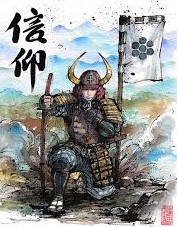
With revenues of 20,000 “koku” of rice, theoretically Takatsuki could sustain a standing army of 20,000 men. As Ukon came into his own at 21, he organized an army of his own kinsmen, his retainers, and later, the males from the houses of Ikeda and Kuroda – and their retainers. Though not all of them were Christian, they fought with tunics emblazoned with a large Cross in red — draped over their armor.
Takayama’s Troops on the March
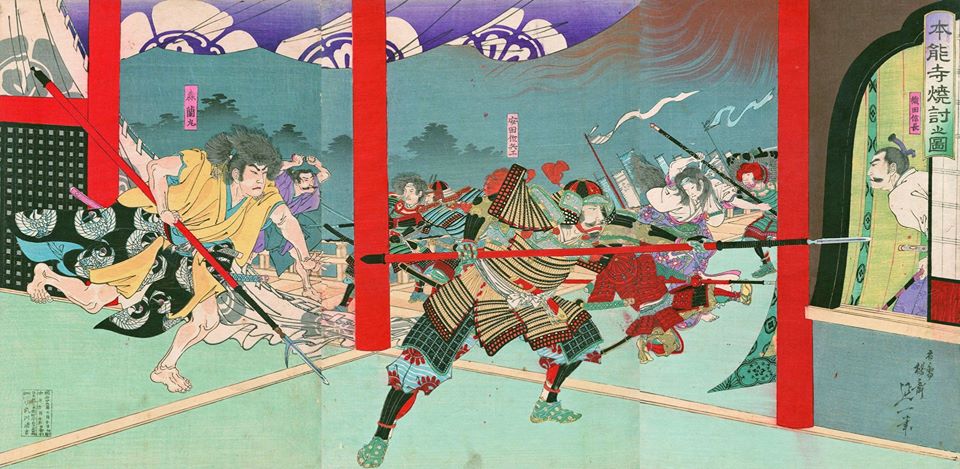
In June 1582, Akechi Mitsuhide betrayed Japan’s first hegemon, Oda Nobunaga at Honnoji – causing the death of Oda by “seppuku.” Hearing of Oda’s death, Toyotomi Hideyoshi raced back into the capital region and along the way he passed through the province of Settsu where both Nakagawa Kiyohide and Ukon Takayama had brought their armies and they joined the Toyotomi vanguard, eventually leading troops on the frontline during the Battle of Yamazaki.
Battle of Yamazaki, 1582
In the Battle of Yamazaki (山崎の戦い), Hideyoshi sent three advance detachments (the first of them, the 700-man army of 30-year-old Lord Takayama) to spearhead the attack against “The 13-Day Shogun,” Akechi Mitsuhide. Hideyoshi himself force-marched an army of 20,000 troops that was eight miles behind the forward forces, advancing by “30 to 40 km a day.”
James Murdoch writes in “A History of Japan” (1903) that Takayama led the first detachment of “less than 1,000 troops” but “they were so fired with the ardor of battle, and so confident with the help of God that on seeing the enemy, Justo did not hesitate to lead them to battle. And they so bore themselves that in a twinkling, they [accounted for/killed] more than 200 nobles of Akechi.”
This led Tokugawa Ieyasu (r. 1603-1605; d. 1616), a future Takayama adversary — and the first of the Tokugawa shoguns who ruled Japan from 1603 to 1868 — to remark: “In Ukon’s hands 1,000 soldiers would be worth more than 10,000 in the hands of whosoever else.” (Johannes Laures.)
The debacle at the Battle of Shizugatake (1583) wiped out the male heirs of the Kuroda and Ikeda families — under the generalship of Ukon Takayama
Disaster at Shizugatake
After Hideyoshi’s triumph at Yamazaki, conflict broke out between the late Nobunaga’s senior retainers over the matter of succession. The tensions culminated in open warfare between factions led by Hideyoshi and Shibata Katsuie (championing Oda’s interests).
Hideyoshi dispatched Takayama Ukon and Nakagawa Kiyohideto northern Omi and tasked them with holding two critical forts placed to block any movement from the Shibata down from Echizen. Takayama was given Iwasakiyama and, some miles to the south, Nakagawa was installed in Shizugatake.
Early the next year (1583), Katsuie dispatched an army under Sakuma Morimasa to capture these frontier forts, and in the course of the campaign Takayama was forced to abandon Iwasakiyama and take up in nearby Tagami. Giddy with his unexpected victory over Ukon, Sakuma went on to besiege Shizugatake and killed Nakagawa. But Sakuma was unable to take the castle itself and in the end, his imprudent advance cost his defeat by Hideyoshi in battle.
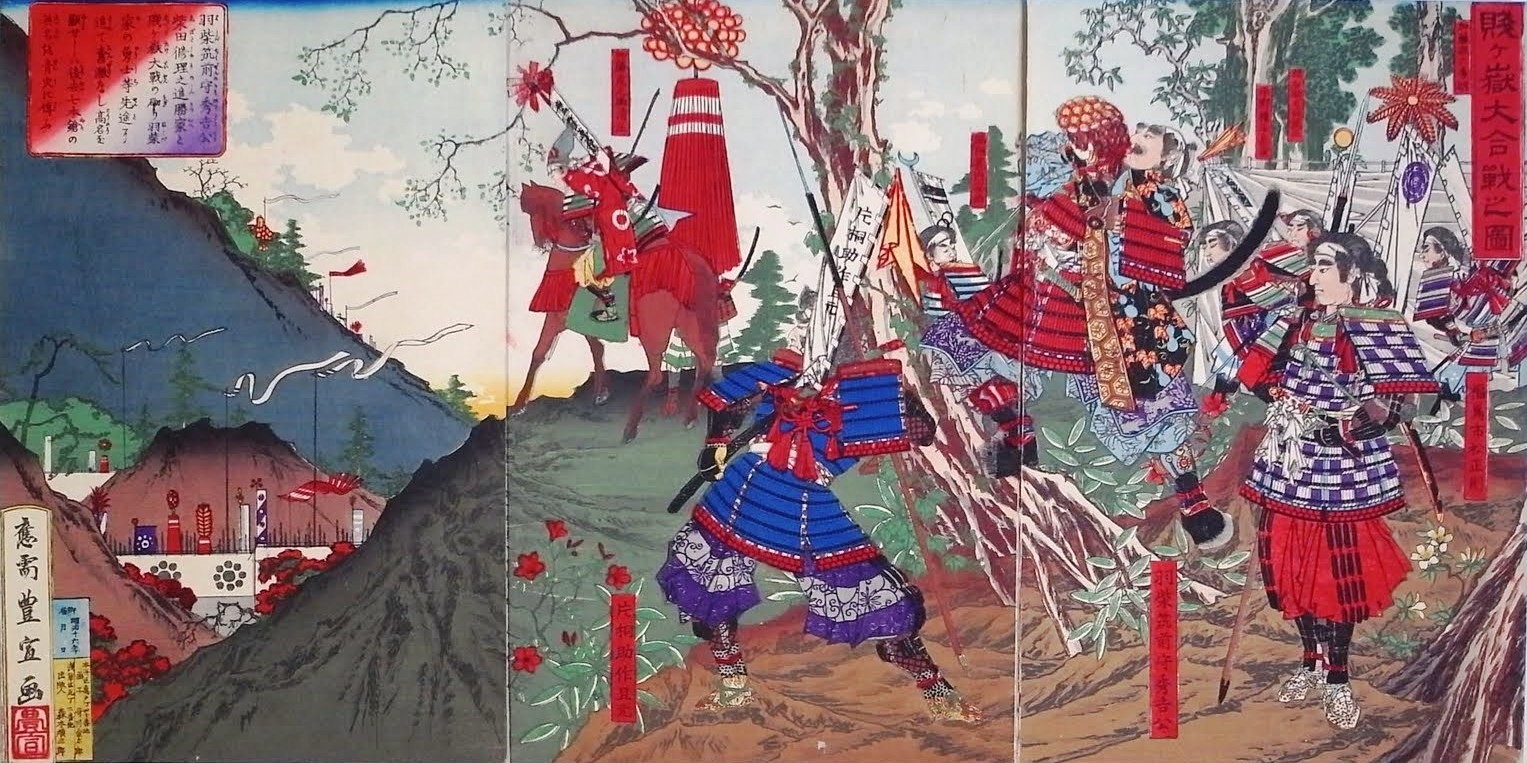
During the Battle of Shizugatake (賤ヶ岳の戦い), Ukon led the same Takatsuki force that won at Yamazaki – but, this time, experienced bitter defeat. Ukon himself was wounded in the fighting and he lost many valued retainers, many of them his own kin.
“Decimated” would be the incorrect word, as Lord Takayama, only 31, lost not only many of his own relatives, but lost the male kin of the Kuroda and Ikeda families, making the two families fade into history.
Takayama’s perfornance in this battle is debated by military historians to this day.
Did Takayama’s Military Setback at Shizugate Sour Hideyoshi’s Confidence in Ukon’s Generalship?
If Takayama lost favor with Hideyoshi because of the horrendous casualties he suffered, there was no sign of that because, two years later, Ukon was rewarded with the larger feudal domain of Akashi (in Hyogo Prefecture) which, with an income of 60,000 “koku,” had three times more revenues than Takatsuki. He was tasked by Hidesyoshi with building a new castle in Akashi. (Only the castle ruins remain today.)
As Ukon left the predominantly Christian Takatsuki for his new fief at Akashi, he brought some 800 Christian samurai with him, to form the core of his fighting force. Then he turned to the opportunity for new evangelization at hand – to the great dismay of the Buddhist bonzes – who however had access to Hideyoshi’s sympathetic mother.
Ukon, a Ronin on the Run
When Takayama was stripped his fief at Akashi (while he was in the middle of a military campaign in Kyushu), his family and his retainers were immediately affected. They had to vacate the premises as soon as they heard word of Ukon’s misfortune.
In the Service of Lord Toshiie Maeda
In the first year of his domestic exile, Takayama was sheltered by the Christian Daimyo Yukinaga Konishi, but eventually landed a position as a guest general (“Kyakusho”) in the domain of Lord Toshiie Maeda at Kaga. Here, with Justa at his side, he formed a Christian community of 600 Christian ronin in his lands in Noto Peninsula. Here, Justa ran the household of Takayama, while Ukon – outside his peace-keeping duties — devoted himself to spreading the Gospel.
Hideyoshi’s spy network kept him informed of Ukon’s whereabouts. After all, though Ukon was a Christian, he never felt personally threatened by Ukon. They had moments together as tea masters – and as builders. With a wink, he allowed Lord Maeda to employ Ukon to rebuild the Kanazawa Castle (still there to this day) and command a flank of Maeda’s army.
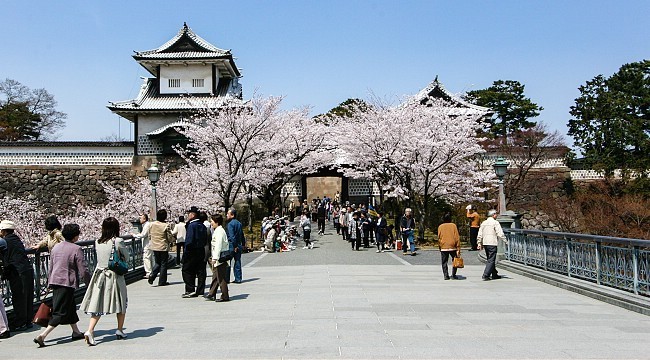
Kanazawa Castle, stronghold of the Maeda clan, was repaired and expanded by Ukon Takayama, a renowned castle-builder. The castle endures to this day.
Ukon’s Last Battle
As a guest general of the Maeda clan, Ukon was involved in one more battle – the Siege of Odawara (1590) — where Hideyoshi decisively crushed the forces of Hojo Ujimasa in August 1590. It is said that Lord Maeda took Ukon to the siege of Odawara in the hope that his valor would obtain the favor of Hideyoshi for him. By May 1590, Hideyoshi had started building up attack forces with the help of Tokugawa Ieyasu, Uesugi Kagekatsu (1555–1623), and Maeda Toshiie – the three Great Daimyo who would later comprise the Council of Five Elders, formed in 1595 by Hideyoshi to rule Japan in the place of his infant son, Hideyori, until he came of age. By June 1590, some 200,000 troops were arrayed against Odawara. In this last of Hideyoshi’s campaigns in Japan, Odawara Castle was finally taken because of internal treachery, resulting in the ritual suicide of the two Hojo leaders.
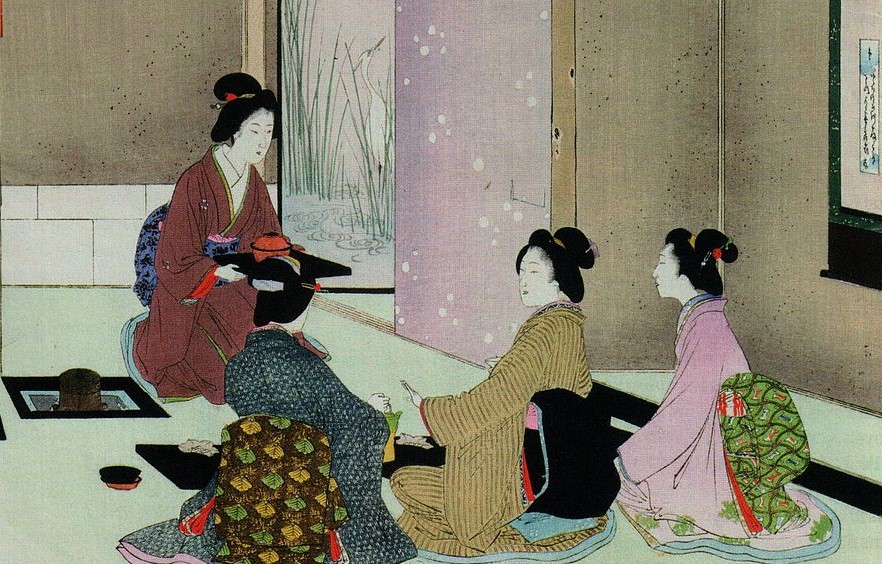
After the Odawara campaign, Hideyoshi invited Ukon to his Nagoya headquarters for tea.
Ukon Takayama having tea with Hideyoshi
After that military campaign, Ukon foreswore the role of a samurai-general, shaved his head, and devoted his remaining years in evangelizing the Hokuriku region.
Aside from Ukon’s family and kin, some 600 masterless Kirishitan samurai, including the former daimyo John Naito and his family, joined Takayama Ukon in Kanazawa where he served the Maeda clan for 26 years. There Ukon formed what is known today as a basic ecclesial community (BEC). Not always having the services of a Jesuit priest throughout the year. they formed a Christian movement that was ever on the look-out for a visiting Jesuit. (A Jesuit was assigned to that area when the widow Justa, returned to Kanazawa in mid-1616 to bury a fingerbone of Ukon in Japanese soil.) Takayama’s Christian community, with its own church, was the Church at the grassroots, in the neighborhood and villages.
Expulsion from Japan
On 1614, the Tokugawa issued a decree, expelling all Christian missionaries and all prominent Japanese Catholics – to remove the virus of Christianity, “that evil religion,” from the land.
(Illustration from Luchie Tajima’s FB wall) — Ukon knew, at age 63, there would be no returning to Kanazawa. But the Jesuit Vice Provincial Jeronymo Rodriguez, SJ. reported on July 18, 1616 that Dona Justa brought back to Kanazawa a fingerbone of Ukon, for burial in his beloved Japan — while Manila now claimed the “Kirishitan Samurai” of heroic virtue who died there as a “Son of Manila.”
Goodbye to Kanazawa
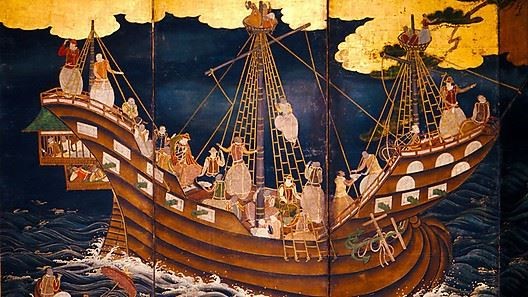
The odyssey of Ukon started on Feb. 14, 1614 in Kanazawa and would take him and his family by foot (through snow-covered roads) to the port of Nagasaki. After waiting some weeks for a Chinese sampan (captained by a Portuguese mariner, with a Chinese and Japanese crew), Lord Takayama and 350 other Catholics, including some 100 “Katekisuta” (カテキスタ) left Nagasaki on Nov. 8, 1614 on their voyage to Manila. The normal voyage took 20 days, but with a turbulent typhoon which cut their main mast in two, it took the junk 43 days to reach Manila. Takayama and his family had a cabin, so the precious cargo of “La Japona” — the statue of “Our Lady of the Rosary” extracted from the demolished Santo Domingo Church in Nagasaki — was entrusted to Ukon’s care. The expelled Jesuit, Franciscan, Dominican, and Augustinian missionaries were on their own, taking turns sleeping on crates – on the open deck. Mercifully, only one passenger was lost during the voyage: Fr. Antonio Critana, a Jesuit. His old age could not cope with the extreme rigor of the voyage.
The first exile boat brought 350 Japanese Christian exiles to Manila on Dec. 21, 1614. It was the first wave of refugees and migrants fleeing religious persecution in Japan across 250 years. The Japanese migrants were eventually absorbed and integrated into the Filipino community — seamlessly, as Japanese Christians all bore Christian names. (Who could say that “Jacobo de la Cruz” was a Japanese Christian from Nagasaki?)#
The exile voyage (and stay in Manila) of Lord Takayama, Lord Joan [John] Tokuan Naito (Hideyoshi’s ambassador to the Ming Court in China during the Korean Truce), and the first women’s congregation of religious women (“Bikuni de Miyako”) are related in six chapters of Colin/Pastells. “Labor Evangelica” (Barcelona: 1900).#
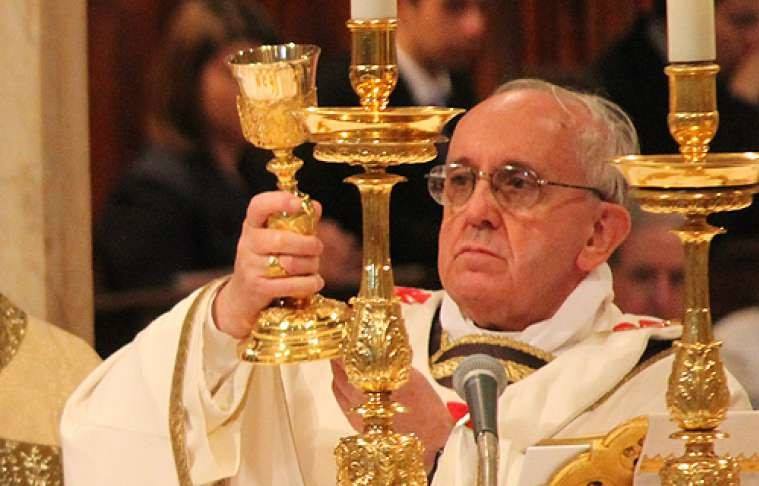
►AS PROPHESIED BY MALACHI — Just before the Consecration, the priest intones the Eucharistic Prayer, based on Malachi’s prophecy in the last book of the Old Testament: “For from the rising of the sun even to the going down, my name is great among the Gentiles, and in every place there is sacrifice, and there is offered to my name a clean oblation: for my name is great among the Gentiles, saith the Lord of hosts.” (Malachi 1:11) The Old Testament prophet Malachi lived some 400 years before Christ.
The Eucharistic Prayer echoes Malachi: “You are indeed Holy, O Lord, and all You have created rightly gives You praise… You give life to all things and make them holy, and You never cease to gather a people to yourself, so that from the rising of the sun to its setting a pure sacrifice may be offered to Your name.”
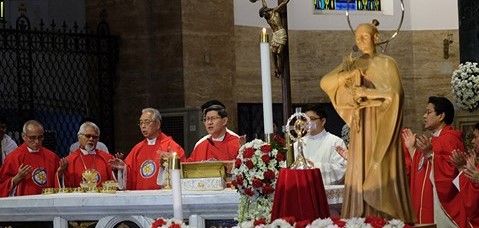
Mass for Blessed Takayama’s First Feastday in Manila Cathedral Basilica
►Malachi’s prophecy 400 years B.C. has come to pass: Fr. George W. Kosicki, CSB, estimates that about “four-to-five Masses begin each second,” and that “there are approximately 8-to-9,000 Masses going on at any moment.” (George Kosicki, “Intercession: Moving Mountains by Living Eucharistically,” Faith Publishing Company): p. 22.
Even if Father Kosicki’s calculations are on the high side, “it is truly inspiring and breathtaking to consider that at any given moment thousands of Masses are being said throughout the world and the infinitely perfect sacrifice of Jesus’ Body, Blood, Soul and Divinity is being lovingly offered to the Eternal Father.”
What an amazing fulfillment of Malachi’s prophecy!
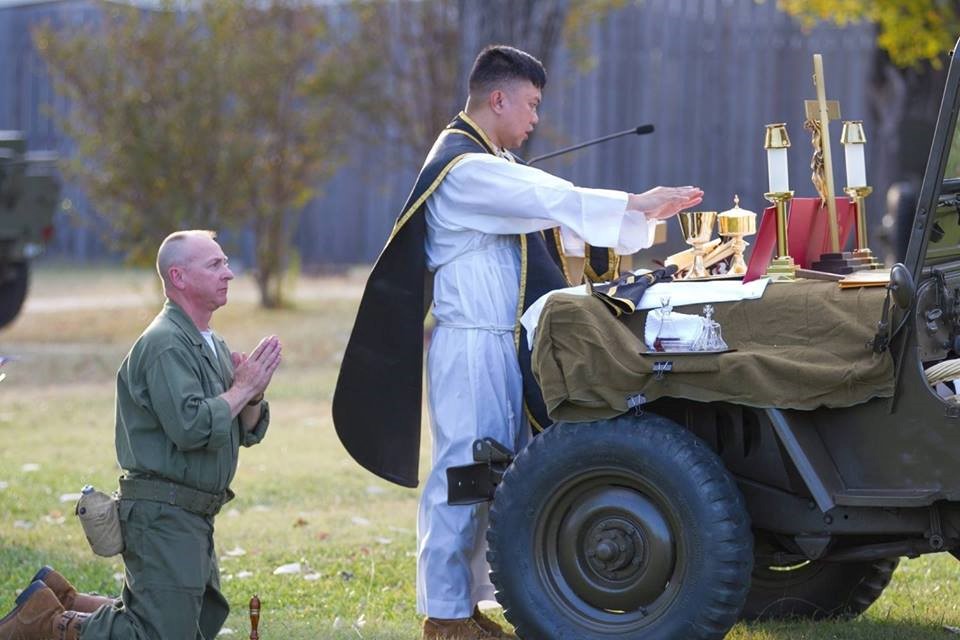
►Whether on a jeepney-hood, in a barrio chapel, in a parish church, in a grand cathedral or basilica – whether celebrated by a newly-ordained priest or the Pope himself – whether celebrated by one priest, or concelebrated by the Pope and 100 Cardinals — the Eucharistic Mass remains the same ritual sacrifice instituted by Christ: “At the Last Supper, on the night he was betrayed, our Savior instituted the Eucharistic sacrifice of his Body and Blood.”
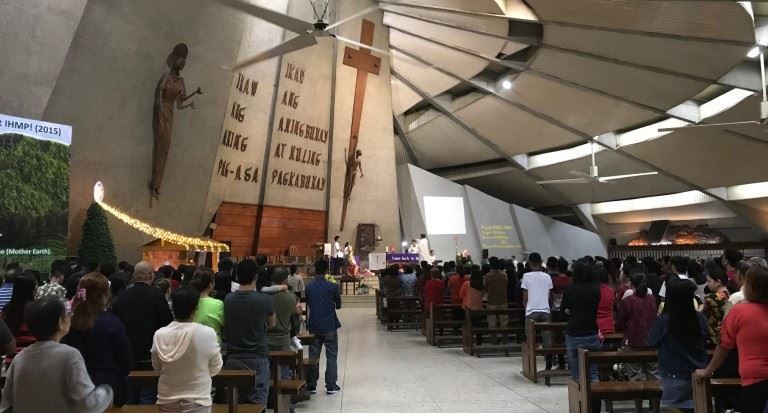
Eucharistic Mass at Immaculate Heart of Mary Parish – Mahinhin cor. Mayumi, UP Village, Diliman, Quezon City.
When we participate in the Holy Mass, we recall and make the passion, death and resurrection of Christ happen again here and now. It is a holy remembrance of what Jesus Christ went through to win our salvation. Holy Mass becomes the highest form of prayer then in such a way that we directly encounter Jesus Christ in His real presence in the Eucharist.
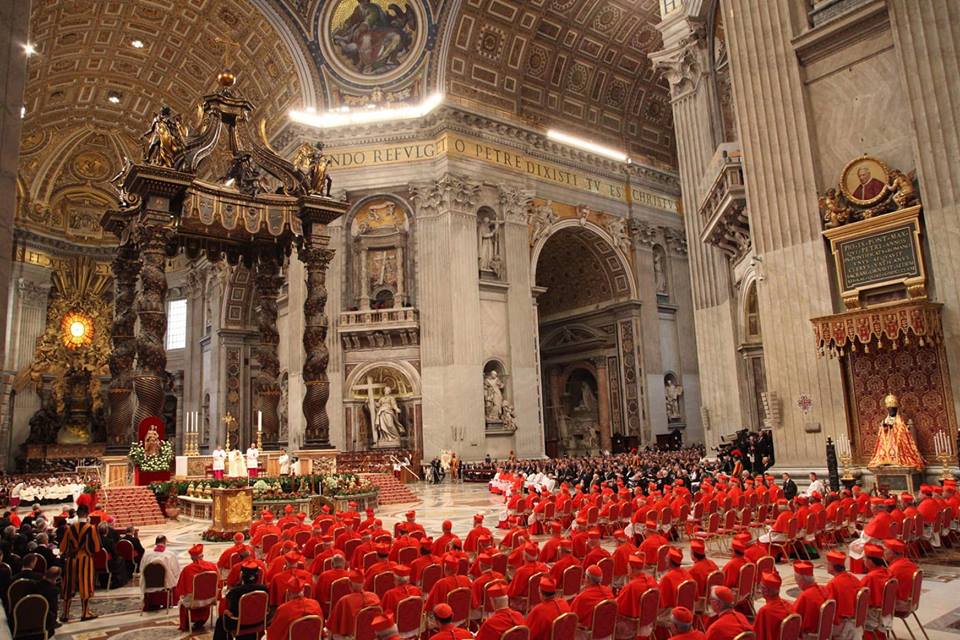
In a Consistory at the Vatican on June 28 (advanced from the original date of June 29), Pope Francis elevated 14 Prelates to the College of Cardinals
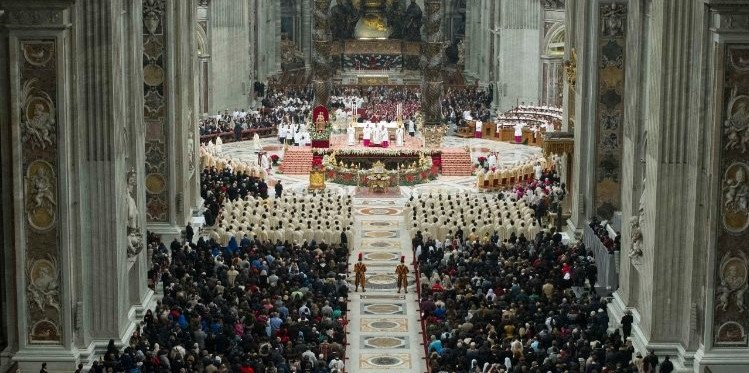
►On Thursday. June 28, 2018, Pope Francis convened an Ordinary Public Consistory at the Vatican Basilica, for the creation of 14 new cardinals, representing 11 countries in five continents.
The new cardinals, following their order of creation, knelt before the Holy Father, who imposed upon them the cardinals’ zucchetto and the berretta, consigned the ring and assigned to each one a church of Rome as a sign of participation in the Pope’s pastoral care for the city.
The celebration began with the greeting, prayer and reading of a passage from the Gospel according to Mark (10: 32-45).
Pope Francis’ Exhortation
►In his homily, Francis told the new cardinals the best promotion a person can receive is to serve the person of Christ as seen in the least of his people. AngelusNews.com was there at the consistory and reports: “This is the highest honor that we can receive, the greatest promotion that can be awarded us: to serve Christ in God’s faithful people.”
Speaking to the new and to the existing cardinals, he said credible authority stems from “sitting at the feet of others,” serving those “who are hungry, neglected, imprisoned, sick, suffering, addicted to drugs, cast aside… real people, each with his or her own life story and experiences, hopes and disappointments, hurts and wounds.”
“None of us must feel ‘superior’ to anyone,” he continued. “None of us should look down at others from above. The only time we can look at a person in this way is when we are helping them to stand up.”
The pope reflected on a passage from the Gospel of Mark, which recalls when the disciples were walking on the road to Jerusalem, and Christ, walking ahead of them, made his third announcement of his impending passion and death.
In recalling this event, St. Mark, he noted, “does not shrink from disclosing secrets present in the hearts of the disciples: their quest of honors, jealousy, envy, intrigue, accommodation and compromise.”
Yet Christ does not worry about this, Francis said. He keeps walking, telling the disciples forcefully: “But it shall not be so among you; whoever would be great among you must be your servant.”
The pope repeated: “‘But it shall not be so among you.’ The Lord’s response is above all an encouragement and a challenge to his disciples to recoup their better part, lest their hearts be spoiled and imprisoned by a worldly mentality blind to what is really important.”
“What does it profit us to gain the whole world if we are corroded within? What does it profit us to gain the whole world if we are living in a stifling atmosphere of intrigues that dry up our hearts and impede our mission?”
Christ teaches that conversion, change of heart, and reform of the Church should be carried out in the light of mission, he continued, pointing out the need to forget one’s own interests for the sake of upholding the Father’s – the dignity of every person.
He urged the cardinals to strive to always be ready to accompany and embrace their distressed brothers and sisters, and to avoid “useless wrangling about who is most important.”
“Only in this way, can the authority of the Shepherd have the flavor of the Gospel and not appear as ‘a noisy gong or a clanging cymbal’,” he said.#
Reading the Papal Bull
The Holy Father then read the formula for the creation of cardinals and solemnly pronounced the names of the new cardinals, announcing the presbyteral or diaconal order. The rite continued with the profession of faith of the new cardinals before the people of God and the oath of fidelity and obedience to Pope Francis and his successors.
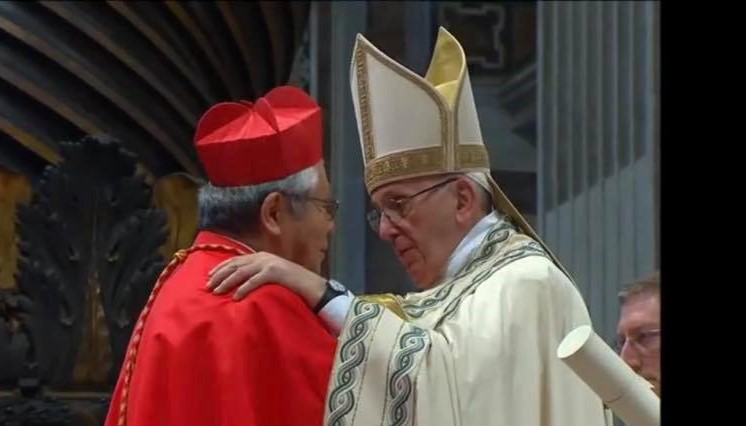
After the consignment of the Bull of the creation of cardinals and the assignment of the title or diaconate, the Holy Father Francis exchanged an embrace of peace with each new cardinal.
Among the 14 New Cardinals is Osaka Archbishop Manyo Maeda
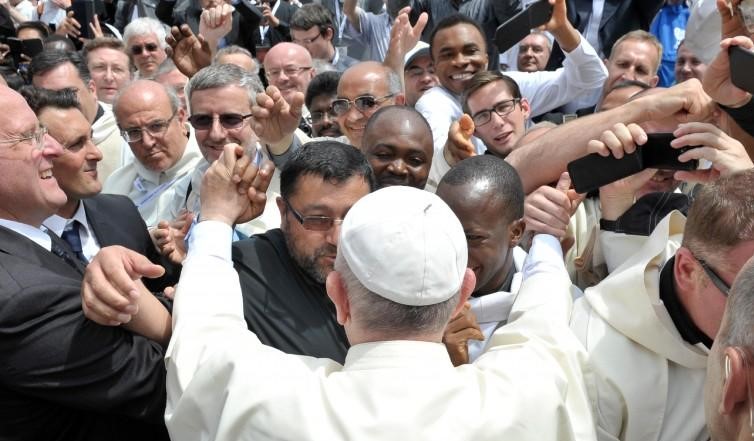
Cardinal Thomas Aquinas Manyo Maeda, in a fraternal embrace with Pope Francis
►Cardinal Thomas Aquinas Manyo Maeda of Osaka is currently the vice president of the Catholic Bishops’ Conference of Japan (CBCJ).
Born March 3, 1949, in Tsuwasaki, Kami-Goto, he was ordained a priest for the Diocese of Nagasaki in 1975. Over the years, he served as a parish priest, editor of the diocesan bulletin and directed the diocese’s commission for social communications.
He served as secretary general of bishops’ conference from 2006 until 2011, when he was made bishop of Hiroshima. Pope Francis appointed him to lead the Archdiocese of Osaka in 2014.
As a native of Nagasaki, Bishop Maeda was widely involved in the peace movement in Hiroshima. He also worked for the beatification of “hidden Christians” who had been exiled to Tsuwano in present-day Shimane prefecture, part of Hiroshima Diocese. In the final outbreak of anti-Christian persecution in Japan 150 years ago, some 3,400 Christians from Nagasaki were exiled to various places throughout the country.
After Pope Francis announced his list of new cardinals in Rome on May 20, Archbishop Maeda was deluged by emails from congregants who had heard the news. The prelate told UCANews.com: “I myself did not know about the announcement at all and I had no contact in advance. Personally, I don’t think I’m the most suitable person to be a cardinal, so I still find it hard to believe.”
A Fisherman – Like the Apostles
►Archbishop Maeda can be called a legitimate successor to the Apostles who were fishermen. When he was a parish priest, he frequently went fishing in his own boat and carried the sort of colorful flag that Japanese fishermen raise when they net a large catch.
For many years, he has also been involved with people with disabilities, while as a member of the CBCJ, he has been on its committees for education and ecumenism.
Like Blessed Takayama, Cardinal Maeda Is a Haiku Poet
►The new cardinal is also a master of the short Japanese poetic form called “haiku” and his poems often appear in his sermons and articles.
Archbishop Maeda wrote a haiku – for the Beatification Ceremony of Blessed Takayama on Feb. 7, 2017:
「冬の虹 仰ぎて行くや 右近祭」
It reads: “Fuyu no niji Aogite ikuya Ukon-sai”
It means: “Rainbow of winter,
Let us go and look up to,
Ukon Festival”
Singular Significance of Blessed Takayama – to Both Japan and the Philippines – According to Cardinal Maeda
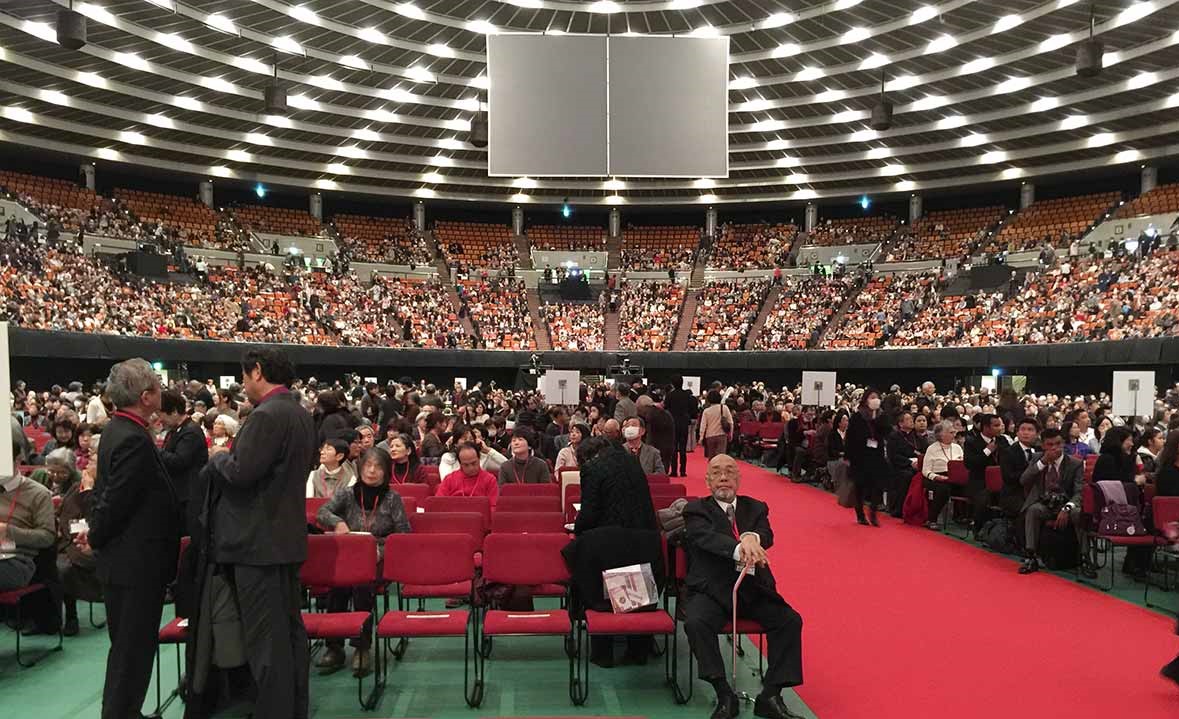
The Beatification Rites of Blessed Justo Takayama (1552-1615) were held in the Archdiocese of Osaka — prefecture where Takayama’s birthplace, Takayama Village, Toyono-cho, and his first feudal domain, Takatsuki, were both situated.
►“During the Sengoku Period (戦国時代 Sengoku Jidai, “Age of Warring States”; c1467-1603) — that is, the period associated with the hegemons who united Japan: Oda Nobunaga, Toyotomi Hideyoshi, and Tokugawa Ieyasu, there lived a feudal chief who led a life imbued with the conviction that “Jesus was Lord,” and who sought to build a Kingdom of God, a kingdom abounding in love. That was Takayama Ukon.
“Ah, what peace Ukon has found in Christ the Lord!”
►What manner of life did Justo Takayama seek to follow? “Despite being the Son of God, Christ humbled himself to be born as a man, he emphatized with mankind, and he partook of human joys and sorrows to the moment of death.” This was the life led by Jesus who died on the Cross, and it was a life that Justo Ukon Takayama sought to emulate. In other words, the path he chose was that of a true king, a king who sought to unite Heaven and Earth, mankind and God, by means of the Cross. As a result, he was also intensely engaged in the performance of many acts of mercy.
“The Beatification of Ukon who chose a Crucifix in place of a Sword.”
►Ukon was not a priest, and yet, besides churches he built theologates and seminaries, and he was a zealous participant in catechism, contemplation, devotional works, Holy Mass, sacraments and other related activities. As well as the Church in Japan, where calls now are being made for the provision of innovative forms of Gospel transmission, let us reflect over and pray for a revival of the work Ukon did to spread the Gospel, starting with the Philippines with which he enjoyed a special kinship, and extending over the entire world.
“The Blessings of Ukon’s Beatification Unite Japan and the Philippines”
►In conjunction with the construction of the Osakajo of Hideyoshi, Ukon erected churches in Osaka for a fresh communcation of the Gospel. In the same way, let us in conjunction with the Beaitification of Justo Takayama, begin now this fresh communication of the Gospel.
“Let us begin by emulating the compassion of Ukon.”
The College of Cardinals Now Has 226 Members
►Archbishop Maeda is the sixth Japanese to be named a cardinal, but unlike his predecessors, he has not been active in international matters.
With Thursday’s ceremony, there are now 226 cardinals worldwide, 74 of them named by Francis during his five-year-old papacy.
Of that total, 125 cardinals are younger than 80 and can vote in a conclave for the next pope when the current pope dies or resigns: 59 of them appointed by Francis, 47 by Pope Benedict XVI, his predecessor, and 19 named by Pope John Paul II.
Three of those named Thursday are too old to participate in selecting the next pope.
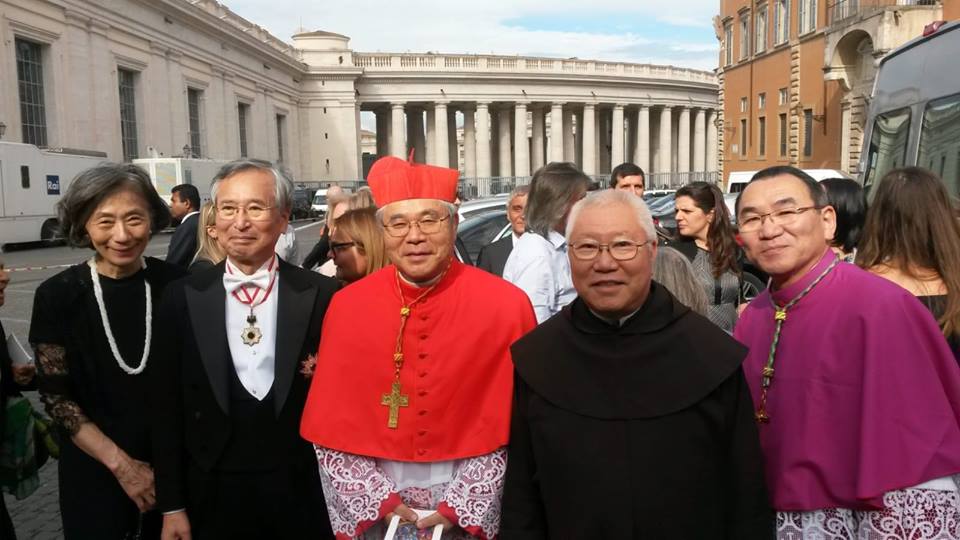
Japan’s newly-installed Cardinal Thomas Aquinas Manyo Maeda with the Japanese Ambassador to the Vatican, Yoshio Matthew Nakamura,
The Challenge Ahead — For the College of Cardinals
►At a post-ceremony reception, Pope Francis asked which pressing questions churchmen should urgently address.
The new cardinals shared with the Associated Press (AP) that the “social exclusion” of migrants is an issue “all must address.” Francis recently has appealed to all nations to be more welcoming to the refugees they can adequately integrate into society.
The new Cardinal from Peru, Huancayo Archbishop Pedro Barreto Jimeno, cited the need to fight corruption worldwide. Francis has made battling corruption inside the church also one of his papacy’s priorities.
After the ceremony, the pope and the new cardinals took minivans to the monastery on Vatican City grounds where Benedict XVI, who retired from the papacy in 2013, lives.
Courtesy Call on Pope Emeritus Benedict XVI
►The cardinals each went up to greet the frail 91-year-old Benedict, who was sitting in a chair, taking his hand and briefly chatting with the emeritus pontiff.
Addressing his “dear brother cardinals and new cardinals,” the pope said the “only credible form of authority is born of sitting at the feet of others in order to serve Christ.”
Serendipity?
Osaka Archbishop Thomas Aquinas Manyō Cardinal Maeda has been designated Cardinal-Priest of Santa Pudenziana. The Basilica of Santa Pudenziana (Santa Potenciana) serves as the national church for the Filipino community of Rome. A happy coincidence?#
Compiled by Dr. Ernesto A. de Pedro
Takayama Trustee









 Blessed Justo Takayama Ukon