The Original Tomb of the Japanese Martyr, Blessed Takayama (1615), Was at the Jesuit ‘Iglesia de Santa Ana’ in Intramuros

The Santa Ana Church (1590) was a look-alike of the Jesuit mother-church in Rome – “Il Gesù Church” (1551). Conceived by St. Ignatius de Loyola, the founder of the Society of Jesus, its facade is "the first truly baroque façade," introducing the baroque style into architecture. “Il Gesù Church” served as model for innumerable Jesuit churches all over the world.
The Santa Ana Church (1590) was built by Fr. Antonio Sedeño, SJ, as a look-alike of the Jesuit mother-church in Rome – “Il Gesù Church” (erected between 1568 and 1584). Conceived in 1551 by St. Ignatius de Loyola, the founder of the Society of Jesus, its facade is “the first truly baroque façade,” introducing the baroque style into architecture. “Il Gesù Church” served as model for innumerable Jesuit churches all over the world.

Lord Takayama was buried near the High Altar – in the expectation he would, one day, be elevated to Sainthood

►The story of Lord Justo Takayama Ukon – and ‘350 Japanese Christian exiles,’ including Lord Juan Tocuan Naito and the 15 cloistered nuns of the ‘Beatas de Miyako’ form part of the evangelical annals of the Philippine Church — (not of the Church of Japan) – as detailed in five chapters of “Labor Evangelica, ministerios apostolicos de los obreros de la Compañia de Iesvs, fvndacion, y progressos de su provincia en las islas Filipinas” by Colín, Francisco (1592-1660; first published 1663); Chirino, Pedro (1557-1635); and Pastells, Pablo (1846-1932), eds. Barcelona: 1900. The history of the Japanese Catholic exiles, written by Jesuits, appears on pp. 434-562.

With Full Military Honors

After State Honors by Spanish Governor-General Juan de Silva and necrological services by Manila Archbishop Diego Vazquez de Mercado (r. 1610-1616), and Superiors of the five religious orders — Augustinians, Franciscans, Jesuits, Dominicans and Recollects – Lord Takayama was laid to rest, with great pomp and ceremony, near the high altar of the Jesuits’ ‘Iglesia de Santa Ana.’

Takayama’s tomb near the main altar – was similar to that of El Adelantado, the Spanish Governor-General Miguel Lopez de Legazpi (1502-1572), who was buried 43 years earlier at the Capilla de Legazpi of San Agustin Church, its top slab covered by a bas relief of Legazpi.
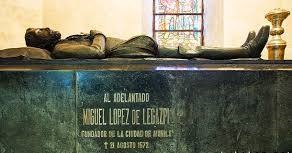
After Santa Ana Church was destroyed by a series of earthquakes (1621-1625), Takayama’s remains were transferred to the new San Ignacio Church (I) that was built in 1632 alongside the ruins of the original church.

But when the Jesuits were deported from the Philippines in 1768, this church deteriorated from neglect and decay. Upon their return to the Philippines in 1859 — after 91 years in exile, the Jesuits built at a different site (partly with stones from the first San Ignacio Church) a new Church – which they also called San Ignacio Church (II). This was inaugurated in 1889.

It means that from 1615 to 1889 – for 274 years! — the bones of Blessed Takayama were at the Jesuit Compound (now PLM Compound), until their transfer from the compound to the newly constructed San Ignacio Church (II) at Arzobispo St., near the Arzobispado de Manila.

Already proposed for sainthood in 1630 – though not yet recognized as a ‘Servant of God’ by the Vatican — fragments of Takayama’s bones served nonetheless as the altar-stone of the Main Altar of the second San Ignacio Church.

The Odyssey of Takayama’s earthly remains is told in “The Search for the Bones of Takayama Ukon.” ◘

Dr. Ernie A. de Pedro
Managing Trustee
Lord Takayama Jubilee Foundation
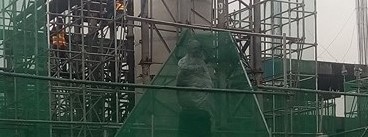
 

No Ceremony Possible to Mark 40th Anniversary of Takayama Memorial (Nov. 17, 2017)

Takayama statue is wrapped in industrial tape

►Dr. Ernie A. de Pedro, Takayama Managing Trustee, has surveyed the current status of the Takayama Memorial, and found the statue tightly wrapped in industrial tape and caged in a steel frame with wire-mesh to shield it from construction debris.

Though three Takayama devotees – Dr. E. A. de Pedro, Raquel Calma Nakayama, of Star Travel, and Teresa Cabigas (who all attended the Takayama Beatification Rites in Osaka on Feb. 7, 2017) — were prepared to drape garlands on Blessed Takayama on Nov. 17, the operation was deemed by project supervisors as too cumbersome to implement.

Another day will come! – when the situation at the Metro Manila Skyway Stage 3 project (MMSS-3 Project) clears up.

IN THE HISTORICAL CALENDAR – FRIDAY, NOV. 17, 2017:

►Marks the 40th anniversary of the establishment of the Philippines-Japan Friendship Park at Plaza Dilao on Nov. 17, 1977.
►Marks the 25th (Silver) anniversary of the proclamation of the Takayama Memorial as a National Monument by the National Historical Commission of the Philippines (NHCP) on Nov. 17, 1992.
►2017 marks the 425th year of the founding of the “Dilao” settlement in 1592 as the first ‘Japantown’ in the Philippines (originally at the area now occupied by Manila City Hall — next door to the sprawling Chinese “Parian” which was located at the Metropolitan Theater area).
►2017 marks the 255th year of the fourth relocation of the Japanese “nihon-machi” to its present site (at Paco Railway Station) in 1762. ◘

Marking Barrio Balete as a ‘Nihon-machi’ at San Marcelino Church, Manila

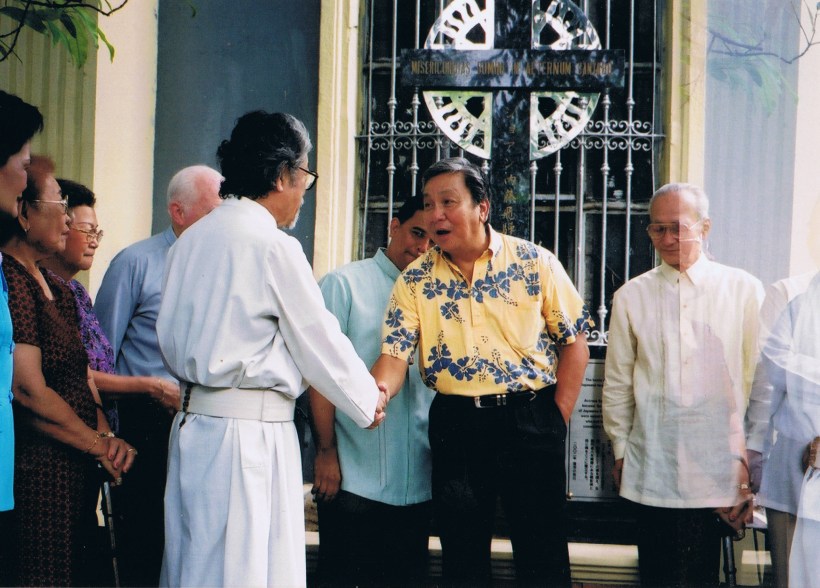
Manila Mayor Lito Atienza inaugurated the Balete Marker at the side of the San Marcelino Church on April 25, 2002
Manila Mayor Lito Atienza (r. 1998-2007) inaugurated the Balete Memorial at the side of the San Marcelino Church on April 25, 2002 — with Fr. Toru Nishimoto, CSsR, first Japanese Redemptorist missionary — who was assigned to Manila for 35 years.

►As Japanese pilgrims – visiting a Philippines to which their Japanese forebears had been deported four centuries ago – discovered there were many places in Manila associated with the Japanese Christian exiles who left Japan in 1614, they wanted permanent markers so future generations will know – before the fast pace of infrastructure development erases them from the map.

The best places for markers are in the grounds of Catholic churches associated with the Japanese Christians. The first such marker was installed at the San Marcelino Church (St. Vincent de Paul Church), on San Marcelino St., Manila

Text on the Plaque Was Both in English and Japanese

The ‘Balete Marker’ reads: “FIRST JAPANESE CHRISTIAN COMMUNITY – The barrio of Balete, along the Estero de Balete, was officially designated as a ‘Japantown’ in 1601 to accommodate hundreds of Japanese who had been settled in Dilao town since 1592.” [We do not know where 1601 came from.]

The marker was commissioned by Ryohei Fujimoto, a staunch Catholic from Kyoto who funded several scholarships for Filipino students – under the Pre-Evangelization Program (PEP) of Fr. Toru Albert Nishimoto, CSsR (1933 – Aug. 21, 2010), the first Japanese priest to join the Redemptorists.

Naito Memorial in Yagi, Kyoto Prefecture
Lord Naito Memorial in Yagi, Kyoto Prefecture

The Cross is an exact copy of a monument in honor of Dom Joan Naito in Yagi-cho, Nantan-shi, Kyoto Prefecture. Naito arrived in Manila on the same exile boat as Dom Justo Ukon  Takayama on Dec. 21, 1614.

Manila Mayor Jose “Lito” Atienza (r. 1998-2007) inaugurated this Balete Memorial on April 25, 2002. ◘

By Dr. Ernie A. de Pedro
Managing Trustee
Lord Takayama Jubilee Foundation
Prayer Invoking Blessed Justo Takayama’s Intercession

Small crucifix hanging on old wooden wall near lighting candle

O GOD, in Your Wonderful Providence, You have chosen Justus Takayama Ukon to be a singular promoter of Your Kingdom, and an undaunted witness to the Catholic Faith —
REWARD, we beseech You, his zeal for Your Glory,
and graciously grant us what we humbly ask
through his intercession.
GRANT us also that, following his example,
we may bravely bear all trials
for the sake of our holy Catholic Faith.
Through Jesus Christ Our Lord. Amen. ◘
(by Fr. Johannes Laures, SJ)

19 Japanese Catholics, Including Nine Nuns, Visit Takayama Memorial at University of Santo Tomas (UST)

The Nagasaki group poses for memento photographs in front of the statue of Blessed Justo Takayama Ukon

►In 29 years of welcoming Japanese pilgrims tracing the footsteps of Blessed Justo Takayama Ukon (1552-1615) who died in Manila, we have had a range of tourists – from one jeepneyful to three tourist busloads – with only a few Catholics among them. In a Philippines which counts with over 200 religious women’s congregations, nine nuns do not really make a splash. But this group of nine nuns from Nagasaki Diocese in a tour group of 19 Catholics, accompanied by Fr. Michael Shimosako, who visited UST on Oct. 9, 2017 is a RARITY. Remember: Only ONE in 300 Japanese is Catholic!

The UST visit of the Japanese nuns of the Nagasaki Diocese was coordinated by the UST Office of Public Affairs (headed by Prof. Giovanna Fontanilla, A.P.R.) and the UST Graduate School (where the Takayama Memorial stands) under Dean Marilu R. Madrunio, PhD. ◘

Dr. ERNIE A. DE PEDRO
Managing Trustee
Lord Takayama Jubilee Foundation

Pope Francis: Charity is ‘the Soul’ of the Church’s Mission

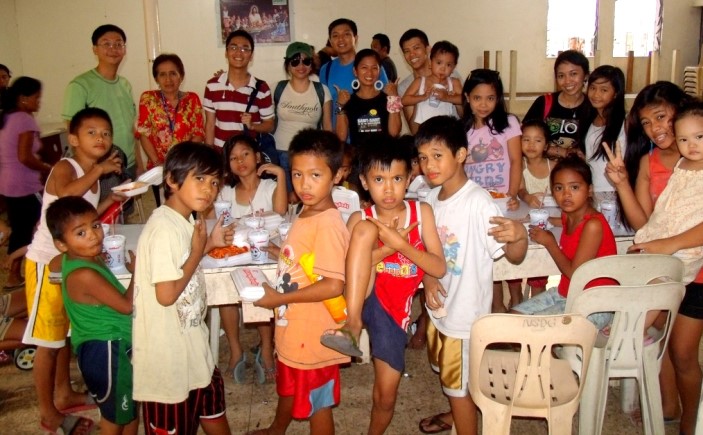
Catholic Charities Manila feeds schoolchildren in a feeding program funded by contributions from Catholic communities

►ROME – Sept. 28, 2017 — On the Feast of St. Vincent de Paul, Pope Francis said that charity is central to the Church’s mission, and we are called to share it with the world, especially those in need. “All of us, in truth, are called to water ourselves upon the rock that is the Lord and to quench the world’s thirst with the charity that springs from Him,” the Pope said on Sept. 27. “Charity is at the heart of the Church, it is the reason for its action, the soul of its mission.”

As Benedict XVI wrote in the encyclical ‘Caritas in Veritate’: “Charity is the main path of the Church’s social doctrine. Every responsibility and commitment outlined by this doctrine is attuned to charity which, according to Jesus’ teaching, is the synthesis of all the Law,” he said.

Pope Francis sent the message Wednesday for the 400th anniversary of the start of the charism of the Vincentian Family, a group of organizations founded by or under the inspiration of St. Vincent de Paul, whose feast is Sept. 27. A 17th-century French priest, St. Vincent is known as the patron of Catholic charities for his apostolic work among the poor and marginalized.

“Inflamed by the desire to make Jesus known to the poor,” St. Vincent “intensely devoted” himself to the announcement of the Gospel, especially through missionary work, charity, and the care and formation of priests, Pope Francis said. In his message, he compared St. Vincent to a tiny mustard seed, which sprouted and spread through his charitable works, the priests he taught, and the religious orders he founded.

‘Reach the Peripheries of the Human Condition’

Like St. Vincent, “you are called to reach the peripheries of the human condition,” Pope Francis said, “to bring not your own capacities, but the Spirit of the Lord, ‘Father of the poor.’” “He spreads you into the world as seeds that sprout on dry land, as a consolation balm for those who are hurt, as a fire of charity to warm up many hearts choked by abandonment and hardened because they are discarded.”

St. Vincent still speaks to us and to the Church today, his testimony inviting us to be on the road, working to sow the love of God in the hearts of others, even the unpleasant, the Pope said. “I ask for the Church and for you the grace to find the Lord Jesus in the hungry brother, the thirsty, the stranger, the one stripped of clothing and dignity, the sick and imprisoned, but also the doubtful, the ignorant, the obstinate in sin, the afflicted, the offensive, the bad-tempered and the annoying.”

He also asked that from the “glorious wounds of Jesus,” the “dying seed that gives life,” and the “wounded rock from which water flows,” members of the Vincentian Family would find the strength and joy to go out of themselves and into the world, facing challenges with creativity. Because “as St. Vincent said, ‘love is creative even to infinity.’”

“This is the way to follow,” the Pope said, “because the Church is always more and more mother and teacher of charity, growing and overflowing in mutual love towards all.” “We ask for smallness of heart, full availability, and docile humility. It pushes us to fraternal communion between us and our courageous mission in the world.” ◘ — Catholic News Agency

Cardinal Tagle, President of Caritas Internationalis, Implores World Governments to Welcome Migrants and Refugees

‘If a person is respected and their creativity is developed, they do not become a threat,’ the Cardinal said in an appeal to governments

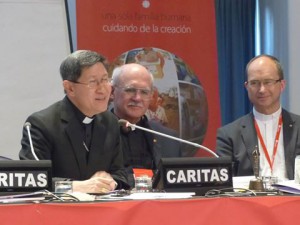
►Cardinal Luis Antonio Tagle, the President of Caritas Internationalis — the global network of national Catholic charities — today (September 27) made an impassioned plea for governments across the world to welcome migrants as he launched a campaign for the world to welcome those leaving their homelands for a better life.

Speaking during a press conference at the Vatican, the Archbishop of Manila became emotional when he talked about his grandfather, a poor migrant who arrived in the Philippines with a widowed mother.

“Whenever I think of migrants, I think of my grandfather who emigrated from China,” he explained. “Who would have thought he’d produce a cardinal grandson.”

He said that if a “politician cares for their country” then they will welcome new arrivals, and said more leaders need to have a personal encounter with migrants.

“If a person is respected and their creativity is developed, they do not become a threat,” the cardinal said in an appeal to governments. “Don’t close the doors. You might be closing the doors to people who will enrich your community.”

“Share the Journey”

Earlier today Pope Francis formally launched the “Share the Journey” campaign in St. Peter’s Square during the Wednesday General Audience.

The two-year initiative is aimed raising awareness about the plight of migrants, encourages people to meet with them and hear their stories, rather than treat them as numbers and statistics.

Opening his arms, the Pope said “Christ urges us to welcome our brothers and sisters with our arms truly open, ready for a sincere embrace, a loving and enveloping embrace.” ◘

by Christopher Lamb, The Tablet

Pope Francis Promises Never to Pardon Priests Convicted of Abuse and Admits Church Too Slow in Facing up to the Problem  

Francis admitted he had made a mistake with softening the sentence of abusive ex-priest, Mauro Inzoli, and said he had learnt from this

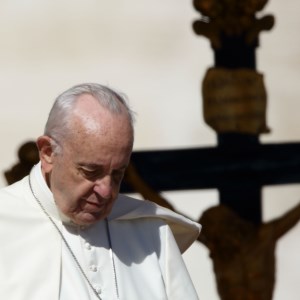
►Pope Francis says he will never pardon priests convicted of sexual abuse while admitting the Church waited too long before taking the matter seriously.

Talking during his first ever meeting with the papal abuse commission today (21 September), the Pope said there can be no place in the priesthood for those who harm children and that he had learnt from his own mistakes in handling such cases.

Francis met the group for an hour and rather than speaking from a prepared speech gave 20 minutes of off-the-cuff remarks.

One of the 14 members of the Pontifical Commission for the Protection of Minors present at the meeting was Baroness Hollins, a professor of psychiatry and member of the House of Lords.

“He [Pope Francis] said if pedophilia is proven then he will never pardon an ordained priest and that the Church has come late to an understanding of how serious this matter is,” she told The Tablet afterwards. “He is completely committed to trying to get the Church to address this properly and he said he felt deeply ashamed about what has happened.”

The Pope faced criticism earlier this year when it emerged he had softened a sentence of laicisation against Mauro Inzoli, 67, an abusive priest in the Diocese of Crema. Inzoli has since been laicised.

During his meeting with the commission the Pope admitted this was a mistake, confessing that he thought at the time he was dealing with matter in “the most benevolent way.” Francis added, however, that he learnt from this and would never do it again.

“Whoever is sentenced for sexual abuse of children can turn to the Pope for pardon,” but he stressed he had “never signed one of these and will never sign.”

Pedophilia an “Illness”

Describing pedophilia as an “illness” Francis admitted that the Church had not faced up to the problem of abuse quickly enough: it was, he said, thanks to a number of “prophetic” men and women that the matter was now being taking seriously.

He stressed that the Congregation for the Doctrine of the Faith (CDF), the Vatican department which acts as a clearing house for abuse case, will be getting more resources. There have been complaints that the congregation has been understaffed and that cases are being processed too slowly.

Baroness Hollins described the Pope’s talk as “very honest” adding that she believes he understands the gravity of the problem.

In the official text prepared for the meeting, Francis re-iterated a “zero tolerance” approach on sexual abuse and pointed out he had implemented new laws to hold accountable any bishops and religious superiors who are negligent when handling cases.

“We are ashamed of the abuses committed by holy ministers, who should be the most trustworthy,” the Pope explained. “Let me say quite clearly that sexual abuse is a horrible sin, completely opposite and in contradiction to what Christ and the Church teach us.”

The papal safeguarding commission is meeting in Rome for its bi-annual general gathering whether they will assess recommendations for improved protection of children and vulnerable adults within the Church, and care for people who have been abused. These will then be submitted to the Pope for his approval. Francis has so far accepted all the group’s recommendations.

Earlier this year the commission suffered a blow when Marie Collins, a sexual abuse survivor from Ireland, resigned due to what she said was internal resistance to the group’s work by the CDF.

Ms Collins has continued to offer her advice to the Church and was in Rome earlier this month to address a group of recently ordained bishops at a Vatican organized conference.

The sexual abuse scandal has dogged the Church for years with last week the Holy See announcing it was recalling a diplomat from Washington for a “possible violation of laws relating to child pornography images.” ◘

By Christopher Lamb, THE TABLET


Cause of Italian Jesuit Priest Martyred in Mindanao Goes to Vatican

Bishop Severo Caermare of Dipolog holds Mass after closing rites for the diocesan investigation into the cause of the martyrdom of 17th Italian Jesuit missionary, Father Francesco Plliola, who served indigenous people in the Philippines. (Photo by Angie de Silva)

Thousands of Filipinos Mark Close of Probe into Life of 17th-Century Jesuit Fr. Francesco Palliola

►UCANews – Sept. 18, 2017 — Thousands of Catholics packed the Cathedral of the Most Holy Rosary in the southern Philippine city of Dipolog last week as the diocese closed its probe into the life of 17th century Jesuit missionary, Father Francesco Palliola.

The diocese nominated Father Pallolia as a Catholic martyr, citing his defense of the faith and upholding of Christian virtues.

The priest is considered the patron of the Lumad or indigenous people of the western tip of Mindanao. He was born to a noble family in Naples, Italy.

The close of the diocesan investigation comes a year and a half after its launch in January 2016.

All Supporting Documents Submitted to the Congregation for the Causes of Saints

Bishop Severo Caermare of Dipolog signed the archetype, transcript and copies of the local historical and theological commissions’ proceedings, which opened in January 2016. They now head to the Vatican.

Father Rene B. Javellana, archivist of the Philippine Province of the Society of Jesus, said Father Palliola was martyred on Jan. 29, 1648 at Ponot, now the town of Jose S. Dalman, an hour away from Dipolog. He was 37 when he died.

A Subanon leader named Tampilo is believed to be his killer.

Tampilo had reportedly been baptized, but later rejected Catholicism.

The priest was trying to bring Tampilo back to the faith when the Subanon leader led an attack on his residence and small church, said Father Javellana, a member of the probe’s historical commission.

People who said prayers for intercession were answered also attended the event.

Among them were 33-year-old Jason Luwagi and his mother, Monica, who said her appeals for intercession led to an overnight cure from a birth deformity that prevented him from walking.

Church officials acknowledged many testimonies of answered prayers but cautioned against venerating Father Palliolia as a saint. ◘


Muslims Rename Mosque in Honor of Mary, Mother of Jesus

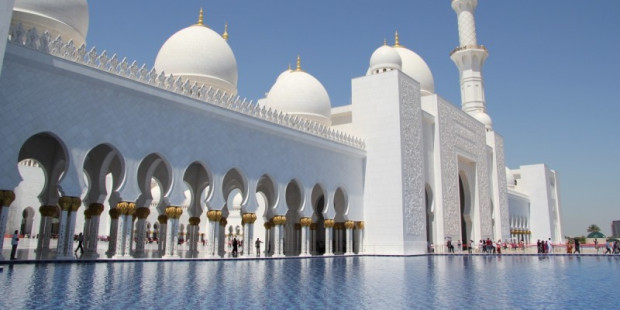
The first mosque named “Mariam, Umm Eisa (Mary, Jesus’ Mother) Mosque.”

►A mosque in Abu Dhabi, capital of the United Arab Emirates (UAE), has been renamed “Mariam, Umm Eisa (Mary, Jesus’ Mother) Mosque.”

Sheikh Mohammad bin Zayed Al-Nahyan, Abu Dhabi crown prince and deputy supreme commander of the UAE Armed Forces, ordered that the mosque be renamed to “consolidate bonds of humanity between followers of different religions.”

[Mary (Mariam) is revered in Islam as the mother of Jesus. She is mentioned in the Qur’an 34 times, while Jesus (Isa) is mentioned 25 times.]

Rev. Elias D. Mallon places this development in context:

“Our Lady plays an important role in Islam. She is the virgin mother of Jesus, although with no connotation of the Incarnation as understood by Christians. She is the one who hears God’s word and believes it. And in the Qur’an, she is the focus of Chapter 19.

“When members of the early Muslim community fled to Abyssinia (ancient Ethiopia) to escape persecution, they were required by the king to explain their new faith. When he heard of the devotion they had to Mary, he immediately accepted them as protected refugees.

“Two women play a major role in Islam. The first is Fatimah, the daughter of the Prophet Muhammad and wife of Ali bin Abi Talib. The second is Mary, Mother of Jesus. Known among Muslims as Fatimah al-Zahra, “the Illustrious,” the daughter of the Prophet is widely revered in Sunni and especially Shi’ite Islam.

“While it is common among Shi’ites to have mosques bearing the name of Fatimah, to my knowledge this mosque in Abu Dhabi is the first to be named after the Virgin Mary.” ◘

From ALETEIA.ORG