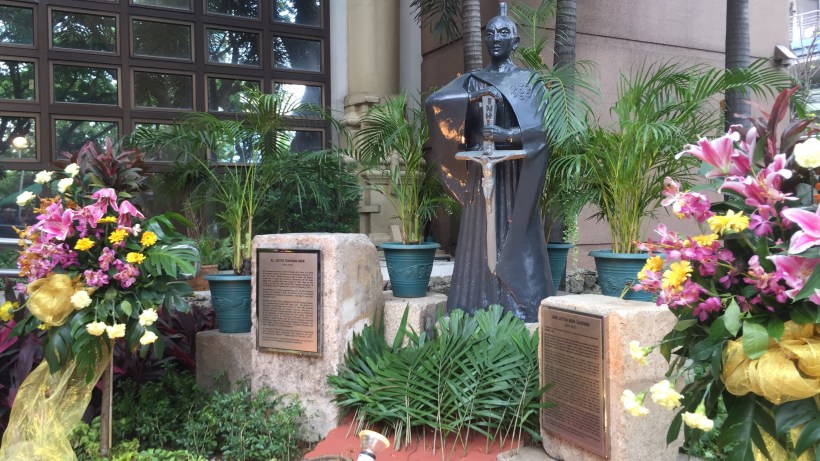
Lord Takayama, Symbol of Philippine-Japanese Friendship, Guarding the DMCI Equipment Yard
But Will Plaza Dilao Still Be There?
►Plaza Dilao Is Now the Equipment Dump of DMCI, Builder of Skyway-3.
The Plaza Dilao Project, funded by popular subscriptions from Japanese cities, chambers of commerce, breakfast prayer-groups, and Catholic and Protestant churches in Japan — with land and labor donated by the City of Manila — was inaugurated as “The Philippines-Japan Friendship Park” on Nov. 17, 1977.
In brief, Nov. 17, 2017 marks:
►FORTIETH (40th) anniversary of the establishment of the Philippines-Japan Friendship Park at Plaza Dilao in 1977.
►25th (Silver) Anniversary of the proclamation of the Takayama Memorial as a National Monument by the National Historical Commission of the Philippines (NHCP) on Nov. 17, 1992.
►425th year of the founding of the “Dilao” settlement in 1592 as the first Japantown (“nihon-machi”) in the Philippines. The Japantown was resettled in its fourth and present site (in front of the Paco Railway Station) only in 1762. Plaza Dilao has been located in its present spot for 255 years!
►ELEVENTH (11th) year of Plaza Dilao as ONE of Manila’s five Freedom Parks.
All these are great milestones in the history of the Philippines and Japan!
At 10:00 AM (Friday) – Laying of Flowers at the Pedestal of the Takayama Memorial. ◘
Parishes Should Serve People and Communities Equally
►MANILA, Aug. 1, 2017 (Ucanews) — Catholic parishes should continue to serve people and communities equally without being “parochial.”
This was the call made by Cardinal Luis Antonio Tagle of Manila at the end of the three-day Philippine Conference on New Evangelization on July 30.
The Manila prelate said the church should continue to support and serve people by making room for others and “entering the wounds of others.”
“How I wish our parishes would enter the doors of the wounds of people so that no parish would become parochial,” he said.
“The word parochial means narrow,” said Cardinal Tagle before some 6,000 participants at the annual gathering in Manila.
Now in its fourth year, the conference discussed issues of social justice, the environment, youth, social media, family, among others.
Cardinal Tagle said that in a world “enveloped by fear” the annual gathering is an invitation to Catholics to make room for those “who want to take the first step towards journeying.”
“By making room for others we become agents of God’s hand, guiding those who have lost direction so that they could find their way,” said the cardinal.
He said “touching the wounds of others” is the “way of communion” that will help people recover a sense of common humanity.
“I hope that every parish really becomes a communion where we open doors, where we surpass our fears, and we see a brother or a sister whose wounds are my wounds too,” said Cardinal Tagle.
In his homily at Mass for the closing of the conference, Archbishop Salvatore Fisichella, president of the Pontifical Council for the Promotion of the New Evangelization, stressed the church’s mission and the role of people in evangelization. “We recognize that we are all involved in a true movement, a movement that unites us to Christ.”
The annual meeting is an initiative of the Archdiocese of Manila to find and introduce new methods to evangelize cultures and societies “fruitfully.”
Father Jason Laguerta, conference director, said the event is a continuing effort of exploring new expressions and narratives in sharing the Gospel “in a language that touches and transforms hearts and souls.”
“New evangelization is fundamentally about the encounter with Jesus and without this there can be no other communion,” said the priest, adding that, “communion without mission is unhealthy.” ◘
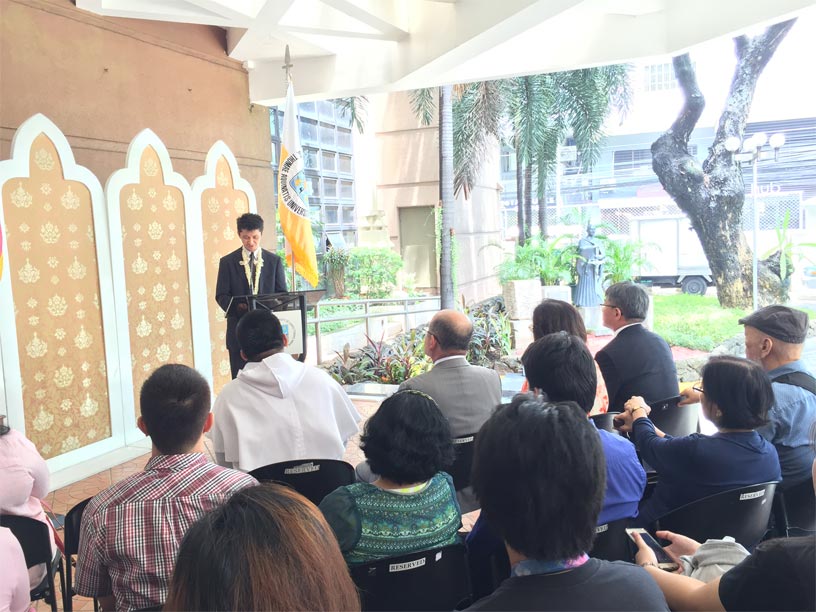
JICC Director Ken Nakamura delivering his speech during the Takayama Memorial event.
The Challenge Facing Us
►Remarks of Hon. Ken Nakamura, Director of the Japan Information and Cultural Center, Manila (JICC), at the installation of the Toyono-cho granite marker at the Takayama Memorial at the Thomas Aquinas Research Complex (TARC), University of Santo Tomas (UST) on July 29, 2017 — at the sidelines of the Fourth Philippine Conference on New Evangelization (PCNE 4), July 28-30, 2017.
FIRST, I WOULD LIKE to thank the administration of the University of Santo Tomas and the representatives of Toyono-cho, Japan for organizing this important event and for inviting me to participate. It is a great pleasure and privilege for me to witness this momentous occasion, which honors the life of Blessed Justus Takayama Ukon.
Lord Takayama has lived through most of the “Sengoku jidai” (戦国時代) or the “Age of the Warring States” which was a dark period in Japanese history, characterized by huge and nearly never-ending political and social conflicts. To say that it was a dangerous time to be in is an understatement. Lord Takayama faced numerous life-threatening dilemmas, which reached their climax upon the rise of a “Shogun” or leader who completely banned the practice of Christianity and executed anyone who engaged in it.
Lord Takayama had two options then: to renounce his faith and perhaps to maintain his social standing or to uphold his beliefs and possibly lose everything. By now, we all know what he chose.
He left his own country because he deemed it necessary to stand up for what he believed in. It was a courageous choice that proved to be the right one. That was affirmed by the warm welcome that was extended to Lord Takayama in the Philippines upon his arrival.
At certain points in our lives, we too are faced with similarly crucial choices that could significantly influence our future. Japan and the Philippines, for instance, have such good relations today because our forefathers have been given choices and the choices they made helped build and nurture our diplomatic bonds. ◘
Dr. Ernie A. de Pedro
Managing Trustee
Lord Takayama Jubilee Foundation
As the University of Santo Tomas hosts the Philippine Conference On New Evangelization (PCNE 4) 2017 on July 28-30, 2017, it is fair to ask: How would a Filipino Catholic face the same test of faith that some 30,000 Japanese martyrs (42 of whom have been proclaimed Saints, while 394 have been beatified or declared “Blessed”) and several hundred Korean converts in Japan (108 of whom are Martyr-Saints) had willingly faced?
We have only one example – San Lorenzo Ruiz (c1600–1637) who tried to flee Manila on board a ship with three Dominican priests who were purposively going to Japan to proselyte, with Lorenzo Ruiz just trying to get away from Manila.
All were arrested upon landing, and after two years in prison, martyred in Nagasaki.
Little is known about San Lorenzo. He was born around the year 1600 in Binondo, Manila – the traditional district for Chinese Christians. He was the son of a Chinese father and a Filipino mother. Both were Christians and took care to raise Lorenzo as a Catholic. He served in his parish church as an altar boy and calligrapher. He was listed as a member of the Dominican Confraternity of the Most Holy Rosary.
Lorenzo married a woman named Rosario. The couple had three children — two sons and one daughter. By Dominican accounts, the family was ordinary and happy.
In 1636, Lorenzo was accused of murder. Allegedly he killed a Spaniard – and in Manila, justice would have been stacked against him, a Chinese mestizo. There are no details of this alleged crime other than a journal entry by two Dominican priests, that he joined their group bound for Japan to escape possible arrest.
The ship departed the Philippines on June 10, 1636, bound for Okinawa. Lorenzo and the Dominican missionaries were arrested by Japanese officials for the state crime of being Christians and ordered to recant their faith. When Lorenzo refused he was imprisoned for two years. On Sept. 27, 1637, Lorenzo and his companions were taken to Nagasaki to be tortured and killed if they would not recant their faith. Despite the painful torture, the men refused to abjure their Catholic religion.
Following this, Lorenzo was hanged upside down, with a rope around his ankles. This method of torture was known as tsurushi, or “gallows and pit.” The torture forces a person to be hanged upside down with a gash cut in their forehead to prevent too much blood from gathering in the head. The gash also causes the victim to bleed to death over an extended period of time. One hand is left free so the victim can offer an agreed symbol that will represent their desire to recant their faith. But Lorenzo refused to recant.
According to the record of his death, his last words were, “I am a Catholic and wholeheartedly do accept death for God. Had I a thousand lives, all these to Him I shall offer. Do with me as you please.”
Lorenzo Ruiz was in good company: St. Antonio Gonzalez, St. Guillermo Courtet, and St. Miguel de Aozaraza; a Japanese priest, St. Vicente Shiwozuka de la Cruz; and a lay leper, St. Lázaro of Kyoto.
Lorenzo was beatified by Pope John Paul II on February 18, 1981 in Manila – a first! The beatification ceremony was held in the Philippines making it the first beatification ceremony ever held outside the Vatican. It was the revered statue of Our Lady of the Holy Rosary (known in Manila as “La Japona”), brought back by Lord Justo Takayama Ukon from Nagasaki in 1614 that “presided over the Beatification Ceremonies of ‘Lorenzo Ruiz and Companions’ in 1981.”
His canonization took place at the Vatican on October 18, 1987. His feast day is September 28. ◘
Dr. Ernesto A. de Pedro, Managing Trustee
Lord Takayama Jubilee Foundation
The world has been riveted by the case of the baby Charlie Gard, and the decision of a British hospital, a British court and the highest court in the European Union – to switch off the life-giving apparatus that is keeping the less-than-one-year-old baby alive. The world has responded by raising funds to make treatment in America possible.
On July 4, Francis McKinney contacted Blessed Takayama Canonization Movement asking for prayers for the desperate baby, Charlie Gard.
“About four months ago, I discovered Blessed Takayama. I pray to him as often as I can. Now, I am not sure if you are aware, but a 10-month old baby by the name of Charlie Gard was to be taken off of life support today for a terminal illness. The European Court had ruled that today was his last. Last night, my family and I knelt down and said a Rosary and prayed the prayer of Blessed Takayama. We asked him that if it was the Lord’s will, to let Charlie live. We asked that someone in power speak out — either Pope Francis or Donald Trump — so that they may influence the concrete decision. As we speak, Charlie Gard is supposed to have been dead. Both Donald Trump and Pope Francis have made a statement regarding poor Charlie within hours of each other.
“I feel in my heart that Blessed Takayama, through the grace of our Lord, intervened and helped Charlie Gard. If you need proof of my prayers, I took screenshots of my Twitter last night saying that I was praying to Blessed Takayama…”.
Immediately, an email was sent out to Prayer Warriors of Blessed Takayama — both lay devotees and religious congregations — in the Philippines and abroad, asking for prayers. Nothing elaborate, The Prayer formulated by Fr. Johannes Laures, SJ – which appears on the Takayama website (www.takayamaukon.com) — will do, followed by “Our Father” and “Hail Mary.”
But the situation remains desperate. Baby Charlie Gard is still in England, waiting for clearance to reach America – and a possible cure.
Please continue to pray for him. ◘
►BREAKING NEWS — (CNN) British baby Charlie Gard, who was at the center of a legal battle that captured the world’s attention, died Friday (July 28, 2017) — one week before his first birthday. “Our beautiful little boy has gone, we’re so proud of him,” his mother, Connie Yates, said in a statement.
Charlie was born on August 4, 2016, seemingly healthy. But two months into his short life his parents noticed his health was declining. They took him to London’s Great Ormond Street Hospital for Children in October where he remained at least until Thursday.
Those of us who fervently implored Blessed Takayama to intercede with God for his well-being send their heartfelt condolences to Charlie’s parents and loved-ones at this very sad time. ◘
►Today (Saturday, July 29) — At 6 PM, the Blessed Justo Takayama Ukon Canonization Movement is sponsoring a Thanksgiving Mass at the Immaculate Heart of Mary Parish Church (Claret Church), Quezon City, officiated by Fr. DESIDERIO MARTIN, CMF, to celebrate the passage of the baby Charlie Gard to God’s Heaven yesterday – one week before his first birthday on August 4.
We do not grieve. We rejoice. And we invite you to be the additional “two or three” so the Lord will be in our midst. Wherever you are, please say a prayer too — not for Charlie alone – but for yourself and your loved ones, remembering we all teeter daily at the brink of our inevitable mortality. ◘
Dr. Ernesto A. de Pedro, Managing Trustee
Lord Takayama Jubilee Foundation
In Western annals, the most celebrated voyage of people fleeing religious persecution is that of the Mayflower Pilgrims in September-November, 1620. The Mayflower has occupied a prominent spot in American tradition as a symbol of the indomitable English settlers’ quest to build “a beacon for Christians around the world” in a New World.
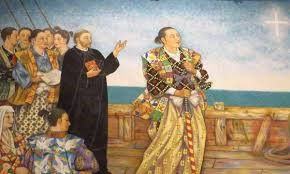
Yet Lord Takayama Ukon’s exile voyage to Manila in November-December 1614 antedated the Mayflower — by six years. Though half-a-world apart, the two voyages shared many uncanny similarities and parallels.
Takayama’s exile ship – actually a Portuguese-captained Chinese junk — left Japan with the consent of the Tokugawa Shogunate to bring Japanese Christians “too prominent to crucify” (and their families) to exile – and religious liberty — in Manila. Likewise, the “Mayflower” left England, with the permission of King James I, with Protestant refugees and migrants seeking to worship in freedom in a settlement they were going to build.
Takayama’s exile ship left Nagasaki, Japan with “300” Christian exiles – suffering one death (Fr. Antonio Francisco Critana, SJ) on board. The Mayflower left Plymouth, England with 102 passengers — suffering one death (William Butten) on board.
Takayama’s exile ship managed the Nagasaki-to-Manila voyage, which normally took 20 days — in 43 days, double the usual duration. The Mayflower navigated the Plymouth-to-Cape Cod voyage, which should have lasted 33 to 40-days – in 66 days, also double the duration.
Takayama’s exile ship suffered a broken main mast, disabling the ship (which was then already in Bataan waters, some “39 to 52 nautical miles” from Manila) from sailing further. Spanish Governor-General Juan de Silva had to send a Spanish man-of-war, partially propelled by sails, but powered mainly by rowers, to tow Takayama’s stricken ship to the Governor’s Landing (now the Postigo Gate) in Manila. The Mayflower similarly suffered a broken main beam amidships – which was repaired with metal braces and tools brought to build the Pilgrims’ new settlement.
In brief: Takayama’s exile ship left Nagasaki on Nov. 8, 1614 and arrived in Manila on Dec. 21, 1614. The Mayflower left Plymouth, England on Sept. 6, 1620 and anchored in Plymouth Rock on Nov. 11, 1620.
By Ernesto A. de Pedro
Managing Trustee
Lord Takayama Jubilee Foundation
Only two months into Facebook, we have finally renewed contact with Rev. Gary Barbaree and Rev. Nobuaki Hanaoka, both American Methodist ministers who participated in the First Takayama Symposium at the University of Santo Tomas (UST) in Manila in 1990, to mark the 375th Anniversary of Takayama Ukon (1552-1615). They were researching in Tokyo on Takayama – and how Takayama Ukon blended Christian ethics and the Japanese point of view to help them in their own evangelization of Japanese Americans — but were told to proceed to UST which was the center for Takayama Studies. THANK YOU, U.S.T. GRADUATE SCHOOL!
On June 8, 1994, the Vatican’s Congregation for the Causes of Saints conferred the title “Servant of God” on Takayama. A second Takayama Symposium was sponsored by UST in 1995 to discuss that encouraging development. Without passing through the prescribed second step — “Venerable” — Takayama was beatified (declared BLESSED) on Feb. 7, 2017.
The fastest progression for Japanese martyrs from BLESSED to SAINT was the Sixteen Martyrs of Japan (1633-1637) — beatified 1981, and canonized 1987. Only six years! Just 30 years ago!
February 3 has been designated as the feastday of Blessed Takayama in the Universal Church. With the concerted prayers of Catholic devotees worldwide, we could aspire for canonization in six years too! IF there is a validating miracle.
By Dr. Ernie A. De Pedro, Managing Trustee Lord Takayama Jubilee Foundation
When their patriarch, Lord Justo Takayama Ukon died on Feb. 3, 1615, the Spanish Governor General, Juan de Silva, was worried about the future of Takayama’s family who remained as houseguests of the Philippine Jesuits at their “Casa San Miguel” in Intramuros.
He offered a royal pension to the widow, Dona Justa Takayama. But she declined the offer. The family will be alright, she said. She had other plans.
Mrs. Justa Takayama, returned to Japan in the first semester of 1616 with her daughter, Lucia Yokoyama, and her eldest grandchild – a development reported on July 18, 1616 by the Jesuit Vice Provincial Jeronymo Rodriguez, SJ.
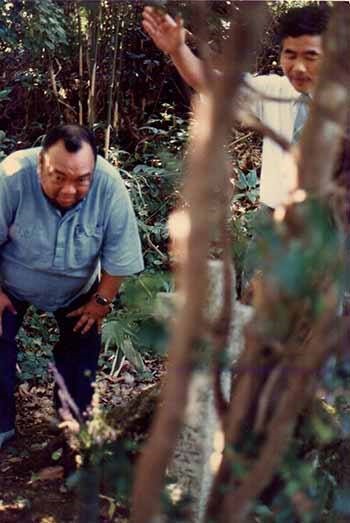
Dr. Ernesto de Pedro, lead Filipino promoter of the Canonization Cause of Ukon Takayama, visits the spot in Shika-machi, marked with a stone crosss, where finger-bone of Takayanma was buried in 1616. The relic was brought back to Japan by Dona Justa Takayama, who wanted a part of Ukon buried in Japan.
She had brought a finger bone of Ukon to be buried on home soil in Kanazawa. By tradition, the eldest son of the Takayama family in Kanazawa – there is an unbroken line to this day — is tasked to care for the memorial in a nearby forested area where a concrete cross has been erected. (Across the centuries, this cross/marker has not been savaged or defiled by any anti-Christians.)
Ukon’s daughter, Lucia Yokoyama, returned to her husband, Yokoyama Daizen Yasuharu (1590-1645), a general of the Maeda clan in Kanazawa after a 28-month separation. According to the Yokoyama family tree, Baron Yokoyama remarried in 1624 – this time, to a daughter of Imaeda Nimbu Naotsune — which indicates that by that year, Ukon’s daughter Lucia had passed away.
It appears that the four other Takayama grandchildren had joined the Japanese Christian community in San Miguel district, which was also a Jesuit parish.
Ambassador HASEKURA Rokuemon Tsunenaga (支倉六右衛門常長, 1571-1622), a retainer of Lord Date Masamune, daimyo of Sendai, who led the first Japanese embassy to Europe (1582-1590), stopped over in Manila from June 1618 to August 1620 on his return home to Japan. He recalls seeing a grandson of Takayama dressed as a foppish Spanish grandee. Instead of wearing traditional Japanese clothes, the young millennial preferred to don Spanish-style garments.
In a letter dated Oct. 6, 1621, Fr. Johannes Battista Porro, SJ, writes that Mrs. Takayama, using the name Rocuzaimon – (Rokuzayemon?) — had settled in far-away Oita Prefecture. Her other grandchildren returned to Japan in 1621 but preferred to proceed to Sakai City. This is the same year Manila Archbishop Miguel Garcia Serrano, OESA, reported to the king of Spain that there are “more than 1,500 [Japanese] Christians … in Santiago, and in the villages of Dilao [the first Japan town] and San Miguel [the Jesuit encomienda reserved for Japanese Christian exiles] — but this was not a fixed population “because the [Japanese] are a people who go to and fro” to Japan.
In 1802, the Takayama family in Oita Prefecture erected a memorial tombstone for Takayama Ukon at the Oita city cemetery. (Note that in 1802, Christianity was still officially proscribed with the death penalty. But nevertheless, the Takayama family proclaimed their descent from Takayama Ukon.) Eimei Takayama, a former mayor of Oita made the claim in an English pamphlet that was widely distributed in Manila during the 1937 International Eucharistic Congress.
Today it is known that there are descendants of Takayama Ukon in Kanazawa, Noto, Oita, Sakai – and in one case we know of, in Tokyo too. With the mobility of the Japanese population in the past 400 years, other Takayama descendants may be in other cities as well. During the Beatification Rites at Osaka in 2017, two Takayama descendants — from “near Kanazawa” – attended the religious event.
By Dr. Ernie A. De Pedro, Managing Trustee Lord Takayama Jubilee Foundation
MANILA–The University of Santo Tomas (UST) unveiled a historical marker on campus Tuesday to memorialize the first lay Japanese Christian missionary in the Philippines.
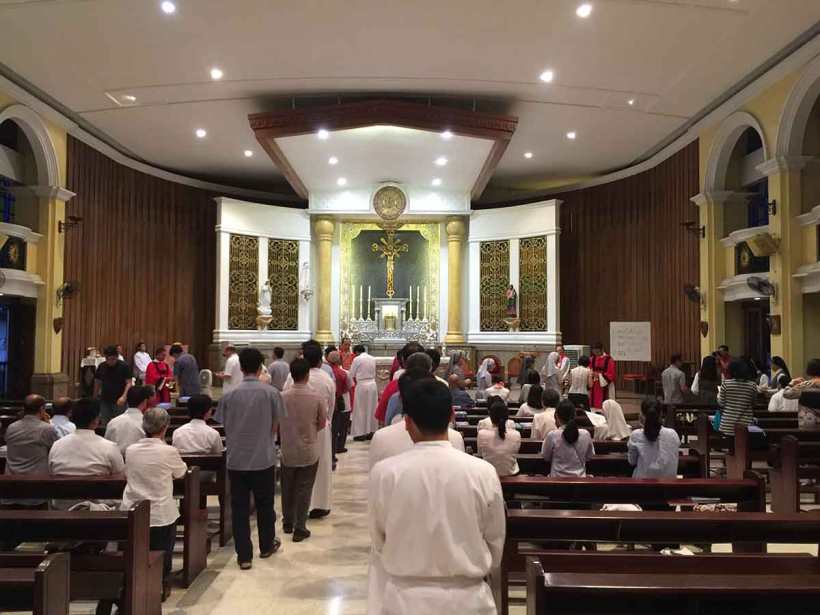
The Jesuit community at the Ateneo de Manila celebrated a Thanksgiving Mass for the Beatification of Blessed Justus Takayama Ukon at the chapel of the Loyola School of Theology on Saturday, March 18 at 5:30PM.




 Blessed Justo Takayama Ukon