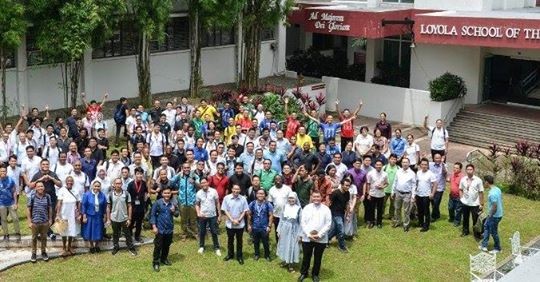
►After the Beatification of Blessed Justo Ukon Takayama (1552-1615) in Osaka on Feb. 7, 2017 – the Jesuit community at the Ateneo de Manila celebrated a Thanksgiving Mass at the chapel of the Loyola School of Theology on Saturday, March 18, 2017.
Very Rev. Fr. Antonio F. Moreno, then the Jesuit Father Provincial, officiated at the concelebrated Mass, along with Fr. James McTavish, provincial superior of Verbum Dei Missionaries, and Fr. Iwao “Wow” Daniel Ikegami, FMVD.
In the congregation were priests, scholastics, seminarians, lay and religious students, and Japanese nuns from various Metro-Manila congregations — and the former Jesuit Superior General in Rome, Fr. Adolfo Nicolas, who lived in retirement at the Ateneo.
Homily by Japanese Priest Born in Brazil
The homily was delivered by Fr. Iwao “Wow” Ikegami, a Brazilian-born Japanese who was ordained August 2015, sharing his journey to the priesthood and the relevance of Blessed Takayama Ukon to relations between the churches of Japan and the Philippines.
Loyola School of Theology (LST) is an international academic community
Blessed Takayama — A Jesuit “Cause”
►Among 86 Daimyo who converted to Christianity, Lord Takayama, as patron of Jesuit missions, used his resources to support the growth and expansion of the early church of Japan — building churches, chapels and seminaries for the Jesuit missionaries, who were the only Catholic religious congregation in Japan beginning 1549 till 1602 when Manila-based Spanish missionaries started arriving.
It was a Jesuit, Padre Pedro Morejon, who conducted a 30-day “Spiritual Exercises” for Lord Takayama — in preparation for martyrdom — before the exile ship left Nagasaki for Manila with 350 Japanese Christian deportees on Nov. 8, 1614.
It was this same Jesuit, Fr. Morejon — (Takayama’s father-confessor) — who wrote the petition of the Manila Archdiocese dated Oct. 5, 1630 — proposing to the Congregation for the Causes of Saints a Japanese Catholic — who died in Manila; under church rubric “where one dies, is where one is born to Heaven” — as the FIRST saint of the Philippine Church.
It was also a committee of Jesuit historians in Japan, headed by Sophia University’s Fr. Hubert Cieslik, SJ, who prepared in 1963 all the supporting documents for Takayama’s “Positio.”
First as Confessor — Then as Martyr
It was the Jesuit General Postulator, Fr. Paolo Molinari, SJ, who presented the original “Postio” enumerating the heroic virtues of a Confessor — “Servus Dei, Justus Takayama Ukon: Materia Praeparata Pro Propositione Super Virtutibus Servi Dei Justi Takayama Ukon” (Manila: Lord Takayama Jubilee Foundation, 1994) – which resulted in Takayama’s being recognized as a “Servant of God.”
It was another Jesuit General Postulator, Fr. Anton Witwer, SJ, who submitted the revised version for a Martyr – “Positio Super Martirio: Beatificationis Seu Declarationis Martyrii Servi Dei Iusti Takayama Ukon Viri Laici in Odium Fidei, Uti Fertur, Interfecti” (Rome: 2015).
Pope Francis Issues ‘Decree of Martyrdom’
It was another Jesuit, Pope Francis, who allowed the “switching” of the “Cause of Takayama” from Confessor (when Takayama earned the title “Servant of God” on June 8, 1994) to Martyr – by issuing a Decree of Martyrdom on Jan. 21, 2016, recognizing Takayama as a martyr — a “layperson … from Japan [who] died from the hatred of the Faith on Feb. 3, 1615 in Manila, Philippines.”
In an unusual development, the “Servant of God” Justo Ukon Takayama skipped the “Venerable” stage — and went directly to “Blessed.”
Takayama Conference Room
Loyola School of Theology (LST)
Rev. Fr. Jose V. C. Quilongquilong, SJ, President, Loyola House of Studies, shares that the Loyola School of Theology has honored Blessed Takayama by naming a conference room after him. The “Takayama Conference Room” is located in the Lucas-LST Wing.
Loyola School of Theology (LST) is one of the seven (7) English-speaking faculties of theology in the world administered by the Society of Jesus and is the only one in the Jesuit Conference of Asia Pacific. For School Year 2018-2019, the LST has 470 seminarians, priests, lay and religious students (283 Filipino and 187 international students) representing 63 religious congregations, 72 dioceses and 38 countries around the world.
Wanted: One Miracle from God Interceded by Blessed Takayama
Dom Justo Ukon Takayama (1552-1615), Lord of Takatsuki Castle at 21. During his 12-year rule of Takatsuki, 18,000 out of 25,000 residents converted to Christianity
Today, Takayama’s “Cause” is awaiting one validating miracle through the intercession of Blessed Takayama — a requirement to show that indeed Blessed Takayama dwells in the presence of God.
The final step is canonization – or inclusion in the Roman Catholic Church’s Canon of Saints, now numbering over 10,000 Saints.#
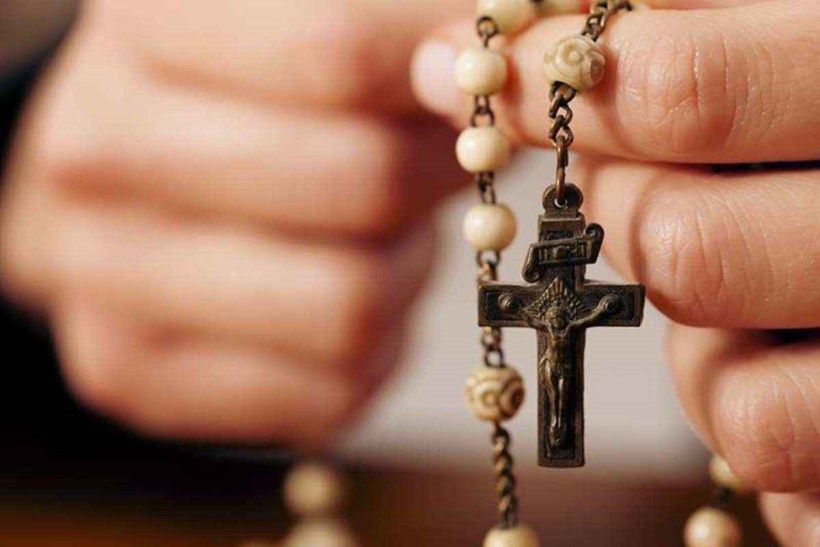
►If you can help it, do not pray the Rosary alone. (It’s easy for the mind to wander – if you pray alone.)
Pray “with two or three” of your family or friends. The Lord has promised: “For where two or three have gathered in My name, I am there in their midst.” (Matthew 18:20).
Basics of the Rosary
►The Rosary helps us keep in memory principal events in the history of our salvation.
As updated today – in Lord Justo Ukon Takayama’s time, the Rosary was simpler — there are 20 mysteries reflected upon in the Rosary, and these are divided into the ● five Joyful Mysteries (said on Monday and Saturday), the ● five Luminous Mysteries (said on Thursday), the ● five Sorrowful Mysteries (said on Tuesday and Friday), and the ● five Glorious Mysteries (said on Wednesday and Sunday). As an exception, the Joyful Mysteries are said on Sundays during Christmas, while the Sorrowful Mysteries are said on the Sundays of Lent.
The mysteries of the Rosary are based on the incidents in the life of Our Lord and His Mother that are celebrated in the Liturgy. There is a parallel between the main feasts honoring our Lord and his Mother in the liturgical year, and the 20 mysteries of the Rosary. Consequently, one who recites the 20 mysteries of the Rosary in one day reflects on the whole liturgical cycle that the Church commemorates during the course of each year.
It’s the Gospel compressed into the Rosary. The Catholic Church grants indulgences for the recitation of the Rosary.
Invite Your Patron Saint — or Blessed Takayama — to Pray with You
As a force multiplier, invite Blessed Justo Ukon Takayama — the Philippine Church’s third Blessed — to pray the Rosary with you. (Lord Takayama was the “Kirishitan Samurai” who was entrusted with safeguarding the image of Our Lady of the Rosary during the perilous exile-voyage from Nagasaki to Manila from Nov. 8 to Dec. 21, 1614.
‘La Japona’ — Enshrined at Santo Domingo Church since 1614
Today, the statue of “La Japona” is enshrined at the Santo Domingo Church in Quezon City.
Praying With the Support of the Entire Heavenly Court
This method of praying the Rosary is based on Our Lady’s promise that devotees of the Rosary will have for their intercessors the entire heavenly court.#
Celebrated portrait of Lord Takayama by Utagawa Yoshiiku
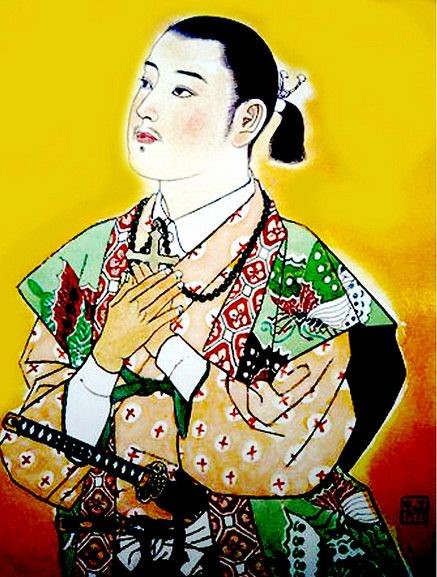
►Japanese secular portraits do not show Justo Ucondono (15521-1615) – or Justo Ukon Takayama as he is known today — wearing the Holy Rosary. Lord Takayama was depicted — most famously in this portrait by Utagawa Yoshiiku (1833-1904) — as a fierce samurai, while many Western portraits show him “armed with the Holy Rosary.”
The Holy Rosary Was Introduced in 1214
St. Dominic is handed the Rosary by the Blessed Virgin Mary in 1214
According to Dominican tradition, the Rosary was given to Saint Dominic of Caleruega (1170-1221) in an apparition by the Blessed Virgin Mary in the year 1214 in the church of Prouille, France — the “cradle of the Dominicans” — where the first Dominican house was founded in late 1206 or early 1207. This Marian apparition received the title of “Our Lady of the Rosary.”
When the Order of Preachers (OP) was approved by Pope Honorius III via the Papal bull “Religiosam Vitam” on Dec. 22, 1216, the daily recitation of the Rosary soon spread among Catholics reached by Dominican missionaries in every corner of Christendom.
Prayer beads were in use in older religions – Buddhism for instance — for counting mantras since the 5th century BCE. In the case of Catholics, the beads are used to keep track of the number of “Hail Marys” in each decade.
What Does the Holy Rosary Mean for Catholics?
►For those of us who have grown up with the Rosary, Venerable Fulton Sheen expresses best what we believe about the Rosary. Archbishop Sheen was known for his preaching on television and radio on Catholic matters. The cause for his canonization as a saint was officially opened in 2002.
Reflection of Venerable Fulton Sheen
►As Jesuit missionaries in Japan’s Early Church were so thinly spread throughout the Japanese archipelago, they were not always available to celebrate a Eucharistic Mass at Takatsuki Castle. Lord Justo Ukon Takayama and his family used the daily recitation of the Holy Rosary to keep their fervor together.
Ukon understood that the Rosary was indeed a powerful weapon against evil — but that power comes from praying it, not wearing it. The physical beads on a string are only a device to help one keep count. Some people wear the Rosary as a symbol of their faith. The Rosary is not a tool for evangelization — but a tool for prayer.
‘Armed’ with the Holy Rosary
Throughout ● Ukon’s 12-year rule at Takatsuki Castle, his first feudal domain at age 21, ● his two-year rule in Akashi (in Hyogo Prefecture), and ● his 27 years of domestic exile in Kanazawa and Noto Peninsula, the Holy Rosary was the glue that kept the Takayama family together – as Jesuit missionaries were not always available every day.
When Ukon was out on military campaigns, his father, Dom Darius Takayama — Takayama Tomoteru (高山友照), 1531-1596 — led the recitation of the Rosary. When Dom Darius was absent, it was Doña Justa Kuroda Takayama who led the prayers. The sons and daughter of Takayama would take turns too. In their turn, the five Takayama grandsons did the honors.
Takayama Iconography
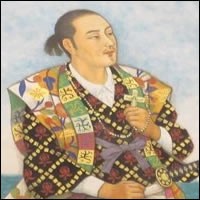
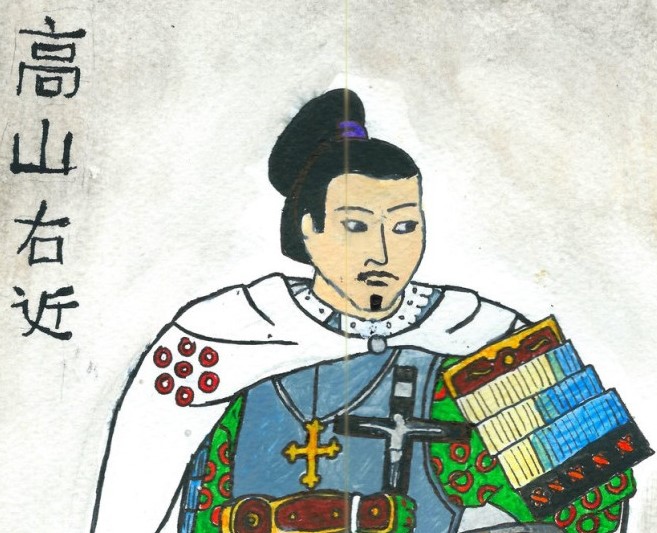
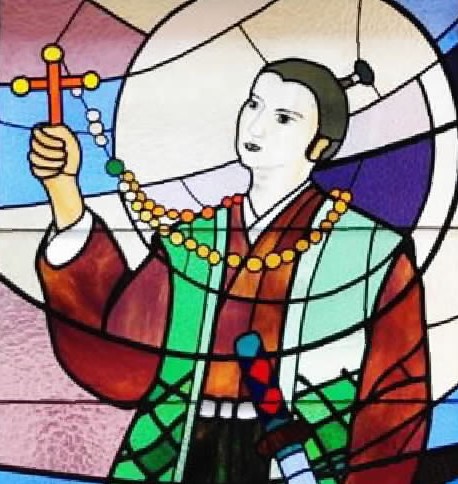
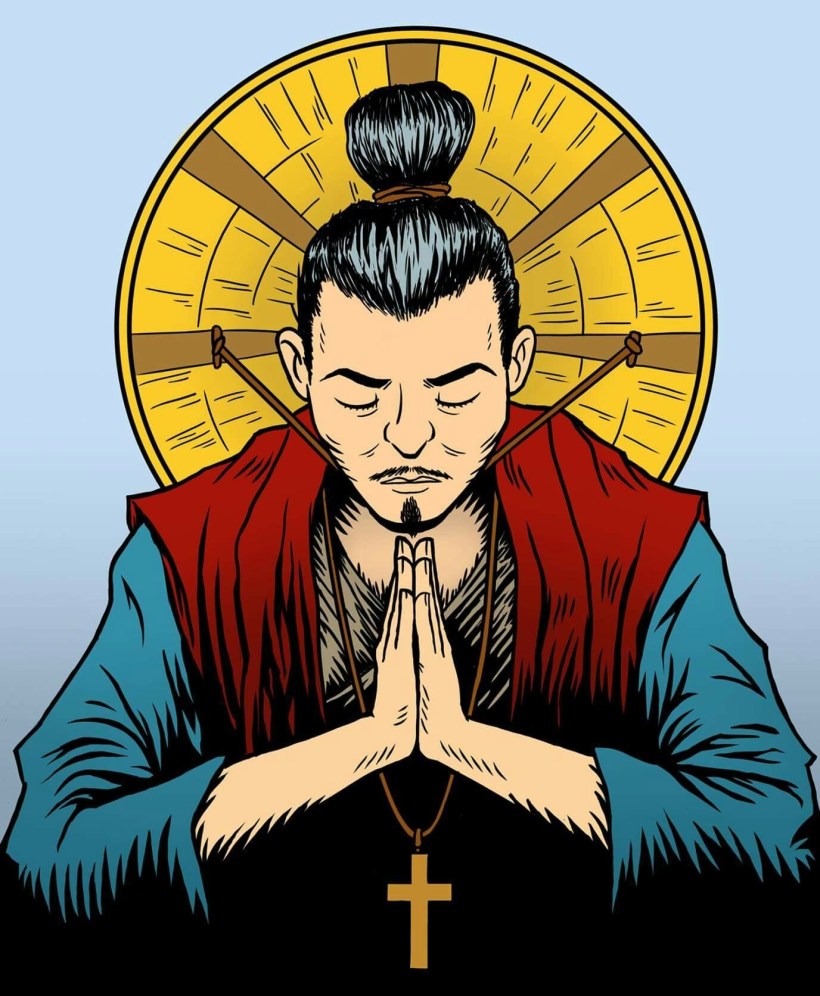
The iconography of Blessed Takayama includes many paintings and statues with the Rosary — either around his neck or in his hand. While the samurai sword was his trademark weapon, the Holy Rosary was his constant jewel – as can be seen in various representations of him.
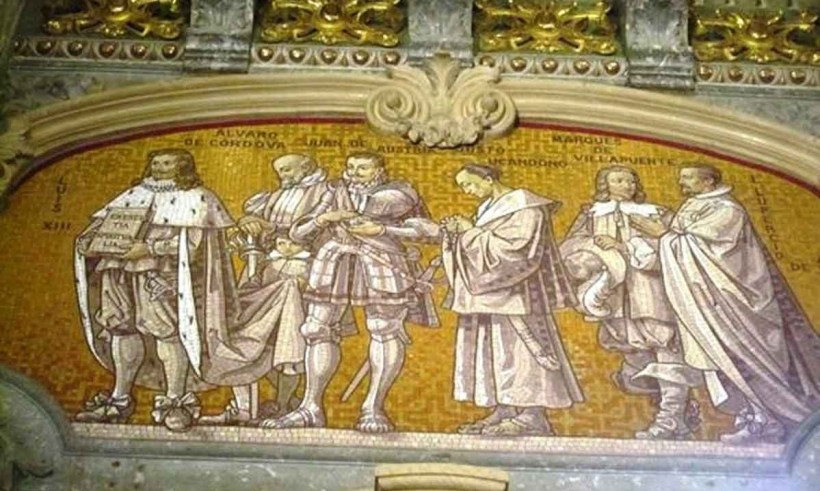
◘ MANRESA MOSAIC — This mosaic in a nave of the Jesuit church in Manresa, Spain depicted six Catholic noblemen who were all products of the Jesuits’ famed “Spiritual Exercises,” among them Lord Justo Ukon Takayama – shown holding a Rosary.
The six “Catholic princes” in the mosaic are: ● the Bourbon king of France, Louis XIII; ● Don Alvaro de Cordoba, a Spanish grandee whose public life was much influenced by the Jesuit manual; ● the Hapsburg prince, Don Juan de Austria (1545-1578) — victor of the Battle of Lepanto (1571); ● Justus Ukon Takayama (identified in the mosaic as “Justo Ucandono”); ● Marques de Villapuente, renowned for his charities, and ● Don Lupercio de Arbizu, the Aragon nobleman who was persuaded by the Jesuits to build Manresa into a city.
Lord Takayama in Manresa mosaic — holding a Rosary.
◘ MARBLE STATUE of the “Kirishitan Samurai” Ukon Takayama — at the plaza fronting the Takatsuki Catholic Church — with a Rosary.
The marble sculpture was carved by the Italian artist Nicolao Arrighini — as a gift of the Claretian missionaries in Japan to mark the 350th death anniversary of Lord Takayama.
◘ PORTRAIT of Ukon Takayama in Osaka’s Cathedral of the Immaculate Conception of the Blessed Virgin Mary — in the heart of Tamatsukuri, Osaka– with a Rosary.
Ukon Takayama at prayer
◘ ANOTHER PORTRAIT of Ukon Takayama in the Osaka Cathedral — with a Rosary.
Ukon depicted with a Rosary
◘ BOOK COVER for a children’s book — with a Rosary.
The provenance is not indicated. — but again, the Rosary is there.
◘ STAINED GLASS — at Shodoshima Catholic Church. Shōdoshima (小豆島) is an island located in the Inland Sea of Japan.
Young Ukon — with the Rosary
◘ NEW IMAGE used in an “estampita” (prayer card) — with a Rosary.
Blessed Justo Ukon Takayama — with halo — shown with Rosary
Preparation for Martyrdom
During the trek from Kanazawa to Nagasaki, the Rosary was recited, not just daily, but as a frequent prayer exercise. It was a conscious preparation for martyrdom — whether at the hands of minions of the Tokugawa Shogunate, or from the perils of the exile-voyage to Manila.
During the Takayama’s 45-day lay-over in Nagasaki – in quarters in Upper Nagasaki, in the so-called Tori-no-Hane Yashiki which local historians have not been able to locate till now — Takayama made a 30-day Ignatian “spiritual retreat” under the guidance of Fr. Pedro Morejon, SJ, chaplain of the “Beatas of Miyako (i.e. Kyoto)” — (Miyako no bikuni), the only religious women’s group in Japan’s Christian Century. The pioneering nuns were being exiled to Manila too – with Ukon’s exile group of 350 Japanese Christians.
In one fell swoop, Nagasaki’s 12 Catholic churches were re-purposed, demolished, destroyed or razed in October 1614 — just days before the deportation of the first group of 350 Japanese Christians to Manila. (Only one passenger, Fr. Antonio Critana, SJ, died during the voyage.)
A few days before their boat sailed south to Manila, Lord Takayama and his family could only watch helplessly and pray to Our Lord Jesus Christ to protect His Church and commend the Church of Japan to the protection of the Blessed Mother as the Nagasaki Bugyō, Hasegawa Fujihiro (1605–1614) effected the wholesale destruction of all 12 churches of Nagasaki in October 1614.
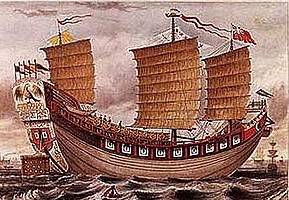
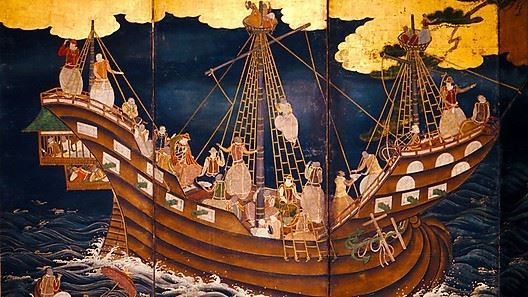
Takayama’s Exile Boat — a Chinese Ocean-Going Junk
By Oct. 27, 1614, all Christian deportees were ordered by Nagasaki Bugyō Hasegawa to proceed to Fukuda (福田村 Fukuda-mura), at the mouth of Nagasaki Bay, to board their exile ships — either to Manila or Macau.
Chinese junk, captained by Portuguese mariner, Capt. Esteban d’Acosta — with a mixed Japanese-Chinese crew of 30.
But the ocean-going Chinese junk bound for Manila, captained by the Portuguese mariner, Esteban d’Acosta, was still loading provisions and not ready to sail just yet. This junk had been contracted to carry Lord Justo Ukon Takayama, Lord Juan Tocuan Naito, their families, other nobles from Christian daimyo families, the nuns of the Kyoto-based “Miyako no bikuni,” the eight priests and 15 brothers of the Society of Jesus (SJ), as well priests from the three mendicant orders from Manila: the Dominicans, Franciscans, and Augustinians — plus some 100 Japanese catechists (“dojuku”). In all, some 350 Christian exiles.
VIP Passenger
The Marian icon “Our Lady of the Rosary” — aka “La Japoma” — was extracted from Santo Domingo Church, Nagasaki, in October 1614. “La Japoma” is now enshrined at the Santo Domingo Church in Quezon City — a fellow passenger on Ukon’s exile boat.
With foresight, the Dominicans had rescued the Marian icon “Our Lady of the Holy Rosary” from the Santo Domingo Church before the church’s destruction. As they were going to take turns sleeping on crates on the open deck, the Dominicans implored Lord Takayama, who had contracted a large cabin for his extended family, to keep the Marian image in his safe-keeping.
A Christian knight, devoted all his life to the Holy Rosary, being asked to safeguard “Our Lady of the Holy Rosary”? Ukon lived for that. It was Ukon’s great honor and privilege to serve Our Lady. Throughout the voyage, the first ever ocean voyage for the Takayama, his family prayed the Holy Rosary together — this time, in front of “La Japona” — taking turns to lead.
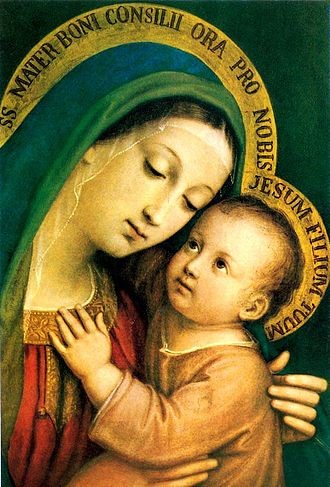
‘Our Lady of Good Counsel’ — Enshrined in St. Augustine Church, One of 12 Churches in Nagasaki
The Augustinians had enshrined a statue of Our Lady of Good Counsel in St. Augustine Church in 1612. Now, only two years later, the church was being demolished. They scrambled to save the Marian icon, which had originated from Manila.
The Augustinian devotion to “Madonna del Buon Consiglio” (Our Lady of Good Counsel) dated back to 1356. (Statues based on this famous Marian image were sculpted for installation in Augustinian churches worlwide.)
Our Lady of Good Counsel
But the Augustinians did not bring on board the statue of “Our Lady of Good Counsel” (“Mater boni consilii”) with them — as the Dominicans has done with “La Japona.” Perhaps they had already made alternative arrangements for the sake-keeping of the Augustinian Marian icon.
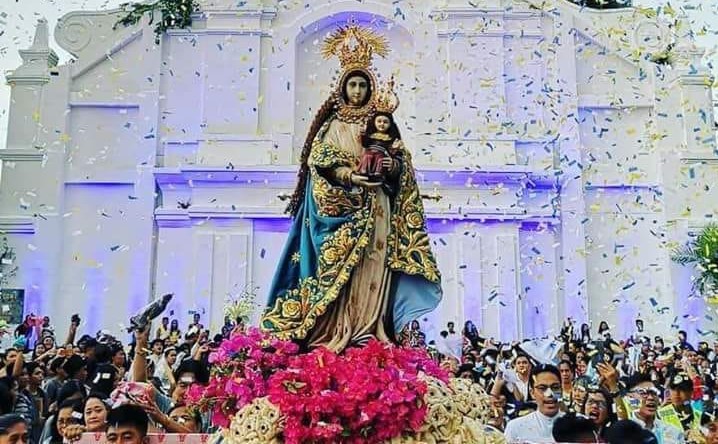
Was The Augustinian Statue of ‘Our Lady of Good Counsel’ Off-Floated to Luzon?
La Virgen Milagrosa de Badoc
Could the “La Virgen Milagrosa de Badoc” found in a crate floating off the coast of Badoc, Ilocos Norte in 1620 be the statue of “Our Lady of Good Counsel” enshrined in Nagasaki in 1612-1614? The statue, based on the Marian portrait that has been revered by Augustinians since 1356, is now dressed in new raiment (Philippine iconographic style) and bedecked with jewels presented by Ilocano devotees across four centuries. The studies go on.
The Rosary — in Ukon’s Hands
Weather permitting, even with so many missionaries on board, there was only a single Mass on the topdeck daily. It was the Rosary the rest of the time.
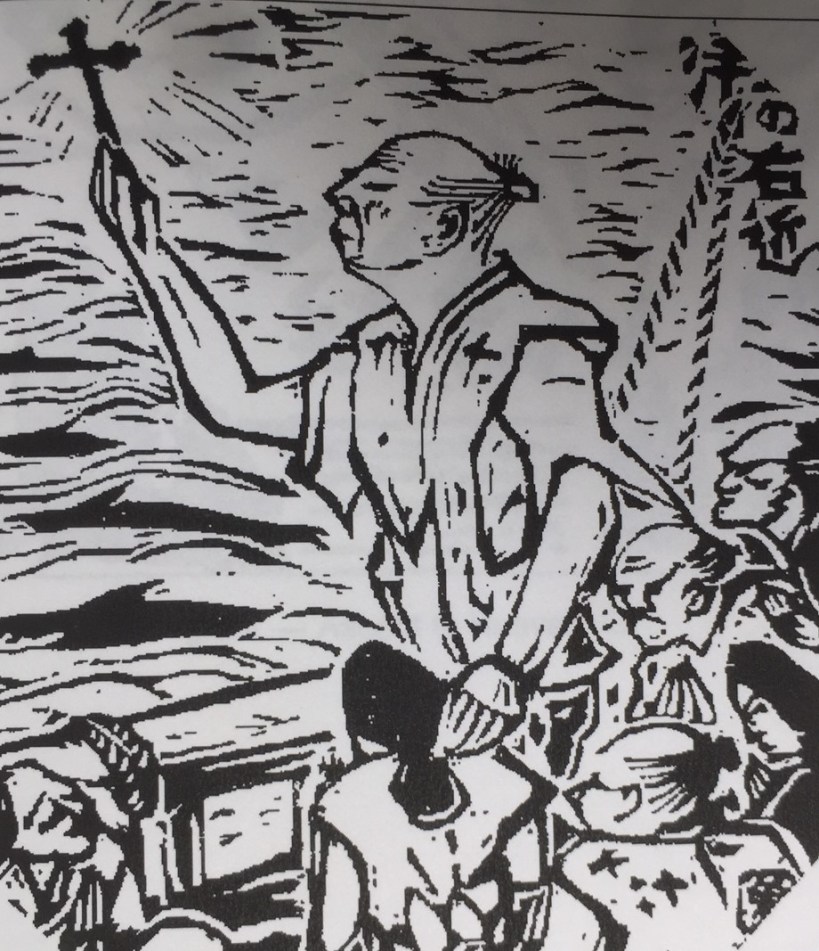
During the 43-day voyage (instead of the normal 20 days), a fight erupted on deck, when a crewman stabbed a Japanese Christian for some unstated reason. As the ship’s crew prepared to face off with the Christian passengers, Lord Takayama stepped out of his cabin to break up the fight – not with a samurai sword on hand – but with a Rosary in his right hand. They had interrupted his prayers. The combatants immediately broke off.
Japanese ‘Refugees and Migrants’ in Catholic Manila
Finally, during his 44-day sojourn in Manila, Dom Justo Ucondono (aka Lord Justo Ukon Takayama) felt free at last to exercise his Catholic religion, with any of six Churches in Intramuros to visit on any given day. Striving to be a channel of God’s grace in his new country, he frequently visited the “nihon-machi” (Japantown) in Dilao to evangelize the Japanese expatriates there — traders, “wako,” castaways, mercenaries, fugitives or seafarers stranded in Manila. He brought the converts to the Paco Catholic Church (est. 1580) for Baptism — with individual Takayama grandsons standing as “ninong” (sponsor).
A Dominican priest praying the Rosary — which has been promoted by the Order of Preachers (OP) since the founding of the religious order in 1206.
At the Jesuit guesthouse “Casa San Miguel” located in the PLM/Jesuit Compound in Intramuros, Manila — near midnight on Tuesday, Feb. 3, 1615 – with his father-confessor, Fr. Pedro Morejon, SJ, beside him, and surrounded by his family praying the Rosary — Ukon commended his spirit to the Lord — and implored Mother Mary to “pray for us sinners, now and at the hour of our death.”#
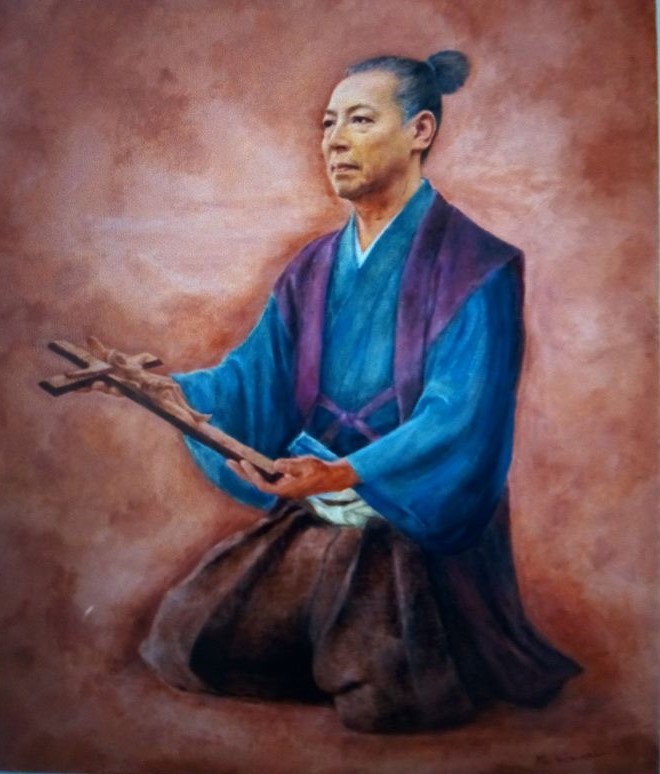
►John Andrew Sustaita — “The Art Guy” – from Grapevine, Texas, is not yet a Michaelangelo – but, for devotees of Blessed Justo Takayama — close!
John Andrew Sustaita, posing with his Takayama portrait, before entering the Vatican.
Working for an art shop called “Real Catholic Art,” which creates artwork for subjects such as our Lady of Guadalupe, St. Maximillian Kolbe, St. Patrick, St. Pope John Paul II, St. Charbel and the Children of Fatima, Sustaita wanted to paint a portrait of Blessed Takayama, but did not know how to tackle his subject. Sustaita proceeded to Japan for an immersion trip to learn and appreciate the culture of the samurai, and the singular relevance of Ukon Takayama who is a venerated exponent of the Martyr Church of Japan.
Sustaita: Immersing himself in Japanese culture by painting a variety of subjects — castles, ladies in kimono, carp (koi), and the like.
Relying on a network of friends and relatives, he imbibed the essence of Japanese civilization in the Osaka region — where Ukon Takayama became a “Daimyo” (feudal governor).
Sustaita’s rendition of the Japanese carp (koi)
When he became lord of Takatsuki Castle (at age 21), Ukon, who was baptized at 12, considered it his obligation to spread his faith in Christianity, and proselytized to many Daimyo close to him, among them Kuroda Kanbei and Gamo Ujisato. The unwavering faith that Takayama Ukon fostered penetrated deep into people’s hearts.
But Japan’s Shinto/Buddhist rulers were wary of faith in a foreign religion. After Toyotomi Hideyoshi’s 1587 order to expel missionaries from Japan, Takayama Ukon was stripped of his fief in Akashi. He found refuge as a “guest general” (“Kyakusho”) under the Maeda family, who were lords of the Kanazawa Domain (金沢藩 Kanazawa han), covering most of Kaga Province. Etchū Provinces and all of Noto Province (modern-day Ishikawa and Toyama Prefectures), in the Hokuriku region of Japan.
However, with the Tokugawa Shogunate’s 1614 general prohibition on Christianity, he was forced to leave Japan, with seven members of his family, and a majority of foreign and Japanese missionaries — finding refuge in Manila in the Philippines, where he died on Feb. 3, 1615.
Discovering Fushimi
Sustaita also visited Fushimi, Kyoto, which is not usually seen as a place connected with Takayama Ukon.
Fushimi was a center of politics from Hideyoshi’s era to that of the third Tokugawa shogun, considered to be a politically important site as a sort of “capital,” and the castle town of Fushimi was filled with mansions built by the lords of Japan to show their submission to the Shogun.
Ukon’s footprints are definitely imprinted on the soil of Fushimi as he was involved in the establishment of the Fushimi Jesuit Church (1604-1614). Gekkeikan Brewery, which acquired one of Sustaita’s Takayama portraits, now owns the land.
Artist retouching his painting
After completing the original which was to be presented to the Vatican, John Andrew Sustaita made four copies of the Blessed Justo Takayama painting, which have found homes at:
◘ The Takatsuki Museum in Osaka,
◘ The Cathedral of the Immaculate Conception of the Blessed Virgin Mary (Tamatsukuri Church) in Osaka,
◘ Gekkeikan Brewery (a brewery with ties to Ukon) and
◘ The Church of Our Lady of Guadalupe, in Hirakata, Osaka Prefecture.
Destination: The Vatican
From his Rome base at a convent of The Oblate Sisters of St. Joseph Oblates (where two of Sustaita’s cousins are nuns), Sustaita bided his time until he received an invitation to the Vatican.
Sustaita’s iconic portrait of Blessed Takayama has been presented to the Vatican.
Takayama portrait — by John Andrew Sustaita
Since the recognition of Justo Takayama as a “Servant of God” by the Congregation for the Causes of Saints (CCS) in 1995, there has been a number of artwork about the “Samurai of Christ” Ukon Takayama submitted to the Vatican’s gallery of saints. Many of these can be seen at Google.com/images or at Pinterest.com. Sustaita’s portrait of Blessed Takayama is now part of the art collection at the Vatican — where other representations of Blessed Takayama will be added as devotion grows.#
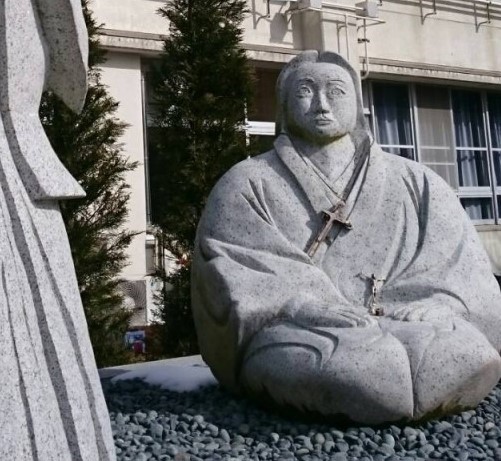
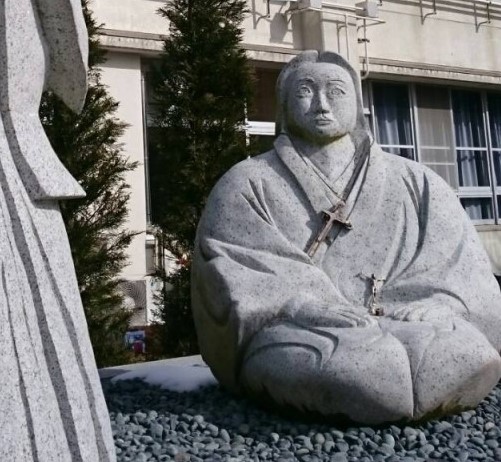
Granite statue of Doña Justa Takayama was installed in Toyomo-cho (Osaka Prefecture) in 2016. It is the first known representation of Doña Justa.
►Her name, for instance: Was her baptismal name “Justa” aligned after Lord “Justo” Ukon Takayama? (No, it was not.) The Kuroda’s eldest daughter was given the Christian name “Justa” when Kuroda Tae (黒田妙)was baptized at age 11 — BEFORE the Takayama couple ever even met. Hikogoro Takayama (Ukon’s boy-name) was baptized “Justo” in 1563 (the year Justa was born) – after St. Justin Martyr (A.D. 100-165). No, there was no effort to align the baptismal names of the Takayama couple.
Aside from what has been written about Sra Justa Takayama (高山ジュスタ)in the Jesuit history of Philippine evangelization, Colin/Pastells, “Labor Evangelica, Ministerios Apostolicos De Los Obreros De La Compania De Jesus, Fundacion, Y Progressos De Su Provincia En Las Islas Filipinas” (Barcelona: 1900) – what else is known about the wife of a celebrated “Kirishitan samurai”?
The Jesuit missionaries — who had a 50-year lead on other Catholic missionaries from the Philippines — studied Japan thoroughly as they sought methods of new evangelization. Fr. Lois Frois, SJ, was among the scholars who wrote studies on how the Japanese were different from, and similar to Europeans.
Fr. Luis Frois, Jesuit Historian
Alone among the contemporary Jesuit missionaries who wrote about Ukon Takayama during various stages of his life — from baptism to his death and funeral in Manila — it is only Fr. Luis Frois, SJ, who has mentioned Justa Kuroda — in Luis Frois (1532-1597), “History of Japan” (Historia do Japõo or Historia de Japam) written from 1583-1597. (The whole five volumes were published in Portuguese only in 1976-1984, and in a Japanese translation in 1977-1980).
The Japanese translation is: フロイス〔著〕松田毅一, 川崎桃太訳, 日本史, 東京, 中央公論社 1977-1980, 12 vols. (Luis Frois, “History of Japan,” trans. by Matsuda Kiichi and Kawasaki Momota.)
As Frois has it: Justa was the eldest daughter of the castle-lord of Yono, named Kuroda (FNU) and his wife Maria, who converted to Christianity – some two months after the Takayama family’s baptism in Sawa Castle. Justa’s mother, Maria Kuroda, was a well-placed noblewoman, being the sister of castle-lord Ikeda Katsumasa. As Ikeda was NOT considered a daimyo, his revenues must have been less than the threshold revenue of 10,000 “koku” of rice.
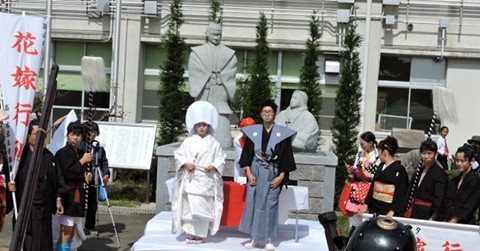
RE-ENACTMENT: Every year, during the “Ukon Festival” presented by the “Ukon-Honoring Association” to mark Ukon’s death anniversary on February 3, the townsfolk attend celebrations in costumes of Ukon’s time.#
From the sources — Ukon was 22, and Justa was 11/12 when the wedding was held in 1573-1574.
Many Details Unknown
Her Japanese maiden-name was Kuroda Tae (黒田妙), but she was baptized and given the Christian name “Justa” – before she had even met Lord Justo Ukon Takayama. Ukon was then 22, the bachelor-lord of Takatsuki for one year when he got married to Justa, who was 11/12. As a rooted Catholic, there would have been a Catholic wedding at Takatsuki Castle, but there is no mention of this ceremony in which a Jesuit priest would have presided. (Of course, only a Jesuit would have presided at the wedding Mass – there were no other religious missionaries in Japan yet — but there is no account of the wedding at all.)
Was it an arranged marriage between two families from adjoining domains? It does not look like it. Takatsuki, which straddled the strategic highway between Osaka and Kyoto was not adjacent to – in fact, was quite some distance away — from Yono. (Today, Yono is a 25-min taxi ride away.)
A Loyal Wife Who, Though Never at His Battles, Was Always There for Ukon
Doña Justa never joined her husband in his wars, but she governed his household – she was the “Lady of the castle at Takatsuki” (for 11 of the 12 years Ukon was lord there) and later, a second castle at Akashi, in Hyogo Prefecture. (When Ukon was stripped of all his possessions by Hideyoshi in 1587, Ukon had to scramble for life, with his family in tow, as he wandered for months as a masterless samurai. During these uncertain times, Justa took charge of his camp, keeping a savvy eye out on the needs of Ukon, their family and their retinue.)
Fighting under the Takayama Banner
Under the ‘Banner of the Cross’
With revenues of 20,000 “koku” of rice, theoretically Takatsuki could sustain a standing army of 20,000 men. As Ukon came into his own at 21, he organized an army of his own kinsmen, his retainers, and later, the males from the houses of Ikeda and Kuroda – and their retainers. Though not all of them were Christian, they fought with tunics emblazoned with a large Cross in red — draped over their armor.
Takayama’s Troops on the March
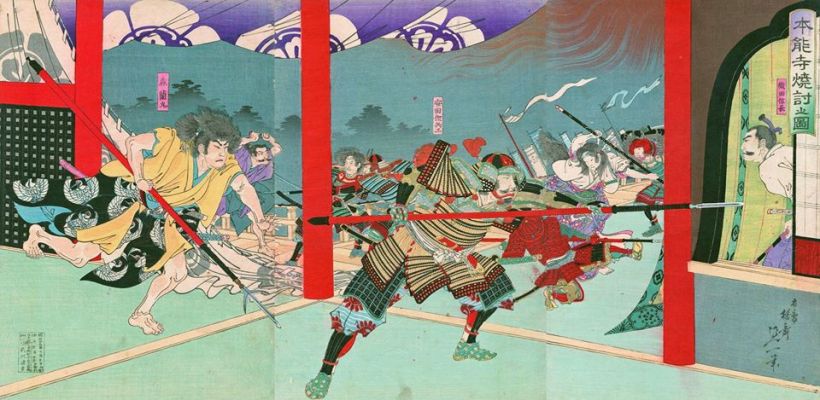
In June 1582, Akechi Mitsuhide betrayed Japan’s first hegemon, Oda Nobunaga at Honnoji – causing the death of Oda by “seppuku.” Hearing of Oda’s death, Toyotomi Hideyoshi raced back into the capital region and along the way he passed through the province of Settsu where both Nakagawa Kiyohide and Ukon Takayama had brought their armies and they joined the Toyotomi vanguard, eventually leading troops on the frontline during the Battle of Yamazaki.
Battle of Yamazaki, 1582
In the Battle of Yamazaki (山崎の戦い), Hideyoshi sent three advance detachments (the first of them, the 700-man army of 30-year-old Lord Takayama) to spearhead the attack against “The 13-Day Shogun,” Akechi Mitsuhide. Hideyoshi himself force-marched an army of 20,000 troops that was eight miles behind the forward forces, advancing by “30 to 40 km a day.”
James Murdoch writes in “A History of Japan” (1903) that Takayama led the first detachment of “less than 1,000 troops” but “they were so fired with the ardor of battle, and so confident with the help of God that on seeing the enemy, Justo did not hesitate to lead them to battle. And they so bore themselves that in a twinkling, they [accounted for/killed] more than 200 nobles of Akechi.”
This led Tokugawa Ieyasu (r. 1603-1605; d. 1616), a future Takayama adversary — and the first of the Tokugawa shoguns who ruled Japan from 1603 to 1868 — to remark: “In Ukon’s hands 1,000 soldiers would be worth more than 10,000 in the hands of whosoever else.” (Johannes Laures.)
The debacle at the Battle of Shizugatake (1583) wiped out the male heirs of the Kuroda and Ikeda families — under the generalship of Ukon Takayama
Disaster at Shizugatake
After Hideyoshi’s triumph at Yamazaki, conflict broke out between the late Nobunaga’s senior retainers over the matter of succession. The tensions culminated in open warfare between factions led by Hideyoshi and Shibata Katsuie (championing Oda’s interests).
Hideyoshi dispatched Takayama Ukon and Nakagawa Kiyohideto northern Omi and tasked them with holding two critical forts placed to block any movement from the Shibata down from Echizen. Takayama was given Iwasakiyama and, some miles to the south, Nakagawa was installed in Shizugatake.
Early the next year (1583), Katsuie dispatched an army under Sakuma Morimasa to capture these frontier forts, and in the course of the campaign Takayama was forced to abandon Iwasakiyama and take up in nearby Tagami. Giddy with his unexpected victory over Ukon, Sakuma went on to besiege Shizugatake and killed Nakagawa. But Sakuma was unable to take the castle itself and in the end, his imprudent advance cost his defeat by Hideyoshi in battle.
During the Battle of Shizugatake (賤ヶ岳の戦い), Ukon led the same Takatsuki force that won at Yamazaki – but, this time, experienced bitter defeat. Ukon himself was wounded in the fighting and he lost many valued retainers, many of them his own kin.
“Decimated” would be the incorrect word, as Lord Takayama, only 31, lost not only many of his own relatives, but lost the male kin of the Kuroda and Ikeda families, making the two families fade into history.
Takayama’s perfornance in this battle is debated by military historians to this day.
Did Takayama’s Military Setback at Shizugate Sour Hideyoshi’s Confidence in Ukon’s Generalship?
If Takayama lost favor with Hideyoshi because of the horrendous casualties he suffered, there was no sign of that because, two years later, Ukon was rewarded with the larger feudal domain of Akashi (in Hyogo Prefecture) which, with an income of 60,000 “koku,” had three times more revenues than Takatsuki. He was tasked by Hidesyoshi with building a new castle in Akashi. (Only the castle ruins remain today.)
As Ukon left the predominantly Christian Takatsuki for his new fief at Akashi, he brought some 800 Christian samurai with him, to form the core of his fighting force. Then he turned to the opportunity for new evangelization at hand – to the great dismay of the Buddhist bonzes – who however had access to Hideyoshi’s sympathetic mother.
Ukon, a Ronin on the Run
When Takayama was stripped his fief at Akashi (while he was in the middle of a military campaign in Kyushu), his family and his retainers were immediately affected. They had to vacate the premises as soon as they heard word of Ukon’s misfortune.
In the Service of Lord Toshiie Maeda
In the first year of his domestic exile, Takayama was sheltered by the Christian Daimyo Yukinaga Konishi, but eventually landed a position as a guest general (“Kyakusho”) in the domain of Lord Toshiie Maeda at Kaga. Here, with Justa at his side, he formed a Christian community of 600 Christian ronin in his lands in Noto Peninsula. Here, Justa ran the household of Takayama, while Ukon – outside his peace-keeping duties — devoted himself to spreading the Gospel.
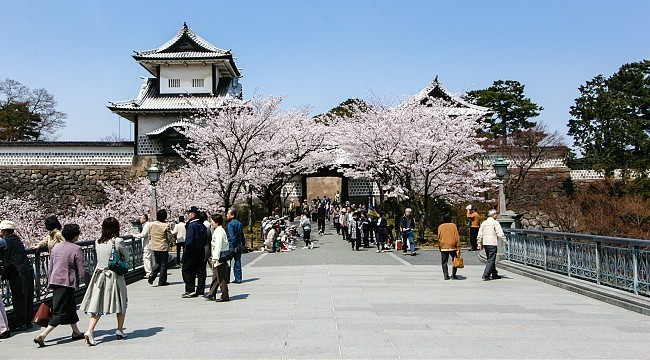
Hideyoshi’s spy network kept him informed of Ukon’s whereabouts. After all, though Ukon was a Christian, he never felt personally threatened by Ukon. They had moments together as tea masters – and as builders. With a wink, he allowed Lord Maeda to employ Ukon to rebuild the Kanazawa Castle (still there to this day) and command a flank of Maeda’s army.
Kanazawa Castle, stronghold of the Maeda clan, was repaired and expanded by Ukon Takayama, a renowned castle-builder. The castle endures to this day.
Ukon’s Last Battle
As a guest general of the Maeda clan, Ukon was involved in one more battle – the Siege of Odawara (1590) — where Hideyoshi decisively crushed the forces of Hojo Ujimasa in August 1590. It is said that Lord Maeda took Ukon to the siege of Odawara in the hope that his valor would obtain the favor of Hideyoshi for him. By May 1590, Hideyoshi had started building up attack forces with the help of Tokugawa Ieyasu, Uesugi Kagekatsu (1555–1623), and Maeda Toshiie – the three Great Daimyo who would later comprise the Council of Five Elders, formed in 1595 by Hideyoshi to rule Japan in the place of his infant son, Hideyori, until he came of age. By June 1590, some 200,000 troops were arrayed against Odawara. In this last of Hideyoshi’s campaigns in Japan, Odawara Castle was finally taken because of internal treachery, resulting in the ritual suicide of the two Hojo leaders.
After the Odawara campaign, Hideyoshi invited Ukon to his Nagoya headquarters for tea.
Ukon Takayama having tea with Hideyoshi
After that military campaign, Ukon foreswore the role of a samurai-general, shaved his head, and devoted his remaining years in evangelizing the Hokuriku region.
Aside from Ukon’s family and kin, some 600 masterless Kirishitan samurai, including the former daimyo John Naito and his family, joined Takayama Ukon in Kanazawa where he served the Maeda clan for 26 years. There Ukon formed what is known today as a basic ecclesial community (BEC). Not always having the services of a Jesuit priest throughout the year. they formed a Christian movement that was ever on the look-out for a visiting Jesuit. (A Jesuit was assigned to that area when the widow Justa, returned to Kanazawa in mid-1616 to bury a fingerbone of Ukon in Japanese soil.) Takayama’s Christian community, with its own church, was the Church at the grassroots, in the neighborhood and villages.
Expulsion from Japan
On 1614, the Tokugawa issued a decree, expelling all Christian missionaries and all prominent Japanese Catholics – to remove the virus of Christianity, “that evil religion,” from the land.
(Illustration from Luchie Tajima’s FB wall) — Ukon knew, at age 63, there would be no returning to Kanazawa. But the Jesuit Vice Provincial Jeronymo Rodriguez, SJ. reported on July 18, 1616 that Dona Justa brought back to Kanazawa a fingerbone of Ukon, for burial in his beloved Japan — while Manila now claimed the “Kirishitan Samurai” of heroic virtue who died there as a “Son of Manila.”
Goodbye to Kanazawa
The odyssey of Ukon started on Feb. 14, 1614 in Kanazawa and would take him and his family by foot (through snow-covered roads) to the port of Nagasaki. After waiting some weeks for a Chinese sampan (captained by a Portuguese mariner, with a Chinese and Japanese crew), Lord Takayama and 350 other Catholics, including some 100 “Katekisuta” (カテキスタ) left Nagasaki on Nov. 8, 1614 on their voyage to Manila. The normal voyage took 20 days, but with a turbulent typhoon which cut their main mast in two, it took the junk 43 days to reach Manila. Takayama and his family had a cabin, so the precious cargo of “La Japona” — the statue of “Our Lady of the Rosary” extracted from the demolished Santo Domingo Church in Nagasaki — was entrusted to Ukon’s care. The expelled Jesuit, Franciscan, Dominican, and Augustinian missionaries were on their own, taking turns sleeping on crates – on the open deck. Mercifully, only one passenger was lost during the voyage: Fr. Antonio Critana, a Jesuit. His old age could not cope with the extreme rigor of the voyage.
The first exile boat brought 350 Japanese Christian exiles to Manila on Dec. 21, 1614. It was the first wave of refugees and migrants fleeing religious persecution in Japan across 250 years. The Japanese migrants were eventually absorbed and integrated into the Filipino community — seamlessly, as Japanese Christians all bore Christian names. (Who could say that “Jacobo de la Cruz” was a Japanese Christian from Nagasaki?)#
The exile voyage (and stay in Manila) of Lord Takayama, Lord Joan [John] Tokuan Naito (Hideyoshi’s ambassador to the Ming Court in China during the Korean Truce), and the first women’s congregation of religious women (“Bikuni de Miyako”) are related in six chapters of Colin/Pastells. “Labor Evangelica” (Barcelona: 1900).#
Manila Archbishop Luis Antonio Cardinal Tagle installs an image of Blessed Justo Ukon Takayama at the Manila Cathedral, where Lord Takayama served at Mass during his 44-day sojourn in Intramuros, Manila — before he passed away on Feb. 3, 1615.
►Our Manila-based movement relies on Social Media to promote the canonization of the ‘Jesuit samurai’ – Blessed Justo Takayama (Osaka 1552-Manila 1615).
Takayama died in Intramuros on Feb. 3, 1615 – only 44 days after he and 350 Japanese Christian exiles arrived in Manila. Because, under Church rubrics, “where a person dies, is where one is born to Heaven,” the Manila Archdiocese proposed this “Son of Manila” for sainthood at the Vatican on Oct. 5, 1630 – the first candidate EVER proposed by the Philippine Church.
First Japanese Martyr to Die Outside Japan
Pope Francis issued a ‘Decree of Martyrdom’ on Jan. 21, 2016, declaring Takayama, a “layperson … from Japan [who] died from the hatred of the Faith on Feb. 3, 1615 in Manila, Philippines.” He was beatified on Feb. 7, 2017. He is thus the Philippines’ THIRD Blessed.
►To spread info about him, we run the website: www.takayamaukon.com – As this is the only Takayama website in English – it is the ‘de facto’ aggregator of Takayama info.
Statistics on Internet Reach
TOP TEN COUNTRIES reached by the Takayama website: <takayamaukon.com> are:
►Philippines — 58.27%; ►United States – 22.68%; ►Japan – 06.99%; ►Singapore – 03.13%; ►Australia – 02.61%; ►Hong Kong – 01.66%; ►Brazil – 01.53%; ►Poland – 01.36%; ►Canada — 01.26%; and ►Romania – 01.08%.
The Takayama website is the only one in English. The above figures show how the statistics stack up.#
On Facebook Platform
►On Facebook, we promote the ‘Takayama Cause’ on the FB Page: //justotakayamaukon.
►Promoter’s FB profile is on: //drernestodepedro.
Prayer for One Intercessory Miracle — through Blessed Takayama — in the Name of Jesus Christ
We implore your prayers and support for the ‘Cause of Blessed Takayama’ which – at this stage – is waiting for ONE ‘intercessory miracle’ required for final canonization.
Dr. ERNESTO A. DE PEDRO
Managing Trustee
BLESSED TAKAYAMA CANONIZATION MOVEMENT
►BOOKS: There are “over 1,000 books, pamphlets, monographs” – and one fiction novel, “Justo Ucundono, Prince of Japan,” by Philalethes [John E. Blox], Baltimore: John Murphy & Co. 1854. (Reprint: Whitefish, Montana: Kessinger Publishing, 2007) — about the celebrated ‘Samurai of Christ,’ Justus Ukon Takayama, the FIRST being Fr. Pedro Morejon, SJ, “A briefe relation of the Persecution lately made against the Catholike Christians, in the Kingdome of Iaponia… Taken out of the Annuall Letters of the Fathers of the Society of Jesus,” St. Omer, France: 1619, translated from the Spanish ‘by Fr. William Wright, SJ [1563-1639].’ (Copy at Bodleian Library, Oxford University)
Particularly important are accounts of contemporary Jesuit missionaries who worked with and documented every year of the life of Ukon Takayama: ◘ P. Gaspar Vilela, SJ (c1524-1572) who baptized Justo in June 1563; ◘ P. Luis Frois, SJ (1530-1597); ◘ P. Organtino Gnecchi-Soldo, SJ (1530-1609); ◘ P. Gaspar Coelho, SJ (1530-1590); ◘ P. Gregorio de Cespedes, SJ (c1532-1611); ◘ P. Antonio Prenestino, SJ (c1543-1589); ◘ P. Giuseppe Fornaleti, SJ (c1545-1593); ◘ P. João Rodriguez Giram, SJ (1558-1629); ◘ P. Mattheus de Couros, SJ (1567-1633); ◘ P. Pedro Morejon, SJ (1562-1639), and ◘ P. Gabriel de Matos, SJ (1571-1634). Some years of Ukon’s life were covered by as many as SIX Jesuit writers.
Even the during the years of Sakoku (鎖国, “closed country”), 1636-1854, many books in Western languages were published, among them, St. Alphonsus Maria de Ligouri, CSsR (1696-1787), Victories of the Martyrs (1775, 1887, 1954) which, based on his research on documents at the Vatican Archives, declared that Takayama was truly a martyr.
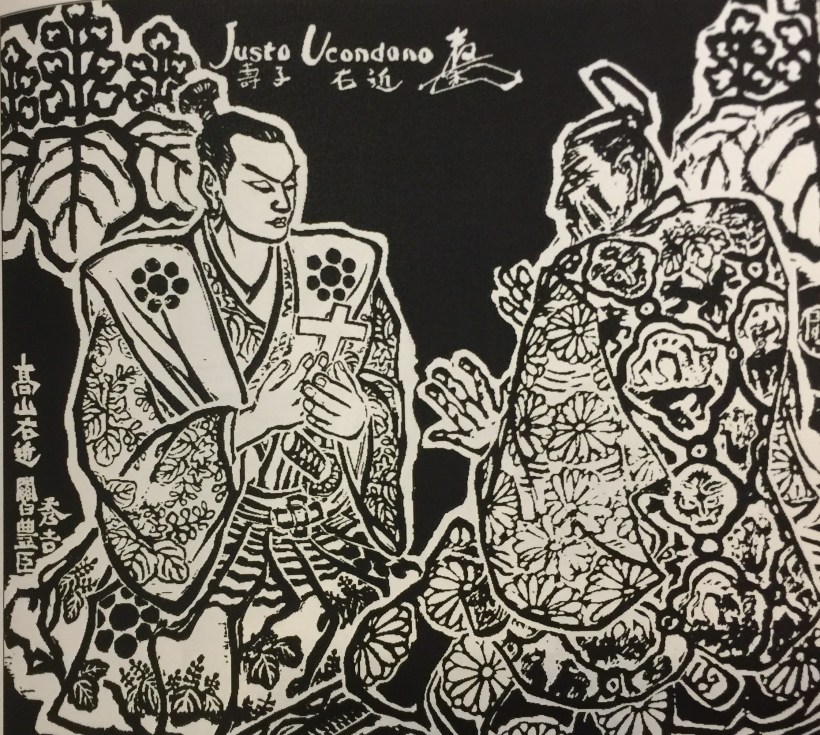
►ARTISTIC REPRESENTATIONS: There are “over a hundred” different representations of the “Samurai of Christ,” Justo Ukon Takayama, in Google.com / Images. But there are no Japanese woodcuts – or woodblock prints — yet.
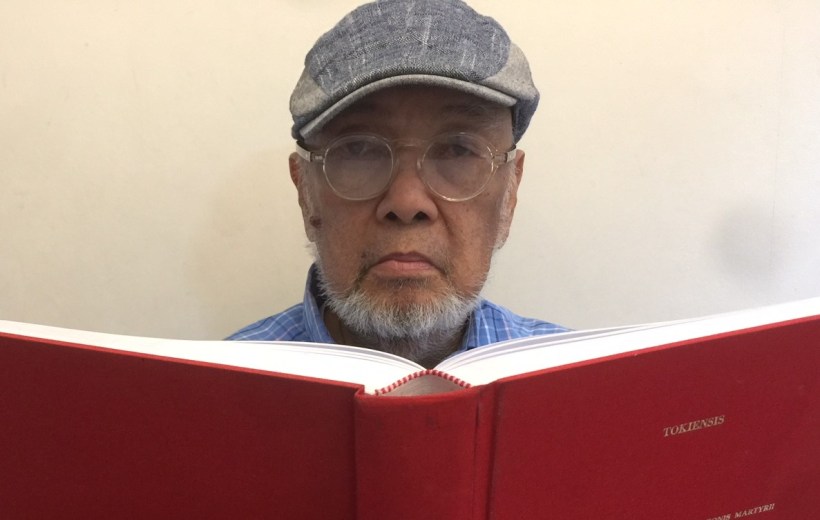
Dr. Ernesto A. de Pedro translated and edited Fr. Hubert Cieslik, SJ, “Justus Takayama Ukon, Servus Dei” (Manila: 1994)
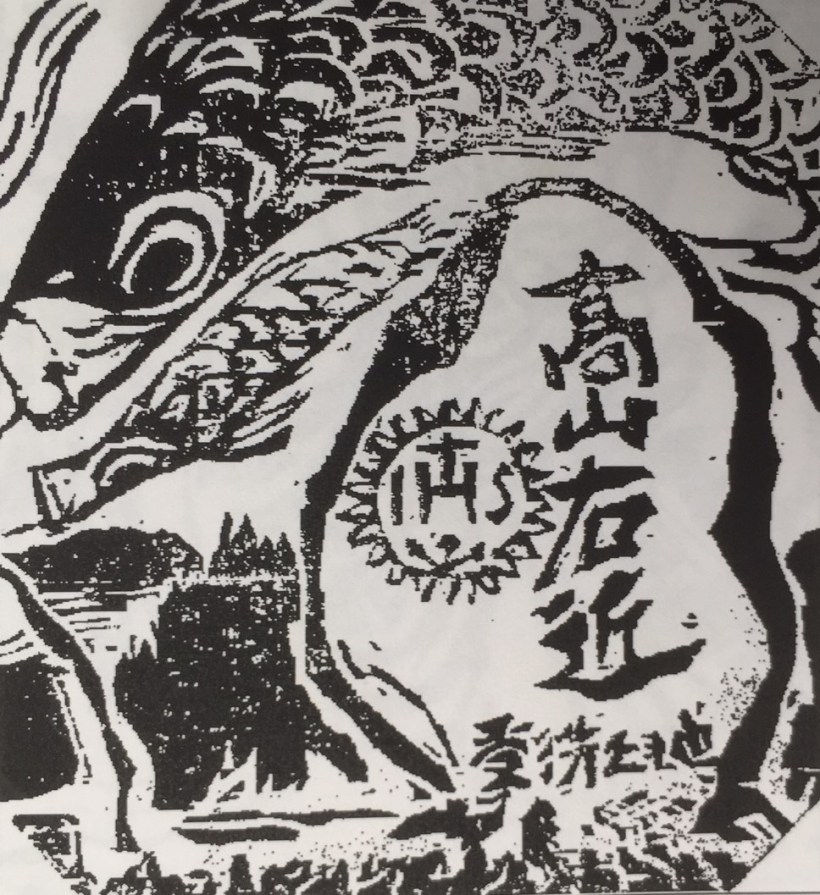
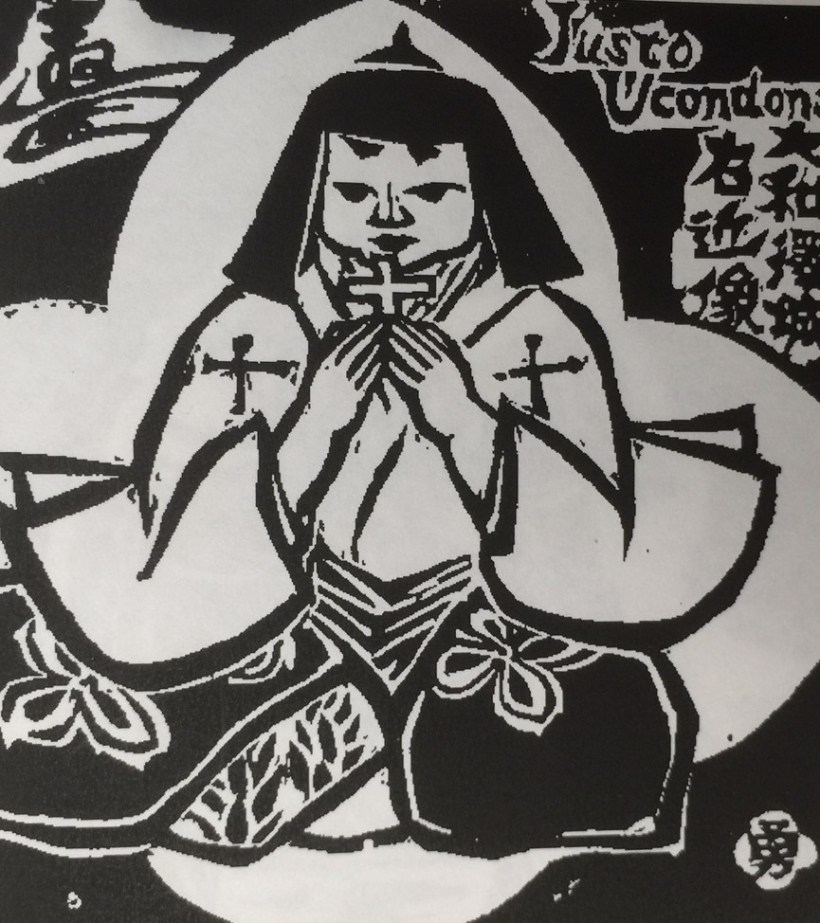
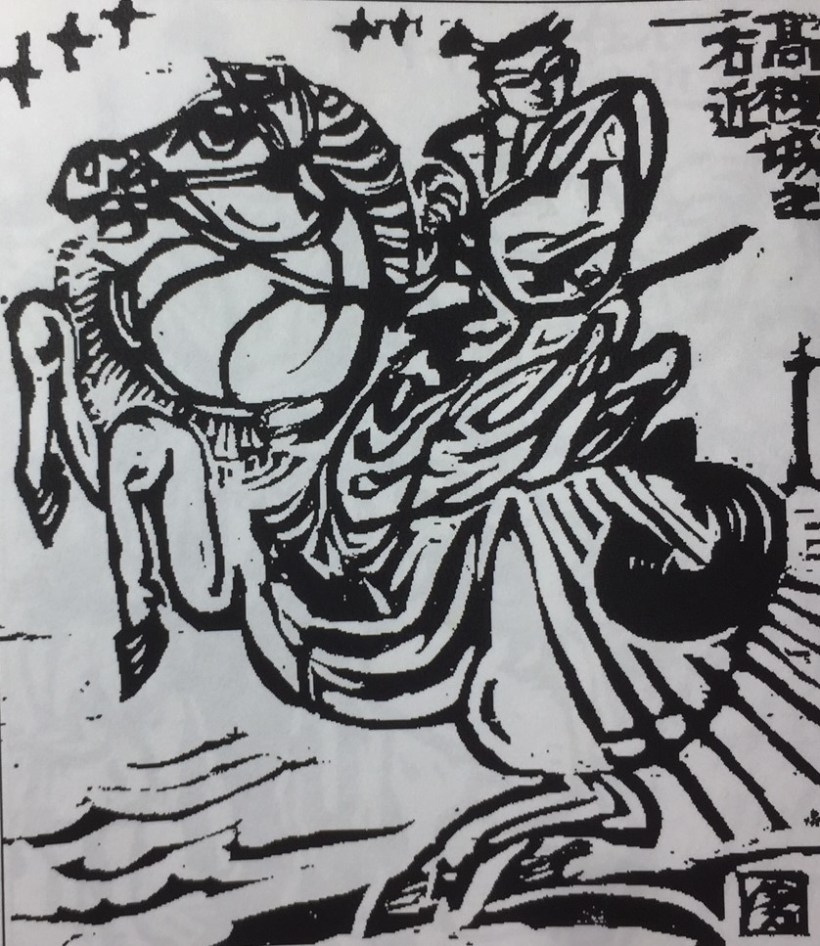
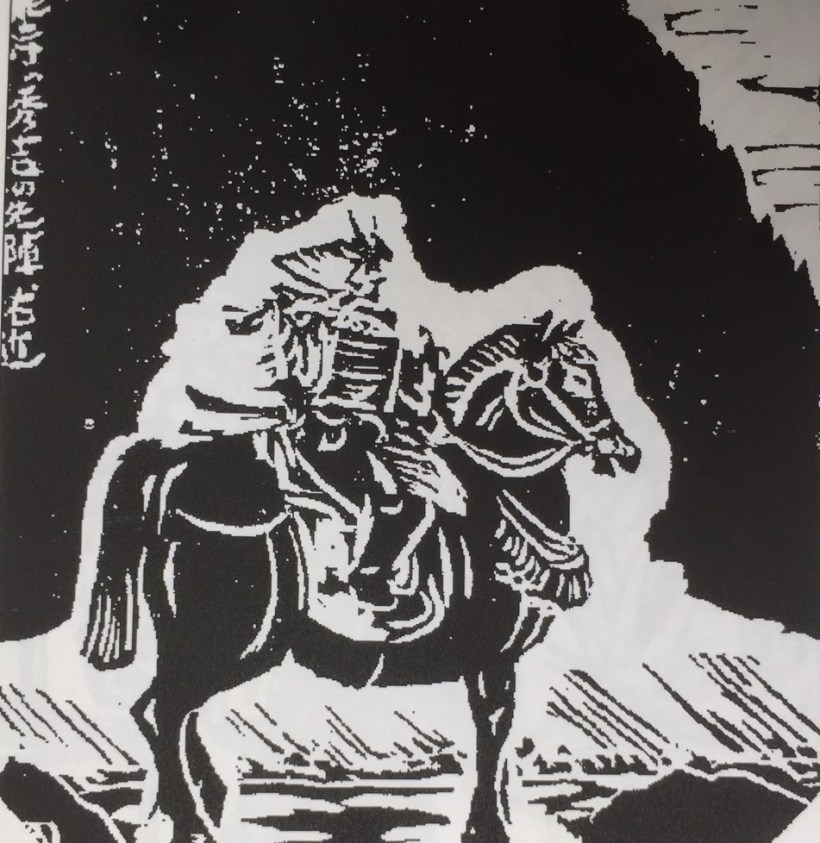
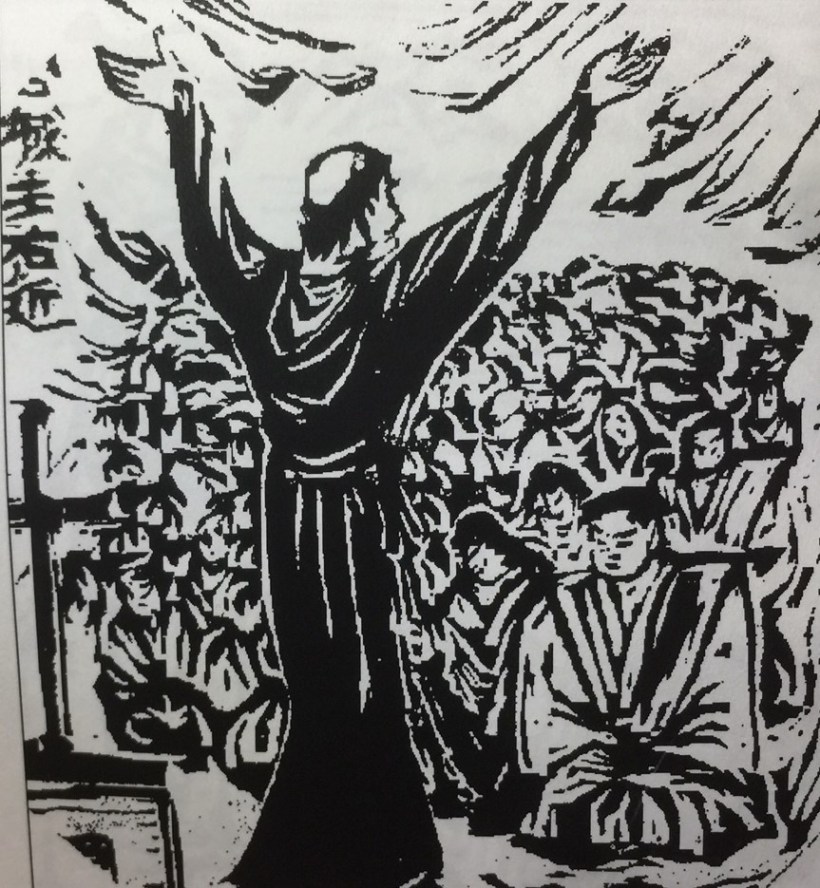
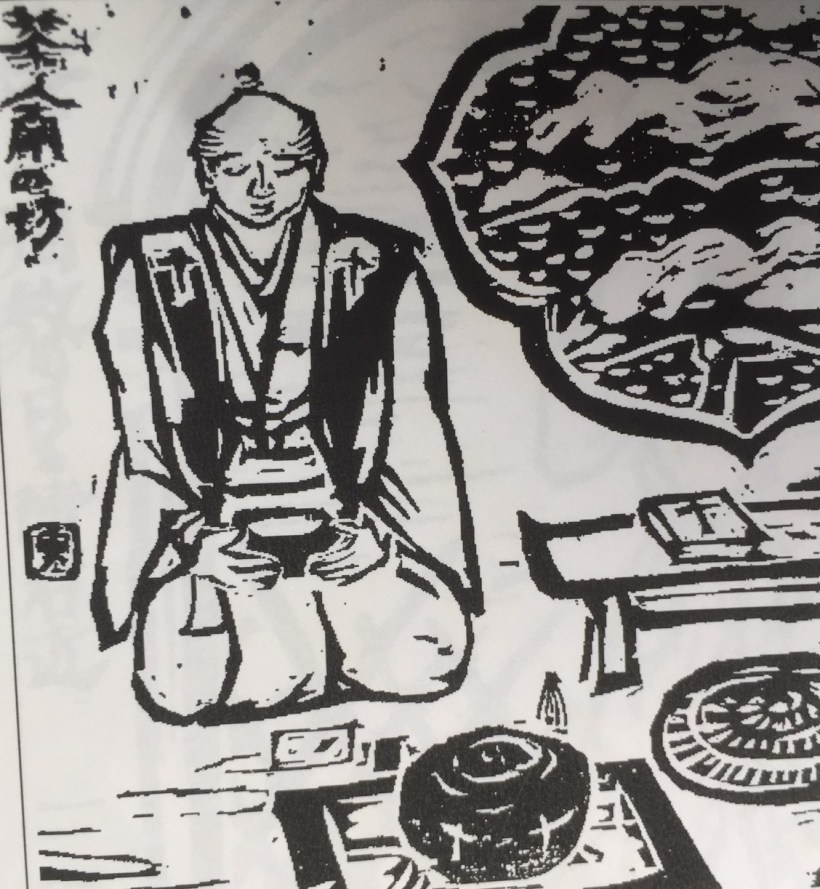
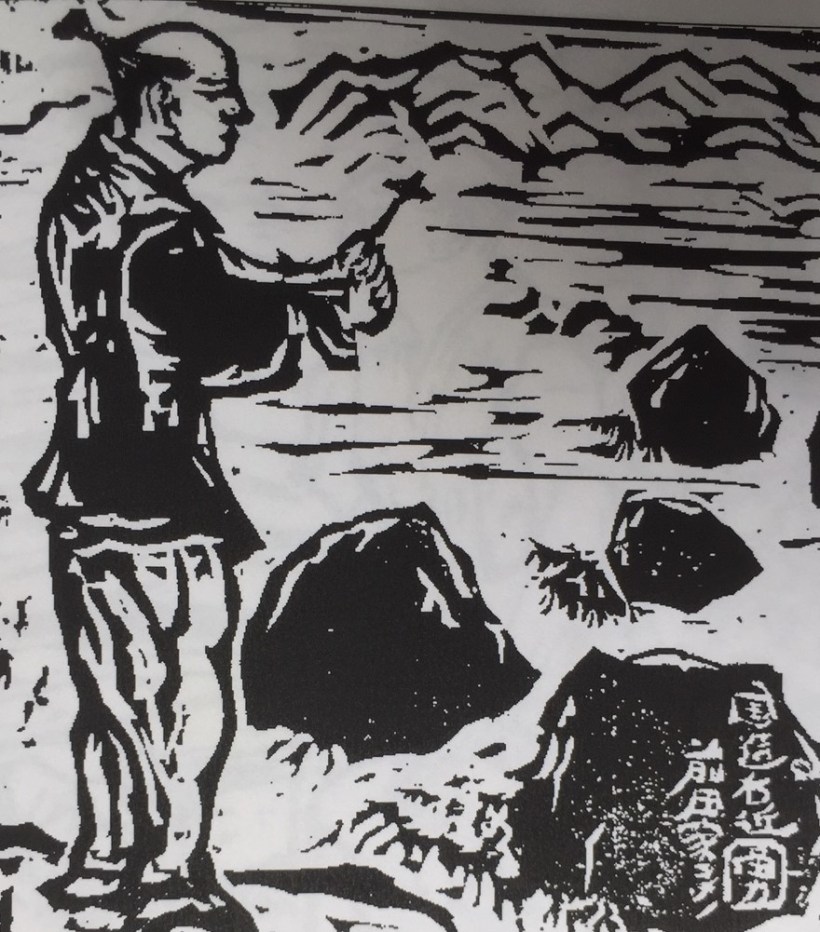
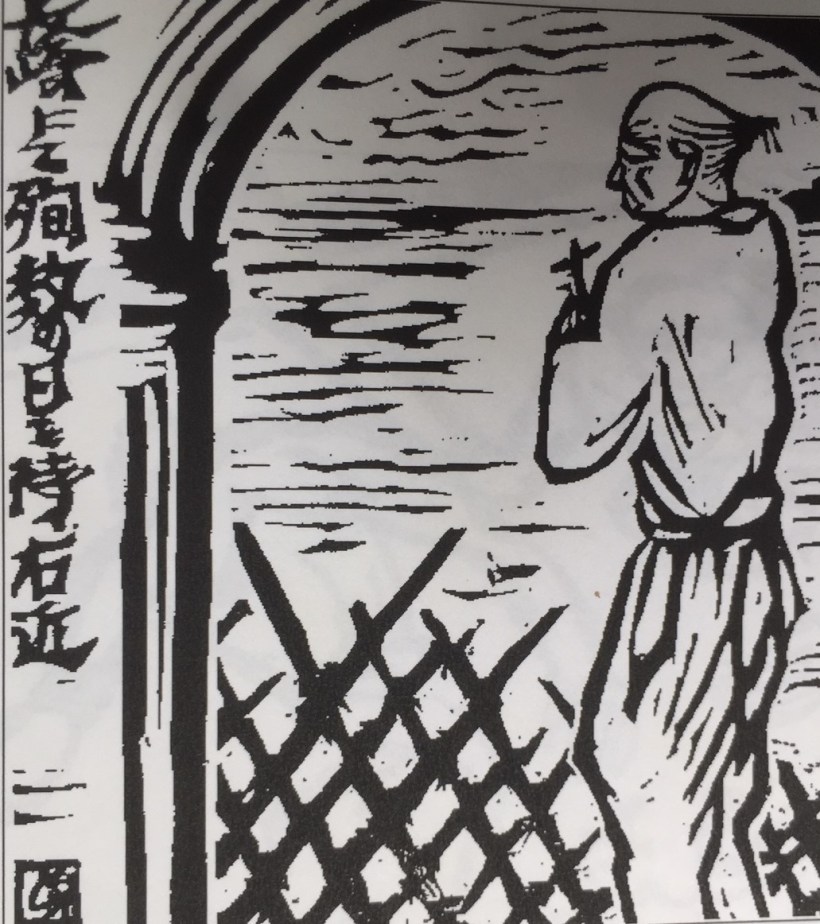
We are sharing 11 woodcuts that appear in Doc. XXX – ‘Opera Artistica et Monumenta’ in Hubert Cieslik, SJ (CBCJ Historical Committee lead historian), “Justus Takayama Ukon, Servus Dei,” trans., edited and laser-printed by Ernesto A. de Pedro (Manila: Lord Takayama Jubilee Foundation, 1994), 661p.
On the basis of this bookbound document, the Congregation for the Canonization of Saints (CCS) at the Vatican granted on June 8, 1994, a ‘Nihil Obstat’ recognizing the Japanese Christian of heroic virtue, Justo Ukon Takayama, as a “Servant of God.”
The Woodcut-Carver Was Non-Christian – But Often Tackled Christian Themes
THE WOODCUTS of Akusawa Isamu (1909- ?), a non-Christian artist known for his monumental woodcut series, was often occupied with Christian themes. In a series of small woodcuts — (24cm x 24cm) — he represented key scenes from the life of Justo Ukon Takayama (1552-1615).
◘ Memorial-stone of the baptism of Justo Takayama at age 12 (at Sawa Castle in Haibara-cho, Nara Prefecture), with carp-flags in the background as symbols of the children’s feast.
Marker for the baptism of Hikogorō Takayama (baptized ‘Justo’) at Sawa Castle in June 1563. This stone marker was erected in 1970 — indicating that this woodcut series was made after that date. By 1937, the Catholic Press Center (Tokyo), under its Director, Fr. (later Osaka Archbishop-Cardinal) Paul Yoshigoro Taguchi, had completed research on keypoints of the life and apostolate of Ukon Takayama.
Justo’s father, Takayama Hida-no-kami or Don Dario Takayama, was the lord of Sawa Castle in the Yamato mountains to the south of Nara. He and his entire household were baptized on the same occasion.
◘ The boy TAKAYAMA Hikogorō (彦五郎), at 12 – at the time of his baptism in June 1563, taking the baptismal name “Justo” — after St. Justin Martyr (c100- c165 AD).
Justo Takayama, at 12
◘ Justus as Lord of the Takatsuki Castle (in Settsu Province) of which he became the castellan at age 21.
Ukon Takayama became Lord of Takatsuki, which was strategically important as it straddled the only highway between two power-centers: Kyoto and Osaka
◘ Justus entering the battle at Yamasaki (1582). Leading a vanguard of “less than 1,000” men, Ukon helped insure the victory of Toyotomi Hideyoshi.
Of Ukon, the Daimyo Ieyasu Tokugawa would later say: “In Ukon’s hands 1,000 soldiers would be worth more than 10,000 in the hands of whosoever else.”
In the Battle of Yamazaki to avenge the death of Oda Nobunaga, Hideyoshi sent three advance detachments to spearhead the attack against “The 13-Day Shogun,” Akechi Mitsuhide, while Hideyoshi himself force-marched an army of 20,000 troops that was eight miles behind the forward forces, advancing by “30 to 40 km a day.” James Murdoch writes in A History of Japan (1903) that Takayama led the first detachment of “less than 1,000 troops” but “they were so fired with the ardor of battle, and so confident with the help of God that on seeing the enemy, Justo did not hesitate to lead them to battle. And they so bore themselves that in a twinkling, they [accounted for] more than 200 nobles of Akechi.” This led Ieyasu (r. 1603-1605; d. 1616) — the first of the Tokugawa shoguns who ruled Japan till 1868 — to remark: “In Ukon’s hands 1,000 soldiers would be worth more than 10,000 in the hands of whosoever else.”
◘ Justus as father of the people.
Lord Justo Takayama converted the majority of the residents of Takatsuki, who had his example as an authentic Christian witness to inspire them
◘ Mission-work of Ukon at Akashi, in Hyōgo Prefecture (1586-87)
On his transfer to the fief of Akashi, which was three times larger than Takatsuki, Ukon devoted time spreading the Word of God, infuriating the Buddhist bonzes who complained to the Kampaku, Toyotomi Hideyoshi
◘ Justus, as tea-master, was known as ‘Minami-no-Bô TAKAYAMA Hida no-kami’
Ukon Takayama was known in tea circles as the teamaster ‘Minami-no-Bô.’
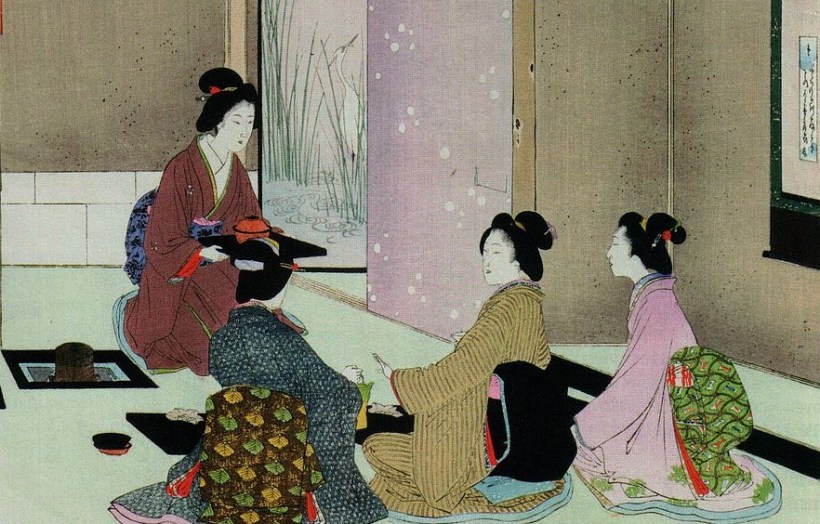
Ukon Takayama was one of seven prized pupils of Sen no Rikyū (1522–1591), who is considered the historical figure with the most profound influence on the development of ‘Chanoyu.’ The principles Sen set forward for the “Way of Tea” — harmony (和 wa), respect (敬 kei), purity (清 sei), and tranquility (寂 jaku) — are still central to tea ceremony today.
Ukon, who is always included in the variable list of “Rikyu’s Seven” (‘Rikyushichitetsu’), was credited with refining the tea ceremony into a serene celebration, with ritual movements “almost like a Mass.” The spirit of the art of tea – characterized by the qualities of harmony, reverence, purity, and tranquility — found in Ukon Takayama its Christian transfiguration.
◘ Justus in Kanazawa
Ukon Takayama spent 26 years ‘in domestic exile’ in Kanazawa
In Kanazawa, Ukon — no longer a Daimyo — served as a samurai-general of the Maeda clan for 26 years. During this period of ‘domestic exile,’ Ukon rebuilt the Kanazawa Castle.
Ukon also built a church in Kanazawa; from 1604, a Jesuit priest and brother resided permanently in the church.
Some 600 of his former retainers and other Christian exiles, such as Naito Tokuan and Ukita Kyukan, took refuge in his lands in Noto Peninsula, where Ukon had built two churches for his Catholic community.
◘ Justus, expecting martyrdom in Nagasaki.
Wary about the hostile designs of the Shogun Ieyasu Tokugawa, Ukon Takayama was ever-ready for martyrdom.
Ukon prepared for death by undergoing the 30-day “Spiritual Exercises” under his Jesuit confessor, Fr. Pedro Morejon, SJ (1562-1639).
The “Spiritual Exercises” are a compilation of meditations, prayers, and contemplative practices developed by St. Ignatius Loyola to help people deepen their relationship with God. For centuries the Exercises were most commonly given as a “long retreat” of about 30 days in solitude and silence.
◘ Voyaging to exile in Manila – with 350 other Japanese Christians, including his wife, Dona Justa Takayama, daughter Lucia Yokoyama, and five grandsons.
The 350 Japanese Christian exiles with Lord Justo Takayama looked forward to life in religious freedom — in the Philippines which was newly Christianized.
◘ Ascent to Heaven.
When Ukon Takayama died, the religious missionaries in Manila were confident that Takayama would be raised to ‘the honors of the altar.’ In 1630, only 15 years after his death, the Manila Archdiocese presented to the Vatican the ‘Cause for his Beatification’ written by Ukon Takayama’s father-confessor, P. Pedro Morejon, SJ. The first candidate for sainthood of the Philippine Church was, in the Decree of Martyrdom issued by Pope Francis on Jan. 21, 2016: a “layperson … from Japan [who] died from the hatred of the Faith on Feb. 3, 1615 in Manila, Philippines.” During the Sakoku Period, the Japanese had no way of knowing whatever happened to Ukon Takayama in Manila. With the Meiji Constitution (明治憲法), proclaimed on Feb. 11, 1889, providing for ‘freedom of religion,’ the first Japanese Catholic pilgrims arrived in Manila on Feb. 3-7, 1937 — to attend the XXXIIIrd International Eucharistic Congress being hosted by Manila. They brought with them a historical research group tracing the footsteps of Ukon Takayama in ‘Old Manila.’ This was the first Japanese Catholic delegation sent abroad since the ‘Tenshō Embassy’ (Japanese: 天正の使節) of four Japanese seminarians visited the Pope and the kings of Europe in 1582.
By coincidence, the Eucharistic Congress started on Feb. 3, 1937, the 322nd death anniversary of the ‘Kirishitan Samurai’ Justo Ukon Takayama.
Justo Ukon Takayana, a ‘Kirishitan Samurai’ during the turbulent ‘Sengoku Period’ — a Catholic Saint?
Since then, students and devotees of Justo Ukon Takayama have kept the fervor burning. Now Beatified (Feb. 7, 2017), Blessed Justo Ukon Takayama is – at this stage – waiting for an ‘intercessory miracle’ required for final canonization.
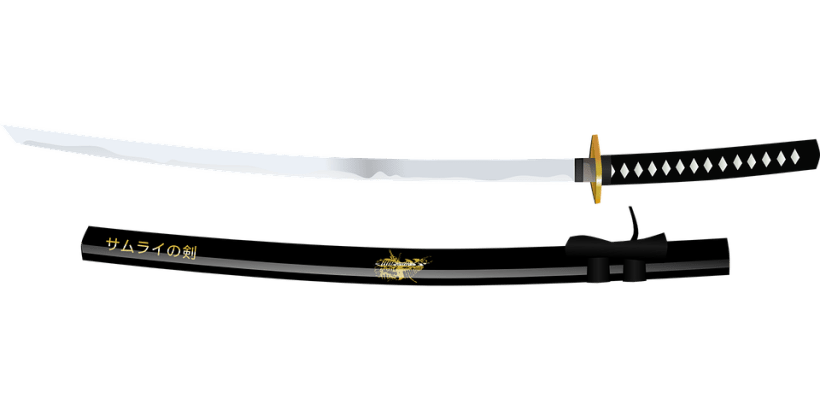
A samurai carries an assortment of weapons, but basically the sword.#
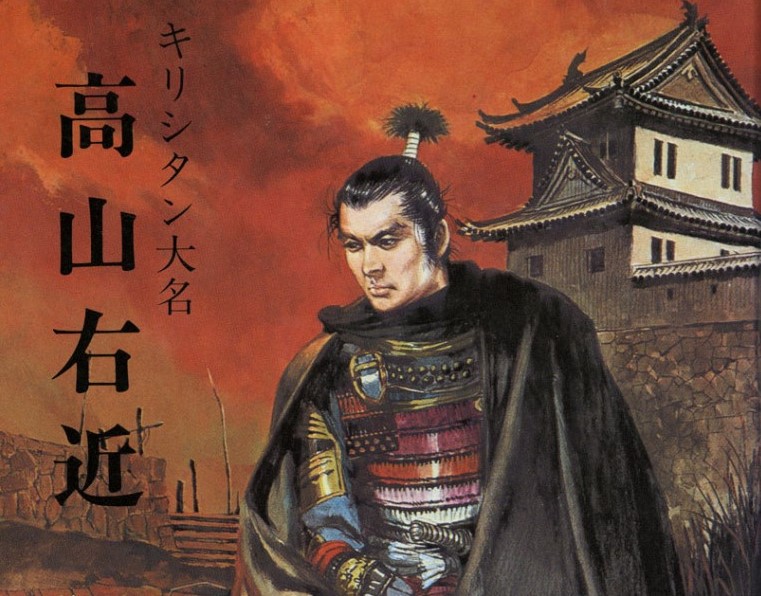
►LORD JUSTO UKON TAKAYAMA (1552-1615) – known in Manila as ‘Don Justo Ukondono’ — had a reputation of being one of the ablest generals of the Sengoku Period (戦国時代). He was once the commanding general of ‘Kampaku’ Toyotomi Hideyoshi’s vanguard. Of him, Tokugawa Ieyasu (1543 – 1616), who would become the first Tokugawa Shogun in 1603, said: “In Ukon’s hands 1,000 soldiers would be worth more than 10,000 in the hands of whosoever else.”
This illustration — a book cover — shows Lord Ukon Takayama before the Takatsuki Castle which he acquired at age 21.
After Takayama was stripped of his second feudal domain at Akashi in 1587, he became a ‘ronin‘ — a masterless samurai. He sought protection from other another Christian daimyo, who was too important and too useful for Hideyoshi to harm. But within the year, Ukon found a place (with the tacit ‘approval’ of Hideyoshi) in Kanazawa – which was the domain of the Maeda, who controlled Etchū, Kaga, and Noto provinces. Here, he served as guest-general (‘Kyakusho’) of the Maeda military – while maintaining openly a Christian community (with an occasional Jesuit priest) in Noto Peninsula with some 600 Christian ‘ronin’ who had all lost their ‘samurai-status’ because of their Christianity.
This illustration, of unknown provenance, was labelled ‘Takayama Ukon — as Ronin’
IN MANILA where Lord Takayama was welcomed as “the epitome of the Japanese spirit,” Spanish Governor-General Juan de Silva (r. 1609 – 1616) visited him “almost everyday” to pump him for information about the military infrastructure of Japan.
Dedicated Christian — But True-Blue Japanese Too
But Lord Takayama, though he and his family had been exiled by Tokugawa Japan for his Christianity, was a true-blue Japanese patriot, who scoffed at the hare-brained plan of Silva (supported by two or three militant Jesuits) – to invade Japan with a Spanish expeditionary force to assist the beleaguered Christians in southern Japan – on the conceit that one armed Spaniard was equivalent to 15 fighting Japanese. Silva was also counting on the support of the Christian daimyos of the South — who would presumably fight on Spain’s side — against the Tokugawa Shogunate. Ha?
Lord Takayama tried to disabuse Silva about the feasibility of such a military plan. He pointed out that in his first feudal domain, Takatsuki which, though smallish, strategically straddled the only highway between the power centers of Kyoto and Osaka, he had a standing army of professional warriors who trained daily and were warriors year-round – unlike the farmer-soldiers of Europe who were called to arms only in case of war. In his own bailiwick, Takayama could call to arms some 20,000 men – armed with swords, spears, archers, arquebuses, hand-thrown explosives and wheeled cannons.
Each Daimyo — (There Were More Than 200) — Had a Larger Standing Army, Year-Round, Than Spanish Manila
When Takayama was transferred to Akashi (明石市), in Hyōgo Prefecture, he had an income of 60,000 ‘koku’ – meaning he could theoretically support an army of 60,000 men.
And there were 200 daimyos throughout Japan, which – though not yet united as one nation – could cohese to fight a foreign invader – just as they fought off two attempted Mongol invasions of Japan (元寇 Genkō), which were launched in 1274 and 1281 by Kublai Khan, the Mongol leader of China’s Yuan Dynasty. The entire nation was mobilized – including the dregs of society like the despised ‘wako’ who were dreaded pirates of the high seas menacing the coasts of China and the Philippines. The ‘wako’ — (Think Yakuza!) — transformed themselves into a formidable navy of their own — this time, in the service of Japan.
Two Mongol Invasion Attempts ‘Unify’ Japan, Convince the Nation It Cannot Be Invaded by Foreign Forces
Between two Mongol attempts (1274, 1281) – there was an interval of seven years, during which time, Japan’s self-defense forces camped at Kyushu’s Hakata Bay (near present-day Fukuoka, Japan) – and were housed and fed for seven years – while waiting for the expected second Mongol invasion.
(To students of Philippine history: Could a Filipino military force of 70,000 be stationed at the mouth of Manila Bay – for seven years – without dying of boredom or breaking up into intramural fights among themselves?)
While Lord Takayama was enroute to the Philippines, the Winter Campaign (Nov. 8, 1614-Jan. 22, 1615) of the Siege of Osaka was fought between the Toyotomi Clan and the Tokugawa Shogunate. Hideyori sent emissaries to Ukon Takayama offering command of Hideyori’s forces — which he declined.
UNKNOWN TO Governor-General Silva, as he was plotting in 1614-15 his military calculations for Manila — not Spain — to “invade Japan” — completely clueless about the epic scale and protracted duration of Japanese warfare — era-changing events were unfolding in Osaka as Toyotomi Hideyori (豊臣 秀頼), 22-year-old son and designated successor of the ‘Taiko’ Toyotomi Hideyoshi (1537-1598), prepared to do battle with the Tokugawa who had established a Shogunate in 1603. Their first inconclusive clash (Nov. 8, 1614-Jan. 22, 1615) ended in a truce. [Notice that the battle began on the same day that Ukon’s exile boat departed for Manila.]
Ukon Is Offered Command of Hideyori’s Besieged Forces
Hideyori had sent emissaries to Nagasaki to offer Ukon the command of Toyotomi forces in the final battle between Hideyori and the Tokugawa. But his emissaries missed Ukon by three days, as the Chinese junk had sailed for Manila on Nov. 8, 1614. The emissaries followed Ukon to Manila and met Ukon at the Inner Court of the San Agustin Convent. (The garden, not damaged during World War II, is still there today).
Here was a chance for Ukon to fight on home soil again. Defending a castle he was familiar with. Against an adversary who had banished him – and his family – to Manila with the cunning calculation Ukon could never return again.
But Ukon was firm: He would spend the rest of his years in the Philippines in prayer and in spreading the Word of God.
Tokugawa Shogunate Obliterates Hideyori’s 71,500-Man Army in June 1615
The Tokugawa Shogunate put a decisive ‘finis’ to the Toyotomi clan’s challenge by totally annihilating its 71,500-man army [including Gen. Thome Naito who returned from exile in Manila, and the legendary swordsman Miyamoto Mushashi] at the Summer Campaign of the Siege of Osaka – May 26-June 3, 1615 – including Hideyori himself and his wife, Senhime, a granddaughter of Ieyasu.
Dedicated to Prayer and Evangelization
LORD JUSTO TAKAYAMA was clear: he would not return to Japan at the head of a Spanish invading force. He would dedicate the rest of his life to prayer and evangelization. As he spoke only Japanese, Portuguese and Spanish, his mission field in Manila was limited to some 3,000 Japanese non-Christian settlers in the Paco area. Which is what he proceeded to undertake.
Accompanied by his five grandsons, and ‘shadowed’ by his volunteer bodyguards – the three Christian ‘ronin’ Hayakawa Uhyoe; Shibayama Gombei, and Ukita Kyukan who had been in Ukon’s Catholic community in Noto Peninsula – Don Justo made a number of converts in the Franciscan parish of Paco, and brought them to baptism at the Paco Catholic Church (today, San Fernando de Dilao Parish Church) – with his grandsons standing as baptismal sponsors.
Surrendering ‘Samurai Sword’ to Franciscans?
To signal his firm resolve to live out his days in prayer, Takayama surrendered his trusty samurai sword – not to the militant Jesuits, many of whom were ex-military, like their founder, St. Ignatius de Loyola (1491-1556) – but to the peace-loving Franciscans, whose six Franciscan confreres drew the first blood of martyrdom at Nagasaki in the first martyrdoms ordered by Hideyoshi on Feb. 5, 1597. The first martyrs, now canonized as saints, are venerated today as “The 26 Martyrs of Nagasaki.”
Why the Franciscans? Takayama had actually never met any Franciscan friars in Japan. When the first Franciscan missionaries arrived in Japan, Ukon was already a back-number in Kanazawa, where he spent 26 years in domestic exile. But in 1597, when the first list of martyrs was being drawn-up by Hideyoshi’s officials, Takayama, as Japan’s most celebrated ‘Kirishitan Samurai,’ had topped the list – a martyrdom Takayama welcomed, if God so willed.
But Ukon’s name was crossed-out after two ‘great daimyo’ — Lord Maeda Toshiie (who, since 1588, had been the liege lord of Ukon who commanded Lord Maeda’s troops in support of Hideyoshi’s campaign at Odawara in 1590) and Lord Ishida Mitsunari (1563-1600), daimyō of Sawayama in Ōmi Province, a 500,000-koku fief (now a part of Hikone) — asked Hideyoshi not to humiliate and crucify Ukon — in a grim parody of Calvary. There were too many uncalculated consequences.
In Manila, Ukon replaced his samurai sword with a crucifix. The ‘Decree of Martyrdom’ issued by Pope Francis on Jan. 21, 2016, recognized Ukon Takayama as a “layperson … from Japan [who] died from the hatred of the Faith on Feb. 3, 1615 in Manila, Philippines.” Ukon was beatified — declared ‘Blessed Justo Ukon Takayama’ — on Feb. 7, 2017.YEARS AGO, I checked out the ‘sword tale’ with the Franciscan archivist, Fr. Pedro Ruano, OFM, asking where ‘Takayama’s Samurai Sword’ could be. He said, “It would be in Madrid – if we have it in the first place.”
One day, someone will get to check out this slender historical thread. But in the scheme of things, this is just a tantalizing history factoid for now.#
This granite statue in Toyono-cho is the first known representation of Mrs. Justa Takayama
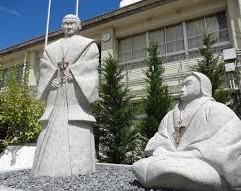
►In 2016, townmates built granite statues to honor Lord Ukon Takayama and Lady Justa ‘Shino’ Takayama in Toyono-cho (Osaka), birthplace of Ukon Takayama (1552-1615). This is the first representation seen of Mrs. Takayama.
Lord Justo Ukon Takayama and Lady Justa ‘Shino’ Takayama are revered in Toyono-cho, Osaka
After the death of Ukon in Manila (Feb. 3, 1615), Doña Justa returned to Kanazawa (with daughter Lucia Yokoyama and one grandson) in mid-1616 to bury a finger of Takayama in the home country. She used the alias Mrs. [Justa] Rokuzayemon during her voyage to Japan. She later settled in Oita City – a 7-hour train ride away (in 2018) from Kanazawa.
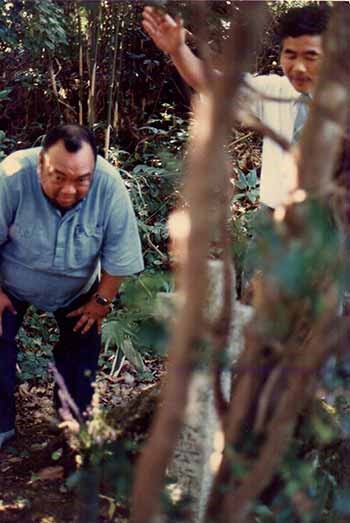
The white Cross marking the spot where Takayama’s finger bone was buried can be seen between the trees. Rev. Minoru Yamagata tells Dr. E. de Pedro that the first-born son of the Takayama family in Kanazawa is assigned to tend to the Cross.
The Cross that marked the spot where Takayama’s finger was buried still exists in a forested area outside Kanazawa – undisturbed during 250 years of virulent anti-Christian persecution. Rev. Minoru Yamagata, pastor of the “Jun-ai Christ Church” of Kanazawa City, brought Dr. Ernesto A. de Pedro, Takayama Trustee, to the site in the course of a journey through Japan tracing all the places associated with Lord Takayama.#
The granite statues of Lord and Lady Takayama form the backdrop for cultural presentations made by Toyono-cho residents.
Dr. Ernesto A. de Pedro
Managing Trustee
Blessed Takayama Canonization Movement
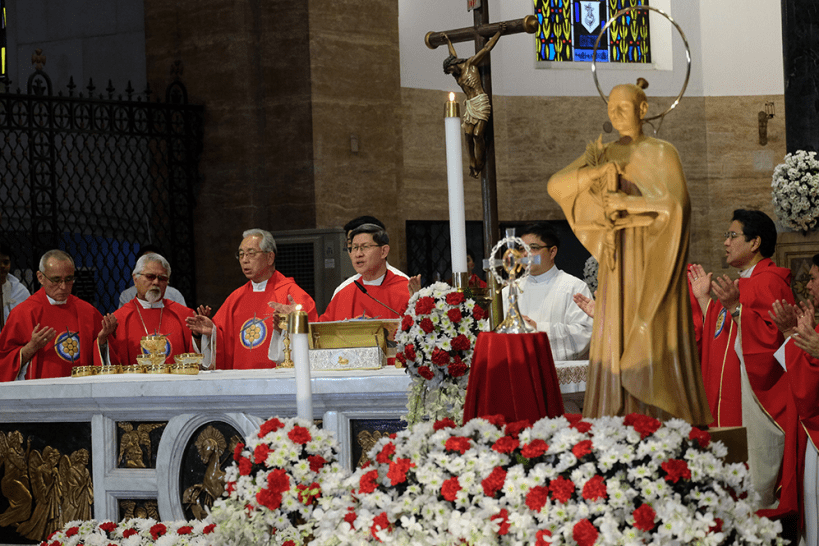
His Eminence, Cardinal Luis Antonio Tagle, was the Main Celebrant
Photos by Erwin M. de Pedro (Takayama Trustee) and (mostly by) Maricar Santos (Archdiocese of Manila – Office of Communications)
►In his homily, Manila Archbishop Luis Antonio Cardinal Tagle set the tone of the Eucharistic Concelebration: “Through Blessed Ukon Takayama [‘martyred’ in Manila, Feb. 3, 1615], through St. Lorenzo Ruiz [martyred in Nagasaki, Sept. 29, 1637] — Japan and the Philippines will always be one. Let us give witness to the world of the power of love that comes from the heart of Jesus. Let us now pause and continue thanking God for the gift of Jesus, the gift of mission and the gift of the great martyrs like Blessed Ukon Takayama.”
* * * * *
The Celebration of the First Blessed Takayama Feastday Took Two Days to Unfold
FIRST CONCELEBRATION — at Paco Parish Church
◘ 4:30 PM, Friday, Feb. 2, 2018 – Directly to Paco Parish Church where Lord Takayama’s converts among Japanese non-Christian expatriates were baptized — the 60-man Takayama Pilgrim Group, led by six Japanese Bishops came — straight from the Manila Airport — to concelebrate a Thanksgiving Mass.
Paco Parish Church (where parishioners number some 92,000) is the first church in the Philippines that enshrined an altar statue of Blessed Takayama on Dec. 21, 2017 — 403th anniversary of the 1614 arrival of ‘Lord Takayama and 350 Japanese Christian Exiles.’
The lead celebrant was Nagasaki Archbishop Joseph Mitsuaki Takami. Concelebrating were: ♦ Tokyo Archbishop Tarcisio Isao Kikuchi, SVD, ♦ Kyoto Bishop Paul Yoshinao Otsuka (Chair of the CBCJ Commission for the Promotion of Saints), ♦ Sapporo Bishop Bernard Taiji Katsuya, ♦ Kagoshima Bishop Paul Kenjiro Koriyama, and ♦ Naha Bishop Berard Toshio Oshikawa, OFM.
Also concelebrating were ♦ Rev. Msgr. Rolando dela Cruz, Paco parish priest; ♦ Fr. Carlo del Rosario, parochial vicar, and two Manila-based Japanese priests: ♦ Fr. Iwao Ikegami, FMVD, and ♦ Fr. Johya Kijima.
The Paco Parish Church was the first stop for the Takayama Pilgrim Group. It was in Paco/Dilao where Takayama continued his evangelization efforts — among non-Christian Japanese expatriates. It was in Paco Church where the first Takayama Altar Statue was enshrined on Dec. 21, 2017.
RECALLING that Lord Takayama and thousands of Japanese Christians were refugees in the Philippines, one Tokyo-based Filipina pilgrim, Puchie Gan, a member of the ‘Gathering of Filipino Groups and Communities’ (GFGC), writes: “Blessed Justo Takayama Ukon whose faith was unwavering and who lived a life of holiness until his death” … serves as the inspiration to Filipino migrants in Japan.
SECOND CONCELEBRATION — at Manila Cathedral
The Manila Cathedral was the center for the Concelebration of Blessed Takayama’s first feastday on Feb. 3, 2018.
◘ 11:00 AM, Saturday, Feb. 3, 2018 — Manila Cathedral Celebrates the First Feastday of Blessed Takayama (1552-1615) – a true ‘Son of Manila.’ In Church rubric, ‘where one dies, is where one is born to Heaven.’ That’s why the Manila Archdiocese proposed Takayama as the first saint of his adopted country, the Philippines in 1630.
THIRD CONCELEBRATION — at U.S.T. Chapel
UST Chapel was the third Manila church to host a Memorial Mass for Blessed Takayama on his first feastday. UST has been the de facto center for the promotion of the Cause for Canonization of the ‘Kirishitan Samurai’ Ukon Takayama since 1988.
◘ 5:15 PM, Saturday, Feb. 3, 2018 — As it has since 1988, the UST Chapel (Santísimo Rosario Church) was the venue of a Thanksgiving Mass for Blessed Takayama – with Kyoto Bishop Bishop Paul Yoshinao Otsuka, Chair of the CBCJ Commission for the Promotion of Saints, as Main Celebrant. Concelebrating with him were four Dominican priests – (l-r) ♦ Fr. Jose Antonio E. Aureada, OP ♦ Fr. Pablo T. Tiong, OP ♦ Fr. Louie B. Coronel, OP and ♦ Fr. Arturo P. Pestin, OP.
Fr. Pablo T. Tiong, OP, UST Vice Rector for Religious Affairs, delivered the homily.
* * * * *
Manila Cathedral-Basilica (VIII) is celebrating its 60th Jubilee on December 8, 2018
Main Eucharistic Concelebration at the Manila Cathedral
The main celebration at the Manila Cathedral involved prelates from the Philippines, Japan and the Vatican.
Cardinal Tagle — before the image of Blessed Justo Takayama
◘ His Eminence, Cardinal Luis Antonio Tagle – Manila Archbishop since Dec. 12, 2011 — was the main celebrant.
Cardinal Tagle — at the Consecration
◘ Three Archbishops concelebrated the Eucharistic Mass — ♦ Apostolic Nuncio, Archbishop Gabriele Giordano Caccia ♦ Nagasaki Archbishop Joseph Mitsuaki Takami, and ♦ Tokyo Archbishop Tarcisio Isao Kikuchi, SVD.
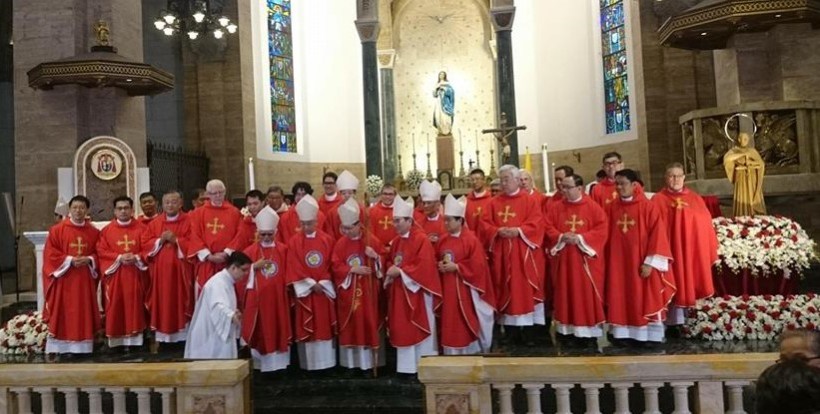
All the concelebrants — at the High Altar
◘ Four Japanese Bishops also concelebrated: ♦ Kyoto Bishop Paul Yoshinao Otsuka (Chair of the CBCJ Commission for the Promotion of Saints), ♦ Sapporo Bishop Bernard Taiji Katsuya, ♦ Kagoshima Bishop Paul Kenjiro Koriyama, and ♦ Naha Bishop Emeritus Berard Toshio Oshikawa, OFM.
◘ Twenty-five (25) priests – among them: ♦ Msgr. Rolando dela Cruz; ♦ Fr. Carlo del Rosario; ♦ Fr. Dandy Parafina; ♦ Fr. Marlito G. Ocon, SJ; ♦ Fr. Martin Licup, SJ, and four priests with the Takayama Pilgrims’ Group from Japan: ♦ Fr. Benerando Raul Gumanit, MSP ♦ Fr. Joya Kijima ♦ Fr. Ryohei Miyashita and ♦ Fr. Jose Norella III, MSP. (For the record, the names of 16 other priests will be listed too.)
Music was furnished by the Manila Cathedral Ministry of Music.
The ‘Beatification Logo’ was emblazoned on the vestments used at the first Blessed Justo Takayama Feastday.
Logo of Blessed Takayama
The Mass vestments (see photos above and below) bore the logo used at the Blessed Takayama Beatification Rites. The logo was designed by Sr. M. Esther Kitazume, of the Sisters of Disciples of the Divine Master.
The emblem on the Mass vestments is based on the Takayama family crest of seven circles.
The emblem reproduces seven round circles of the Takayama family, with the Cross and three rings in the background. Each circle represents members of Ukon’s family and also the seven sacraments and seven gifts of the Holy Spirit. The Cross is a sign of Ukon’s offer of his life for faith.
Concelebrated Mass, Including Cardinal Tagle’s Homily, Livestreamed on Facebook
MANILA ARCHBISHOP Luis Antonio Cardinal Tagle enjoined the Filipino faithful and Japanese pilgrims: “Be martyrs … by giving yourself to others and finding meaning in suffering.”
Cardinal Tagle urged the faithful to emulate Blessed Justo Ukon Takayama, a Japanese Christian who was persecuted for his faith and died in exile in Manila.
Some of the 60-man Japanese Pilgrims’ Group who flew in to celebrate the first Feastdsy of Blessed Justo Ukon Takayama.
BUT IN THESE MODERN TIMES, Cardinal Tagle pointed out that one “does not have to wait for martyrdom” and that Catholics “are invited to be martyrs every day.”
“Every day, we are asked by Jesus to be with Him, to be witnesses to His love. So give yourself to others and be united with them in their suffering,” Tagle said.
In his homily, Tagle cited Blessed Takayama’s life, especially his choice to remain true to his faith even if he had a chance to save himself by simply renouncing it.
“He knew the dangers, he was given a chance to turn away from Jesus and his faith. But he remained faithful to Jesus. Others said he was crazy for not saving his life,” the prelate said.
But in today’s times, Blessed Takayama’s “foolishness” is now a source of wisdom and strength for Catholics, Tagle said.
The prelate added that the Christian understanding of suffering is to give life to others in an ultimate act of love.
“It is not looking for suffering because we enjoy it. It is love, it is mission, it is a gift of self that gives someone like Jesus the strength to suffer and die. With love, you can suffer meaningfully and in a manner that gives life to others,” Tagle said.
Tagle added: “Have no fear, love and when you love you will have the strength to suffer. People who love but are afraid of suffering do not know how to love.”
‘Kirishitan Samurai’
As a samurai general, Lord Takayama served under the hegemons, Oda Nobunaga and Toyotomi Hideyoshi, but was already in domestic exile (in Kanazawa) when Tokugawa Ieyasu established the Tokugawa Shogunate (1600-1868).
BLESSED JUSTO TAKAYAMA was a Japanese samurai and ‘Daimyo’ (feudal lord) who lived during the Sengoku period (戦国時代 Sengoku Jidai, “Age of Warring States”; c1467–c1603) in Japan, and was baptized as a Catholic with the name, Justo, when he was only 12.
In 1587, Christians were ordered expelled from Japan and all Christian feudal lords asked to renounce their faith.
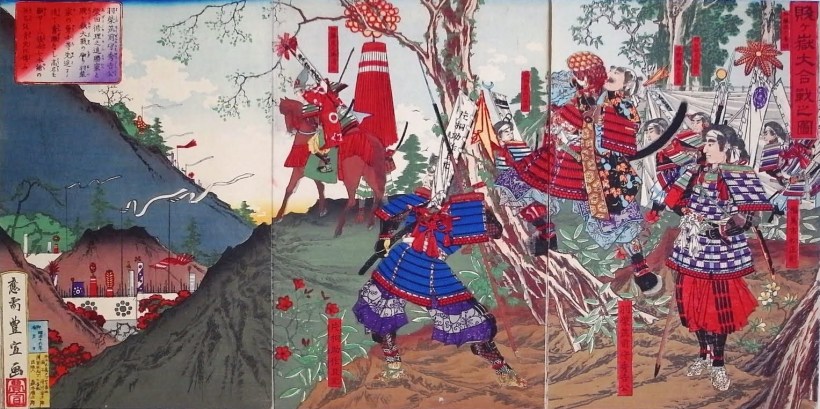
There was no ‘direct confrontation’ between Hideyoshi and Ukon — as depicted in this famous woodblock print. Hideyoshi sent an emissary — the Grand Teamaster Sen no Rikyu — to demand that Ukon abjure his allegiance to ‘that evil religion’.
REFUSING TO GIVE UP his faith, Blessed Takayama was expelled from his feudal domain of Akashi in 1587 – and became a ronin, a masterless samurai. In the first year, he was protected by well-placed Christian allies.
He and his family – wife Justa Takayama, married daughter Lucia Yokoyama, and five grandsons – were eventually forced to leave their homeland. Given a choice between Manila and Macau, he chose Manila because his Spanish Jesuit father-confessor, Fr. Pedro Morejon, SJ, was Manila-bound. The overloaded Chinese junk, which normally sailed the route from Nagasaki to Manila in 20 days, took 43 days to reach Manila, as it was buffeted by a severe typhoon that snapped its main mast into two, off the coast of Bataan.
Arriving in Manila in Sunday, Dec. 21, 1614, ‘Lord Takayama and 350 Japanese Christian exiles’ were warmly welcomed by Spanish Jesuits and Filipino Christians. The cannons of Fort Santiago boomed and church bells in Intramuros’ six Churches rang in welcome.
However, 40 days after his arrival (on Jan. 30), he fell ill “of a tropical illness,” and – like St. Francis Xavier who died several days after falling ill on Shangchuan Island, off the southern coast of Guangdong, China on Dec. 3, 1552 (the year Ukon was born) – Ukon died on Feb. 3, 1615. His sojourn in Manila lasted only 44 days – as the cunning Tokugawa Ieyasu had hoped for.
Pope Francis’ Decree of Martyrdom (2016)
When Pope Francis’ Decree of Martyrdom was issued on Jan. 21, 2016, Fr. Anton Witwer, SJ, Jesuit General Postulator, explained: “Since Takayama died in exile because of the weaknesses caused by the maltreatment he suffered in his homeland, the process … is that of a martyr.”
In his decree, Pope Francis recognized Justo Ukon Takayama as a “loyal Japanese layman, who was martyred in Manila in 1615.” The Holy Father said: “Rather than compromise, Ukon renounced honors and prosperity and accepted humiliation and exile. He remained faithful to Christ and to the Gospel; for this, he is a wonderful example of strength in the faith and dedication in charity.”
* * * * *
A Welcome Entreaty for an Altar Statue of Blessed Justo Ukon Takayama for Laoag
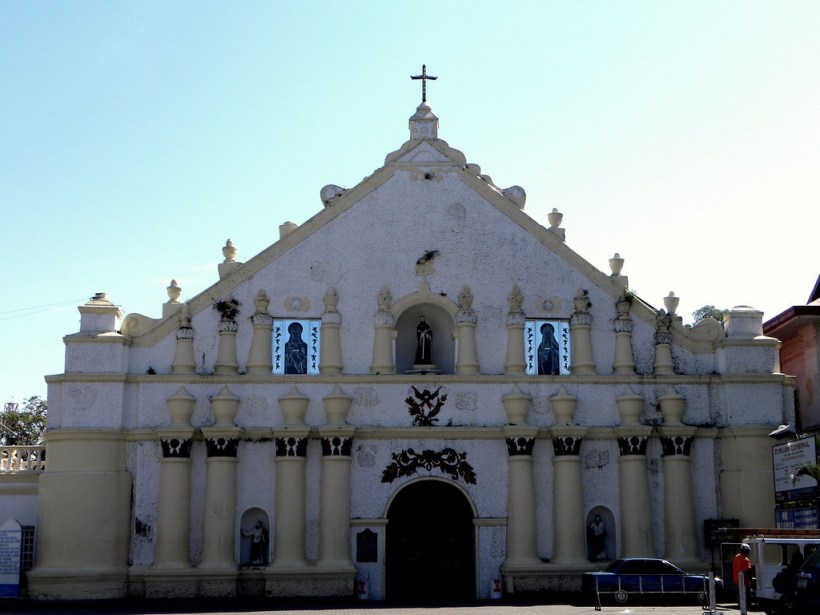
►During the Takayama Thanksgiving Mass, the Bishop of Laoag, Msgr. Renato Mayugba entreated the Japanese Bishops to make Laoag Diocese the first outside Manila to enshrine a Takayama altar statue — at St. William Cathedral (est. 1580; current church built in 1612).
St. William’s Cathedral is the seat of the Diocese of Laoag (Ilocos Norte).
THE DIOCESE OF LAOAG has 22 parishes – and a ‘Japanese connection.’
In 1620, fisherfolk found two crates floating in the sea off the shores of Badoc town, Ilocos Norte — presumably off-floated from a Japanese church desperate to save them from destruction by the Tokugawa Shogunate.
One crate contained the statue of the ‘Black Cristo Milagroso’ — (as ebony as the ‘Black Nazarene’ at Quiapo) — now enshrined in Badoc’s adjoining town, Sinait, Ilocos Sur.
The other crate contained the statue of the Blessed Virgin — “with Japanese features” — cradling the Infant Jesus in her arms. The Marian statue is revered today as ‘La Virgen Milagrosa de Badoc.’ Devotees call her “Mary, Cause of Our Joy — Patroness of Ilocos Norte.”
The canonical coronation of “La Virgen Milagrosa de Badoc” is on May 31, 2018.
* * * * *
At the Sidelines of the Takayama Feastday
◘ Veneration of Takayama Relic
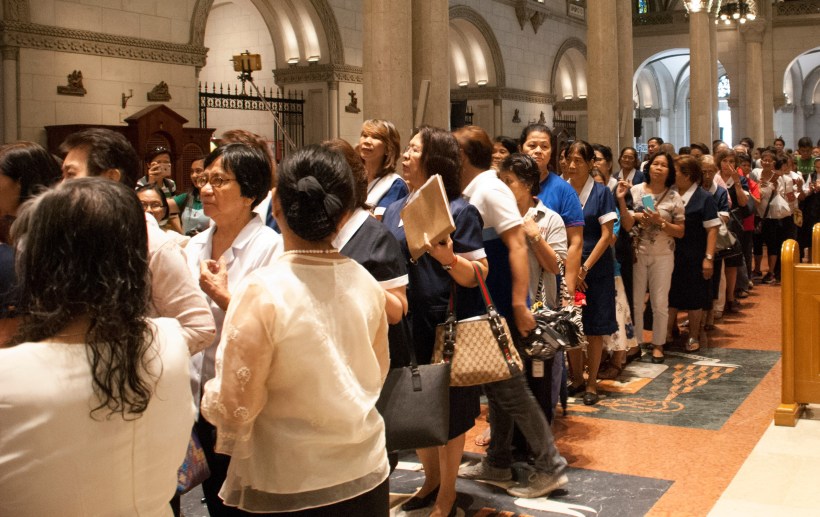
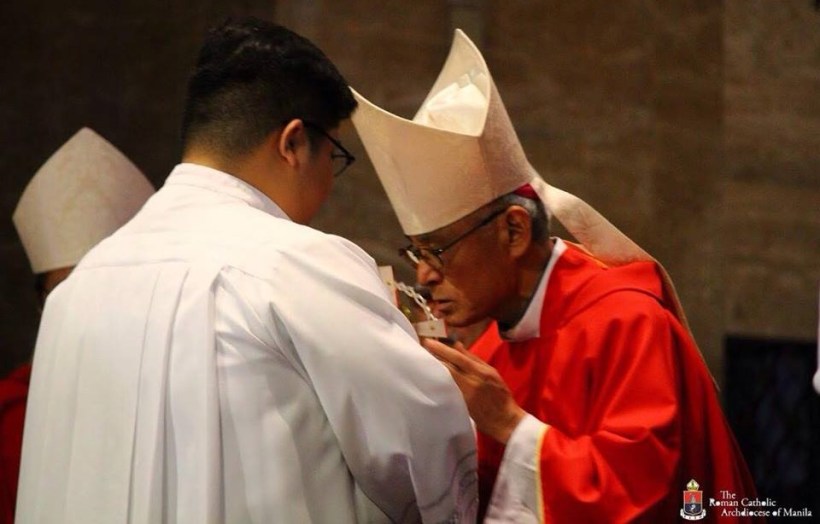
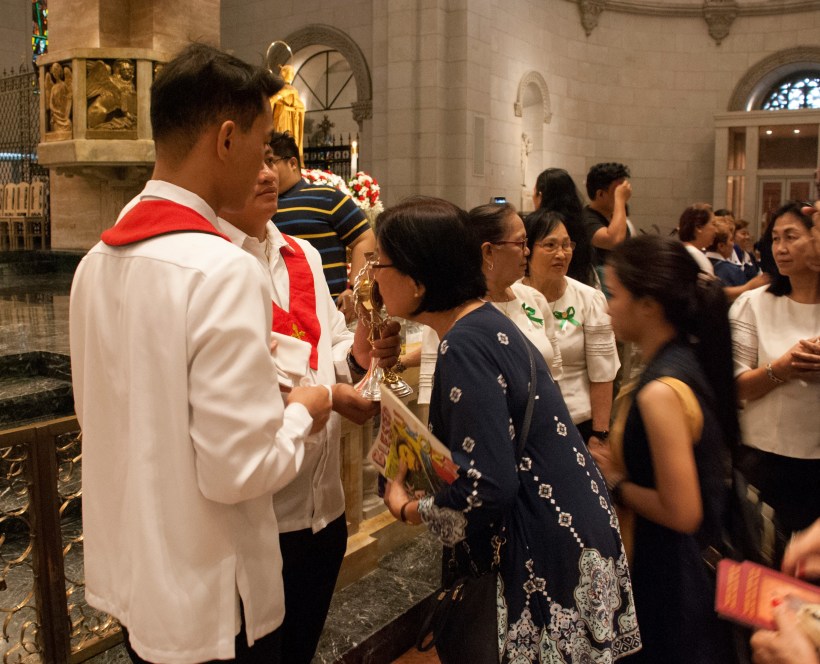
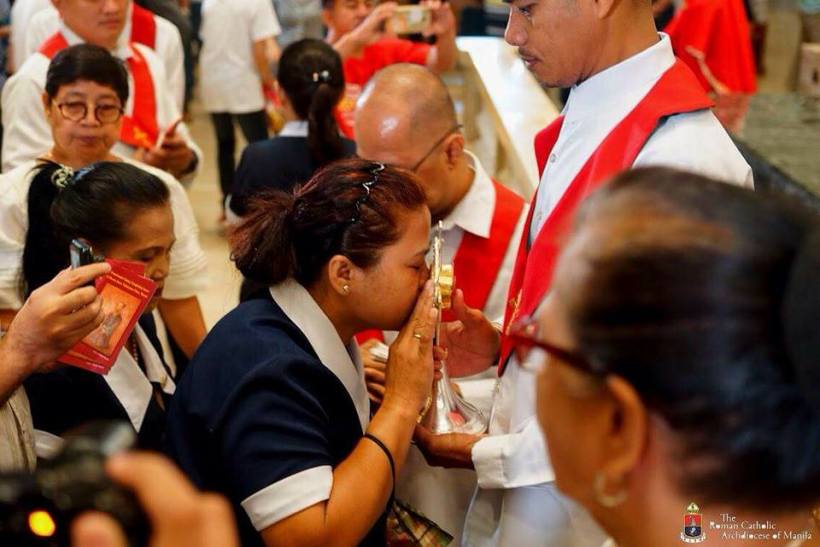
For the first time since the Catholic Bishops’ Conference of Japan (CBCJ) presented the Manila Cathedral with a Takayama Relic – church-goers were invited to venerate it.
The Takayama Relic is a piece of Ukon’s vest (‘chaleco’) encased in a monstrance-shaped gold reliquary.Church-goers formed a line to venerate the relic.Japanese Bishops led the queue that venerated the Takayama RelicMrs. Aida M. de Pedro represented the ‘Prayer Warriors of Blessed Takayama’
◘ ‘Estampitas’ or Prayer Cards
Prayer cards in Tagalog were distributed by both the CBCJ and the Manila-based Blessed Justo Takayama Canonization Movement.
‘Estampitas’ (prayer cards) — in Tagalog — were distributed by both CBCJ and the Manila-based Blessed Takayama Canonizstion Movement
The CBCJ prayer cards enjoined – in Tagalog – all Takayama devotees to report any purported “miracle through the intercession of Blessed Takayama” – to the Bishop of the Diocese where the miracle happened. For better coordination – whatever country it is from – also inform <blessedtakayama@gmail.com> and <ernestodepedro@gmail.com>. The concerned ecclesiastical authorities will be alerted.
◘ Some Desperate Cases, Imploring Blessed Takayama’s Intercession, Attended the Takayama Mass
Some severe medical cases imploring Blessed Takayama’s intercession attended the Mass. For months they had been praying on the basis of ‘estampitas’ or prayer cards. Now, the Takayama Movement presented those on its waiting list — with 12” Takayama statuettes to help them focus on their devotion.
This 12″ Blessed Takayama statuette (made of resin-fiberglass) is from a limited production run — to accommodate the visiting Japanese pilgrims. Distribution at normal religious channels will be announced when there is an adequate supply.
◘ First Japanese Pilgrimage (8:30 AM, Feb. 3, 2018) to PLM University Chapel
The 60-man Takayama Pilgrims’ Group began the Feb. 3 Takayama Feastday – with an 8:30 AM visit to the PLM University Chapel – which was arranged by the Department of Tourism (DOT) and the Intramuros Administration (IA). Fr. Albert Fuyuki Hirabayashi, SJ (in light blue coat), Secretary of the CBCJ Commission for the Promotion of Saints, coordinated the brief visit. (Photo by Robert Queddeng)
The Jesuit Compound (now the PLM Campus), is where Lord Justo Takayama sojourned for 44 days (since arriving on Dec. 21, 1614); died on Feb. 3, 1615 – and was buried near the High Altar of the Jesuits’ Santa Ana Church, in the Jesuits’ expectation that he would soon be raised to the honors of the High Altar.
Invoking the spirit of Blessed Justo Takayama — inside the PLM University Chapel. (Photo by Yuya Cruz, Ars Dream Travel, Manila)
For the first time in 403 years – Japanese pilgrims step on ‘hallowed ground’ as they visit the Pamantasan ng Lungsod ng Maynila (PLM) where the University Chapel was inaugurated by Cardinal Jaime Sin on Dec. 17, 1990.#
◘ ‘Sketching Blessed Takayama’ as Prayer
Having no Takayama ‘estampitas’ — in English or Tagalog — to focus on, a Filipino cancer patient in Tokyo drew his own imaginings of what Takayama looked like.
Noel Velez made his own sketches of Blessed Justo Takayama, as he prayed for Ukon’s intercession during his illness.
The ‘Paintings/Sketches of Blessed Takayama’ by the Filipino artist +Noel Velez (1951-Jan. 14, 2018) as he lay dying in a Tokyo hospital – and died only 20 days before the Takayama Feastday in Manila — was published in a slim booklet by his widow Puchie Gan – and presented to Cardinal Tagle before the Takayama Thanksgiving Mass on Feb. 3, 2018.
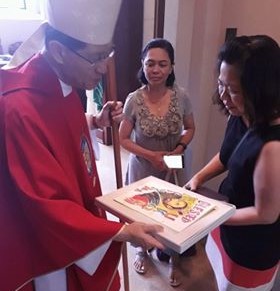
Cardinal Tagle is presented with slim book of Velez’s sketches of Blessed Takayama by Velez’s widow, Puchie Gan
A graduate in Bachelor of Philosophy from the Our Lady of the Angels Seminary, Noel moved to Tokyo in 1990 to join his wife, Puchie Gan. He worked as Staff Designer for Sesame Street/Japan and served as Musician and Pastoral volunteer in the Archdiocese of Tokyo. The passion for the art was heightened during the battle with cancer of the lungs. Blessed Justo Takayama Ukon whose faith was unwavering and who lived a life of holiness until his death served as the inspiration for all the artwork in this book.
Ukon Takayama as a Samurai — as sketched by Noel Velez
Noel died on Jan. 14, 2018 at Juntendo University Hospital in Nerima-takanodai, Tokyo. Fr. Russell Becker, OFM, pastor of Franciscan Chapel Center in Roppongi, Tokyo — where the Velezes serve as Music Ministers — administered the Last Rites.
Noel’s widow, Puchie Gan, attended the Takayama Thanksgiving Mass. with a Filipino-Japanese delegation from the ‘Gathering of Filipino Groups and Communities’ (GFGC) from Tokyo.#
* * * * *
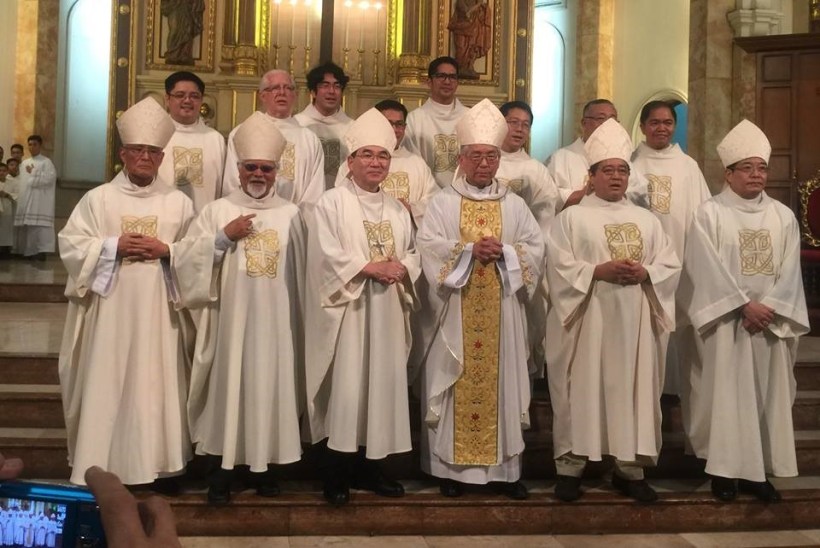
MEMENTO PHOTOGRAPH of the seven prelates who concelebrated the Thanksgiving Mass at the first Feastday of Blessed Justo Takayama. — representing the Philippines, Japan and the Vatican.
Dr. Ernesto A. de Pedro
Managing Trustee
Blessed Justo Takayama Canonization Movement



























 Blessed Justo Takayama Ukon